Tether’s USA₮ Token Explained: Why Its US Debut and New CEO Could Redefine Stablecoins
Share
Key Takeaways
USAT is the Tether’s first fully US-compliant stablecoin, created under the GENIUS Act.
Bo Hines, a former White House crypto advisor, will lead Tether US from Charlotte, North Carolina.
USAT aims to rival Circle’s USDC by targeting American businesses and institutions.
Tether’s shift signals a significant shift from offshore dominance to US regulatory engagement.
Tether, issuer of the world’s largest stablecoin USDT, is now seeking legitimacy within the United States. On September 12, 2025, the company revealed USAT, a token built for American businesses and institutions, while appointing Bo Hines, the former head of the White House’s crypto advisory group, as CEO of Tether US, according to CNBC.
On January 27, 2026, Tether haslaunched USA₮, a new U.S.-regulated, dollar-backed stablecoin designed to operate under the GENIUS Act’s federal framework.
Issued by Anchorage Digital Bank, USA₮ targets U.S. institutions and payment platforms, while USD₮ continues to serve global markets. The token is now live on major exchanges including Kraken, Crypto.com, Bybit, OKX, and MoonPay, aiming to provide a compliant digital dollar for the U.S. financial system.
USAT announces its stablecoin | Source: @USAT_io on X
Let’s dive deeper.
What is USA₮, and How is it Different From USDT?
Tether’s USDT was launched in 2014 and remains the number one stablecoin regarding market capitalization, according to CoinMarketCap. However, despite this dominance, Tether has consistently faced some form of skepticism from the US.
Try Our Recommended Crypto Exchanges
Sponsored
Disclosure
We sometimes use affiliate links in our content, when clicking on those we might receive a commission at no extra cost to you. By using this website you agree to our terms and conditions and privacy policy.
USA₮ will be powered by Hadron, Tether’s advanced platform for real-world asset tokenization. It is Tether’s attempt to create a fully US-compliant stablecoin (made in America). It’s tied 1:1 with the US dollar, and built to abide by the GENIUS Act’s stablecoin issuance rules, which require reserve audits and consumer protections.
These requirements directly address many of Tether’s concerns and, should it meet the Act’s standards, USAT could transform Tether from a perceived risk to a recognized pillar of the US financial system.
Unlike USDT, which is a globally available stablecoin, USAT will be the “regulation-first” stablecoin. To reinforce this credibility, Tether will utilize regulated companies, including the crypto platform Anchorage Digital and the financial services firm Cantor Fitzgerald, to issue and maintain custody of USAT.
If USDT is the global liquidity pool, USAT is the US-licensed digital dollar. It exists for US institutions that can’t legally work with an unregulated asset like USDT.
Tether’s Existing Stablecoin Offerings
USAT joins Tether’s extensive list of stablecoin offerings:
USDt: Dollar-pegged stablecoin for global use.
EURt: Euro-pegged stablecoin for EU markets.
MXNt: Mexican peso-pegged stablecoin.
CNHt: Offshore Chinese Yuan-pegged Tether token, despite China’s crypto ban.
XAUt: Gold-backed stablecoin called Tether Gold.
This portfolio of stablecoins, now including USAT, provides Tether with its global reach. Countries like Ethiopia or Nigeria use stablecoins to escape financial strain, though USAT’s inclusion has a target: the US financial system, and Circle’s USDC and Arc, which has long been regulated in the United States as well as Europe.
What Does Tether’s USA₮ Mean for Businesses and Institutions?
USAT’s business proposition is simple: to become a regulated stablecoin that US businesses can actually use. Here are some examples:
US fintech companies that pay in crypto can use USAT for payroll. A crypto payroll ensures instant payments, 24/7, and minimal transaction fees.
Corporate treasurers could treat USAT as a dollar-denominated asset similar to a Treasury bill, offering regulated yield strategies and other services normally only possible in traditional finance.
Banks and exchanges bound by US oversight could offer USAT custody.
However, it’s important to note that Circle already offers similar services to U.S. institutions, which could limit USA₮’s competitive advantage.
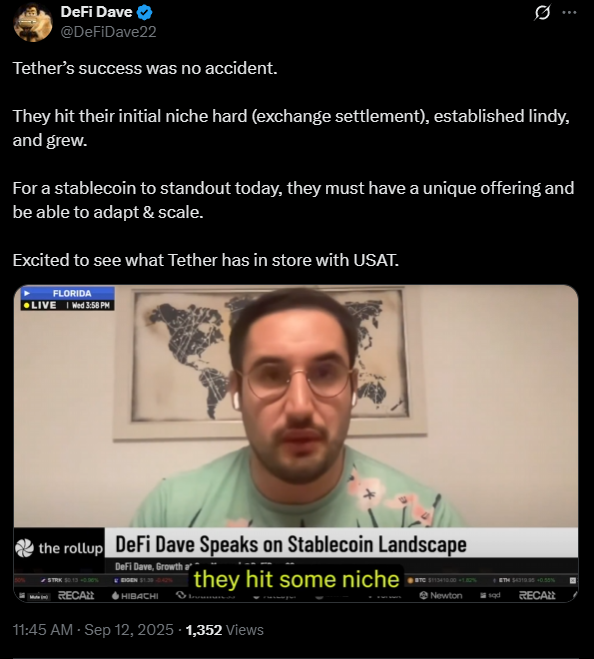
Crypto commentator and stablecoin expert @DeFiDave22 (Dave Liebowitz) claims that for USAT to stand out amongst the stablecoin pack, it “must have a unique offering and be able to adapt and scale.” Whether or not USAT can offer something more than Circle remains to be seen.
DeFi Dave claims Tether’s success comes from its niche appeal. | Source: @DeFiDave22 on X
Will USA₮ Comply with the GENIUS ACT?
Yes — USA₮ is designed to be compliant with the U.S. GENIUS Act framework for stablecoins. Passed in 2025, the Guiding and Establishing National Innovation for U.S. Stablecoins Act (GENIUS) Act is the law that regulates the stablecoin landscape.
At least in the US. Stablecoin issuers must offer:
Regular audits: Issuers must make monthly, public reserve disclosures.
Consumer protections: Issuers must “comply with strict marketing rules” to protect consumers from deception.
Establish verification policies: Issuers must employ anti-money laundering (AML) and know-your-customer (KYC) policies to verify all customers.
USAT is Tether’s answer to these regulations. If it fails to comply with the GENIUS Act, USAT’s specific use case will render it irrelevant. Success, on the other hand, could push Tether to a prime stepping stone toward the future of finance.
Who Is Bo Hines, and Why Does His Leadership Matter for Tether
A further attempt at legitimacy is hiring Bo Hines. Once the Executive Director of the Presidential Council of Advisors for Digital Assets, he will now lead Tether at its future US headquarters in Charlotte, North Carolina.
Interestingly, Hines has no background in crypto startups, operating purely on the political and regulatory side of the digital asset matter. That said, he played a part in establishing the GENIUS Act, as he worked in Washington at a time when stablecoins became national policy issues.
Hines matters because the GENIUS Act makes stablecoins a regulated class of currency. Who better to oversee Tether than the Act advisor himself?
Can USAT compete with USDC? The challenge for USA₮ is that USDC already has a strong foothold in the U.S. market. Circle benefits from an early institutional lead, while Tether brings unmatched liquidity and global scale. A U.S.-compliant Tether could still compete aggressively for market share.
Will regulators approve? Tether’s past transparency concerns are also relevant. If the GENIUS Act leads to deeper audits of Tether’s broader reserves, regulators could uncover issues that undermine confidence in USA₮ before it gains traction.
Can Tether manage multiple identities? Tether leads the global, lightly regulated stablecoin market, but U.S. rules will require far stricter compliance. Balancing these two very different regulatory regimes could prove challenging.
For Tether, USAT is more than just another product. It’s a bet that the company can prove itself in the United States. If it succeeds, USAT will mark a monumental achievement in financial history. Not just for Tether, but for the US as a whole.
Why USAT Faces More Than Just Circle: The New Wave of Competitors
Stripe (and Paradigm), Fireblocks, and others are accelerating the race to build infrastructure tailored for stablecoins, adding competitive pressure and context to Tether’s USAT launch.
Stripe is working on a new layer-1 blockchain called Tempo that is “stablecoin-first,” focused on global payments, payroll, remittances, tokenized deposits, and other real-world finance applications.
Meanwhile, Fireblocks has introduced the Fireblocks Network for Payments, which is a global stablecoin payment/settlement network designed to connect PSPs (payment service providers), banks, liquidity providers, issuers, and on/off ramps through unified APIs, with compliance built in.
Also, Hyperliquid (which has launched its own high-performance layer-1 blockchain) is in the process of rolling out a native stablecoin, USDH, to reduce dependence on external stablecoins like USDC.
In relation to USAT, these moves suggest that Tether is entering a crowded but fast-evolving space where regulation, performance, and integration with financial institutions matter more than ever.
If USAT is to succeed, it will need not only legal compliance (via the GENIUS Act) and institutional credibility (new CEO, etc.), but also to compete on infrastructure: throughput, connectivity, ease of settlement, and interoperability.
USAT is trying to stake a claim not just as another stablecoin, but as a U.S.-licensed, U.S.-regulated one, which gives it a potential differentiator, but also sets a higher bar for performance and trust, given what others (Stripe, Fireblocks, Hyperliquid) are building.
Can Tether’s USA₮ Compete With USDC in the Regulated US Stablecoin Market?
Tether’s USA₮ marks a pivotal moment in the evolution of stablecoins. Unlike USDT, which dominates global markets but often sits outside U.S. oversight, USA₮ is built to comply with the GENIUS Act and appeal to American businesses and institutions.
Its success will hinge on whether it can rival Circle’s Arc and USDC while navigating strict regulations and growing competition from players like Stripe, Fireblocks, and Hyperliquid.
In a world where SWIFT remains the backbone of cross-border payments and XRP continues pushing instant settlement, USA₮ positions Tether to bridge traditional finance and regulated crypto in the United States.
USAT’s reserves will be held and audited under US law, with Cantor Fitzgerald as a custodian.
Can retail investors buy and use USAT directly?
While designed for institutions, retail USAT access will depend on exchange listings and regulatory approval.
Will USAT pay interest or offer yield directly?
USAT itself will not pay yield. The GENIUS Act bans stablecoin issuers from paying yield on their own assets. Third-party distributors, like an exchange, can offer yield, similar to how Coinbase offers yield on USDC.
How could USAT affect DeFi adoption in the US?
If compliant stablecoins like USAT are widely accepted, they could unlock regulated access to DeFi protocols for US institutions, bridging traditional finance with on-chain liquidity.
Disclaimer:
The information provided in this article is for informational purposes only. It is not intended to be, nor should it be construed as, financial advice. We do not make any warranties regarding the completeness, reliability, or accuracy of this information. All investments involve risk, and past performance does not guarantee future results. We recommend consulting a financial advisor before making any investment decisions.
Max Moeller is a Chicago‑based writer and video editor passionate about games, tech, and crypto. Whether it’s crafting clear, insightful articles or piecing together engaging video retrospectives, he’s driven by curiosity and takes pride in keeping things human. Since 2017, Max has been published in a variety of notable crypto magazines.


 Easy
Easy