Solana’s Alpenglow proposal aims to slash block finality to 150ms, rivaling Visa and Mastercard as community voting gets underway. | Credit: Getty Images.
Share
Key Takeaways
Solana’s Alpenglow (SIMD-0326) has received a resounding majority vote in favor.
The proposal would cut transaction finality from 12.8 seconds to ~150 milliseconds.
If passed, Solana could rival Visa and Mastercard in speed, opening doors for real-time DeFi, gaming, and institutional use cases.
Solana (SOL) has officially approved a major consensus upgrade that could redefine its core infrastructure.
The overhaul, known as Alpenglow (SIMD-0326), will replace the network’s current framework with near-instant block finality, slashing transaction settlement from an average of 12.8 seconds to just 150 milliseconds.
We sometimes use affiliate links in our content, when clicking on those we might receive a commission at no extra cost to you. By using this website you agree to our terms and conditions and privacy policy.
Alpenglow introduces a 1.6 SOL per-epoch fee, roughly 80% of today’s vote costs, with funds burned to offset SOL inflation.
Validators risk losing rewards—or even removal from the active set—if they abstain or submit contradictory votes.
Some community members have suggested tiered fees based on stake size to ensure participant fairness.
Where the Vote Stands
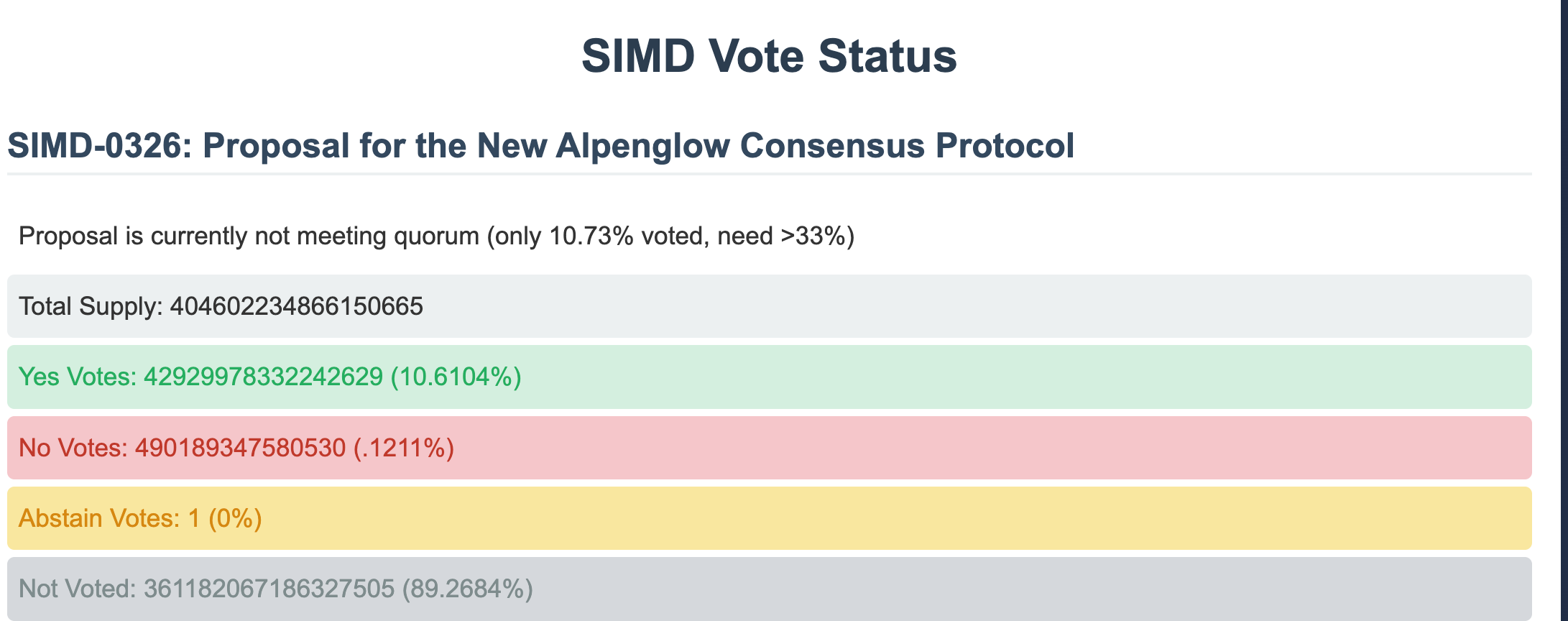
Community voting, which runs from Epoch 840 through 842 (roughly four days total), requires a two-thirds majority to pass.
As of Epoch 840, voter turnout hovered near 11%, with overwhelming support: 10.6% in favor versus just 0.12% opposed.
While turnout is still early, the direction suggests strong backing from developers and validators, many of whom see Alpenglow as the breakthrough needed to make Solana competitive for real-time finance, gaming, and high-frequency applications.
Why It Matters For Solana
The blockchain industry has long wrestled with a trade-off: decentralization slows networks down, while centralization sacrifices trust for speed.
By compressing block finality to fractions of a second, it promises to rival traditional financial rails and expand what decentralized applications can realistically achieve.
If passed, Solana would cement its reputation as the blockchain most willing to push consensus boundaries. It would show how next-generation networks could finally meet institutional and consumer expectations for scale.
Prashant Jha is a seasoned crypto journalist based in Delhi, India, with a Bachelor’s Degree in Computer Science Engineering. Passionate about the evolving world of blockchain and cryptocurrencies, he has been a dedicated voice in the industry since 2018. Prashant’s expertise lies in regulatory reporting, where he unravels complex legal and financial developments with clarity and precision. Before joining CCN in 2024, he honed his craft at Cointelegraph, establishing himself as a trusted name in crypto journalism.
His coverage spans major industry events, including the high-profile collapses of FTX, Three Arrows Capital (3AC), and LUNA, offering readers insightful analyses of their regulatory and market implications. Prashant’s technical background enables him to bridge the gap between intricate blockchain technology and its real-world applications, making his work accessible to novices and experts.
Beyond his professional pursuits, Prashant is an avid music enthusiast, often exploring diverse genres to unwind. A sports lover, he has a particular passion for cricket and frequently engages in discussions about the game. His multifaceted interests and sharp journalistic instincts make him a valuable contributor to CCN, where he continues shaping the crypto landscape's narrative.