Ripple Acquires GTreasury for $1B as SWIFT Turns to Linea: The $120T Race to Modernize Global Payments.
Share
Key Takeaways
Ripple’s $1B acquisition of GTreasury strengthens its position in global corporate finance.
Integrating Ripple’s blockchain with GTreasury’s platform could free up capital, boost cash efficiency, and support tokenized and stablecoin settlements.
Together with Hidden Road and Rail, it forms an integrated network linking institutional trading, stablecoins, and treasury operations.
Both Ripple’s expansion and SWIFT’s Linea pilot reflect a broader industry shift toward blockchain-based, real-time, and transparent global payments.
Ripple’s $1 billion acquisition of GTreasury marks a defining moment in its evolution from a blockchain payments company into a broader financial infrastructure provider. The deal, announced in October 2025, extends Ripple’s reach into the global corporate treasury sector, a market estimated at over $120 trillion in value flows annually.
GTreasury is a long-established provider of treasury management software (TMS) used by multinational corporations to oversee liquidity, payments, risk exposure, and cash forecasting. By acquiring the company, Ripple gains access to a mature network of enterprise clients, as well as sophisticated systems that handle daily capital management and interbank payments.
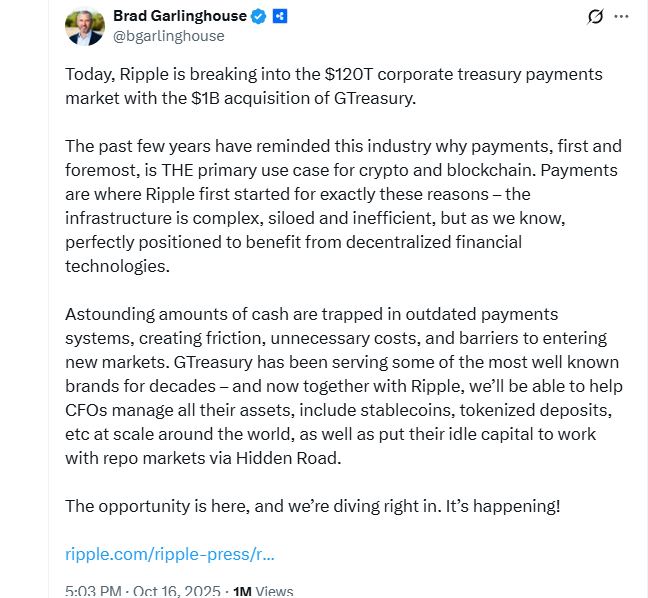
In a statement, Ripple CEO Brad Garlinghouse called the move “an entry into the $120T corporate treasury payments market,” emphasizing that outdated systems still dominate the sector.
According to Garlinghouse, blockchain technology can help free trillions in trapped liquidity by enabling instant settlement, 24/7 transfers, and tokenized asset management.
Ripple is breaking into the $120T corporate treasury payments market with the $1B acquisition of GTreasury. | Source: @bgarlinghouse on X
The deal follows Ripple’s earlier acquisitions in 2025, including prime brokerage platform Hidden Road and stablecoin management firm Rail, forming a multi-pronged strategy to integrate digital assets with traditional finance.
Try Our Recommended Crypto Exchanges
Sponsored
Disclosure
We sometimes use affiliate links in our content, when clicking on those we might receive a commission at no extra cost to you. By using this website you agree to our terms and conditions and privacy policy.
For more than a decade, Ripple has focused primarily on cross-border payment rails built on blockchain technology. Its flagship solution, RippleNet, provides near-instant international money transfers using the XRP Ledger.
With GTreasury, the company moves deeper into corporate treasury operations, where cash visibility, liquidity optimization, and risk control are daily challenges.
GTreasury’s tools already connect corporations to global banks, manage complex payment flows, and streamline reconciliations. Integrating those functions with Ripple’s blockchain-based settlement layer could enable real-time movement of tokenized deposits and stablecoins.
For CFOs and treasurers, that means capital can be redeployed or invested immediately, rather than sitting idle in different accounts or time zones.
Ripple has also hinted that GTreasury’s clients may gain access to digital asset yield opportunities, including integration with repo and money market platforms via Hidden Road.
Together, the ecosystem could help enterprises blend traditional liquidity management with decentralized finance (DeFi) tools under regulated frameworks.
Why the $120 Trillion Treasury Market Matters
The global corporate treasury ecosystem, covering everything from payroll and supplier payments to hedging and short-term investments, represents one of the largest, least digitized financial segments.
Analysts estimate that $120 trillion in corporate cash and liquidity circulates across systems that often rely on batch processing, correspondent banking, and manual reconciliation.
These inefficiencies translate into delayed cash availability and higher transaction costs. Ripple’s expansion into this market underscores a growing belief among fintech leaders that blockchain can streamline treasury operations by connecting banks, corporates, and payment networks in real time.
By combining GTreasury’s software with blockchain rails, Ripple aims to tackle three longstanding pain points in global finance:
Slow settlement cycles that trap liquidity across multiple accounts.
Limited transparency in cross-border flows and intercompany transfers.
Inflexible infrastructure that prevents 24/7 movement of funds.
The potential payoff for corporations is significant: improved working capital efficiency, lower costs, and the ability to manage both fiat and digital assets within a single platform.
Ripple’s Integration Plan and Broader Expansion
Ripple’s integration strategy builds on its recent acquisitions to form a multi-layered financial network.
Hidden Road expands access to institutional trading, repo markets, and short-term funding tools.
Rail provides the backbone for stablecoin issuance and tokenized deposits, allowing Ripple’s clients to settle in regulated digital currencies.
GTreasury anchors those technologies in the real-world treasury operations of large enterprises.
Together, these components enable Ripple to offer an end-to-end suite for liquidity, payments, and asset management, spanning digital and traditional markets. The combined system could allow treasurers to execute payments, hedge exposures, and invest idle balances all from within one integrated environment.
Ripple’s ultimate goal is not only to replace legacy messaging systems like SWIFT but to create a unified network for instant value transfer between institutions, corporates, and markets.
SWIFT’s Linea Pilot and the Broader Payments Landscape
While Ripple pushes deeper into the corporate side of finance, SWIFT, the 50-year-old interbank network, is exploring its own modernization path. In 2025, SWIFT began a pilot program on Linea, an Ethereum Layer-2 network developed by Consensys, to test blockchain-based messaging and settlement between major global banks.
The pilot aims to explore on-chain communication and interoperability between traditional and digital assets, potentially enabling banks to process transactions more quickly and transparently. SWIFT’s experiment highlights how even legacy financial infrastructure is adapting to blockchain technology to remain competitive in a rapidly changing payments environment.
Unlike Ripple’s direct acquisition strategy, SWIFT’s approach is experimental and collaborative, leveraging its established network to integrate blockchain capabilities without displacing existing participants.
Together, these moves from Ripple and SWIFT reflect a shared industry goal: modernizing global money movement through digital infrastructure.
Challenges Ahead for Blockchain-Based Treasury Systems
Despite growing interest, transforming global treasury and payment systems is far from straightforward. Several hurdles remain before blockchain becomes a core pillar of enterprise finance.
Regulatory frameworks: Corporations must ensure compliance with anti-money-laundering (AML) and know-your-customer (KYC) standards, as well as new regulations on tokenized assets.
System interoperability: Integrating blockchain rails with enterprise software and banking APIs requires robust, standardized interfaces.
Adoption barriers: Treasury departments are traditionally conservative, often requiring years to validate new technology before implementation.
Operational risk: 24/7 money movement introduces new challenges in liquidity forecasting, settlement risk, and fraud prevention.
Scalability and privacy: Corporate transactions demand both speed and confidentiality, areas where blockchain solutions are still evolving.
Ripple’s acquisition may help address some of these challenges by combining a regulated, enterprise-grade platform (GTreasury) with blockchain-based settlement and tokenization capabilities.
Industry Implications of Ripple’s Move and Competitive Outlook
Ripple’s acquisition sends a strong signal across both the fintech and banking sectors. By targeting the intersection of digital assets and corporate treasury, the company positions itself in a space where few blockchain firms have gained traction.
For traditional financial institutions, this move highlights an emerging competitive threat or potential partnership opportunity. Banks using Ripple’s technology may gain the ability to serve corporate clients with faster settlement and on-chain liquidity solutions. Others may opt to develop or integrate similar blockchain capabilities directly, as SWIFT’s Linea pilot demonstrates.
In the broader fintech landscape, the acquisition reinforces a trend toward convergence between blockchain and traditional finance. Ripple is not just bridging crypto and banking, it is effectively merging them into a single operational stack for global liquidity.
The Road Ahead for Global Payments Modernization
Both Ripple and SWIFT are approaching modernization from different directions: Ripple through direct technological ownership and product integration, and SWIFT through collaborative innovation within its existing network.
Regardless of which approach proves faster or more effective, the destination appears similar: a world where money moves as easily and instantly as data.
For corporations, the implications are clear. Treasury teams may soon operate in an environment where cash positions, tokenized assets, and payment rails are unified across borders and currencies. The lines between traditional and digital finance will continue to blur, reshaping how liquidity is managed globally.
Conclusion
Ripple’s $1 billion acquisition of GTreasury underscores a pivotal shift in the financial technology landscape. By entering the massive corporate treasury market, Ripple aims to extend blockchain’s utility beyond payments into the daily fabric of enterprise finance.
Meanwhile, SWIFT’s exploration of blockchain solutions through Linea signals that even incumbents recognize the urgency of innovation.
As the race to modernize global payments intensifies, one thing is clear: the next phase of financial infrastructure will be defined not by speed alone, but by interoperability, transparency, and 24/7 accessibility.
Whether Ripple or SWIFT leads that transformation, the $120 trillion opportunity they’re targeting could redefine how the world’s money truly moves.
What is the purpose of Ripple’s acquisition of GTreasury?
Ripple’s $1 billion acquisition of GTreasury aims to expand its blockchain payments technology into the corporate treasury sector. The deal gives Ripple access to GTreasury’s global enterprise clients and treasury management tools, allowing businesses to move, invest, and optimize liquidity using digital assets and blockchain-based payment rails.
How does Ripple’s strategy differ from SWIFT’s blockchain initiatives?
Ripple is integrating blockchain technology directly into financial and treasury systems through acquisitions like GTreasury, Hidden Road, and Rail. SWIFT, on the other hand, is testing blockchain applications such as its Linea pilot within its existing interbank messaging network, modernizing rather than replacing its infrastructure.
What is the $120 trillion market Ripple is targeting?
The $120 trillion figure refers to the estimated size of the global corporate treasury and payments market, which includes cash management, cross-border payments, liquidity flows, and short-term investments handled by enterprises worldwide. Ripple’s entry aims to digitize and accelerate these massive capital movements using blockchain technology.
How could the GTreasury acquisition impact corporate treasurers?
Corporate treasurers could benefit from 24/7 liquidity access, instant settlement, and real-time visibility into cash positions. Integrating Ripple’s blockchain rails with GTreasury’s software could reduce idle capital, improve working capital efficiency, and enable access to tokenized assets and stablecoin-based settlements.
Disclaimer:
The information provided in this article is for informational purposes only. It is not intended to be, nor should it be construed as, financial advice. We do not make any warranties regarding the completeness, reliability, or accuracy of this information. All investments involve risk, and past performance does not guarantee future results. We recommend consulting a financial advisor before making any investment decisions.
Onkar Singh has three years of experience as a digital finance content creator. Throughout his career, he has collaborated with various DeFi projects and crypto media outlets. In his leisure time, he enjoys fitness activities at the gym and watching movies across different genres. Balancing his professional and personal interests, Onkar continues to contribute to the digital finance landscape while pursuing his hobbies.


 Easy
Easy