How Decentralized Is XRP, Really? The Facts Explained
Share
Key Takeaways
XRPL is one of the fastest-growing blockchain solutions for cross-border remittance; however, despite growing adoption, the question of decentralization looms.
The pre-mined nature of XRP and Ripple’s control over most of the circulating supply often leads to centralization concerns.
XRPL has become a key tech for cross-border remittance with the help of XRP as a liquidity tool.
The finality consensus uses validators and nodes open to everyone, but the UNL model again highlights centralization concerns.
In the rapidly evolving crypto world, decentralization is still hailed as the cornerstone of trust, security, and freedom from central control. However, onlyBitcoin is considered truly decentralized, with no pre-mined coins or central control, while the remaining cryptocurrency tokens continue to contend for decentralization.
XRP, the native cryptocurrency of theXRP Ledger (XRPL), occupies a unique and debated position on the decentralization spectrum.
Introduced byRipple Labs in 2012, XRP has established a distinct market niche by becoming the token of choice for quick and inexpensive cross-border bank payments.
However, its strong ties to Ripple Labs and its pre-mined token supply have led to contentious discussion on whether XRP is decentralized or more centralized due to Ripple’s influence.
XRP and the XRP Ledger (XRPL) Explained
XRP Ledger is a decentralized payment network that uses the XRP token to facilitate instant cross-border transactions at a fraction of the cost of traditional financial networks.
New Trending Crypto Wallet Offers
Sponsored
Disclosure
We sometimes use affiliate links in our content, when clicking on those we might receive a commission at no extra cost to you. By using this website you agree to our terms and conditions and privacy policy.
The XRPL was developed byJed McCaleb, Arthur Britto, and David Schwartz, and later backed by Ripple Labs. Since its inception, the XRPL network has reliably processed over 70 million transactions.
What Does “Decentralized” Mean in Crypto?
In crypto,decentralization means no centralized authority controls a blockchain’s day-to-day tasks. It calls for eliminating reliance on a single authority.
However, decentralization is not an absolute parameter, but rather a spectrum that can be evaluated across three key dimensions:
Governance: This refers to the key decision-making process of a blockchain. For example, who makes decisions about protocol changes and upgrades? Are these initiatives done with community consensus or dictated by central entities and foundations?
Infrastructure: Infrastructure decentralization refers to the core workings of a blockchain and crypto network, where the role of node operators and validators defines how decentralized a network is. This includes whether anyone can become a validator or whether there is a massive barrier to entry.
Control over supply: It is one key instrument for checking the decentralization of a crypto project; the more distributed the supply, the better the decentralization.
For example,Bitcoin stands out on all three parameters of decentralization. The governance is in the hands of validators, and anyone can mine BTC and get mining rewards (and earn transaction fees) based on their hardware input. The supply is capped at 21 million, and miners receive the newly mined coins by verifying new blocks.
Ethereum has worked on a proof-of-stake mechanism since 2022, where anyone can become avalidator bystaking 32 ETH. Validators are randomly chosen to propose and attest to new blocks, and in return, they earn staking rewards. If they act maliciously or go offline too often, part of their stake can be “slashed” as a penalty.
For those who don’t have 32 ETH, staking pools and liquid staking services allow smaller holders to participate collectively.
However, with the price of ETH nearing $5,000 by the end of August, it’s becoming increasingly complex for ordinary users to become validators, requiring them to stake over $14,500 worth of ETH.
How the XRP Ledger (XRPL) Works
The XRP Ledger can be thought of as a digital record book that is shared by numerous computers all over the world. It is run by a network of nodes, rather than being governed by a single business or bank.
This ledger uses XRP to transfer value from one place to another. TheXRP is then converted into the receiver’s chosen fiat currency and supported by the ledger.
For example, person A sends $1000 USD from Singapore to a relative B living inIndia using the XRPL. The ledger would first convert the USD value being sent into XRP. The XRP is then sent to a partner bank on the XRPL in India. The partner bank then converts the funds received from XRP to local fiat, which is all done in seconds.
Network Architecture of XRPL: A Consensus-Based Model
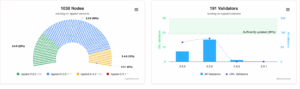
TheXRPL network is run by a series of nodes that communicate with each other. These nodes agree on the ledger’s state using a consensus process, like everyone double-checking and agreeing on the same transaction history. The XRPL network boasts over 1,300 nodes and 191 validators as of September 2025.
List of XRPL nodes and validators. Source: XRPscan
XRPL’s consensus process involves validators agreeing on the ledger’s state every three to five seconds. This is quite in contrast to Ethereum’sproof-of-stake (PoS), which depends on staked tokens, and Bitcoin’sproof of work (PoW), which requires miners to solve computational problems.
Validators play a key role in reaching consensus and avoiding any double-spending. In contrast toBTC mining, validators cooperate to keep the ledger up to date rather than competing for rewards. This process makes XRPL more sustainable and carbon-neutral.
How XRPL Reaches Agreement Without Mining or Staking
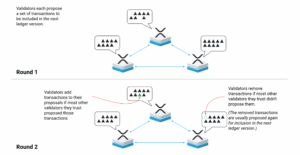
The XRPL network consensus is achieved using theRipple Protocol Consensus Algorithm (RPCA), where a transaction cannot be added to the ledger until at least 80% of the validators on a server’sUnique Node List (UNL) reach a consensus that it is valid. Once around 80% of trusted validators agree, the transaction is finalized, making consensus quick and efficient in theory.
The RPCA is a lightweight, energy-efficient procedure that can process up to 1,500 transactions per second (TPS), with the ability to scale to tens of thousands using Payment Channels.
Every validator keeps track of its own UNL, a list of reliable validators that it uses to reach a consensus. Transactions that comply with the protocol’s requirements are verified in seconds, achieving finality without the delays caused by PoW or PoS.
All transactions are publicly documented and protected by robust cryptography, making this process transparent.
XRPL consensus model. Source: xrpl.org
How Finality Is Achieved in 3–5 Seconds on XRPL
The instant RPCA consensus model helps achieve a transaction finality time of 3-5 seconds. Once a transaction enters the ledger, it is spread across validators for verification.
Once a supermajority of 80% is achieved, the transaction is permanently recorded in the ledger, making it almost instant for the end user.
The speed is critical for XRPL’s growing adoption across banks, as the ledger offers instant transactions across borders compared to Bitcoin’s 10-minute processing time and Ethereum’s a few minutes.
How XRPL Handles Double-Spending and Fault Tolerance
Eliminating the double-spending vulnerability is a key factor for decentralized networks. XRPL’s consensus mechanism has been designed to facilitate fault tolerance.
Even if specific validators are dishonest, as long as at least 80% of the UNL is honest, the network would continue to process transactions. The risk of a single point of failure decreases with validator diversity,
Every transaction on the XRPL requires a tiny fee (paid in XRP, often a fraction of a cent). This fee prevents spam (people flooding the network with fake transactions). The fees are burned, which slightly reduces the total supply of XRP over time.
Who Runs the Validators? XRPL Governance Explained
XRPL’s validator network is open to anyone and everyone and currently boasts over 180 validators, run by academic institutions, exchanges, companies, and private citizens.
As per the 2023 FAQ posted by Ripple, the firmy operates less than 10% of these validators, and only one is on the default UNL of more than 35 trusted nodes. This contrasts with previous years when Ripple operated the bulk of validators.
Did you know that Ripple are holding nearly HALF of all XRP tokens and are waiting to dump them? 🩸
It’s only a matter of time before this ponzi collapses.
The Unique Node List is the trust anchor. In theory, any operator can publish a UNL, and users can choose whichever one they trust. In practice, most operators and clients stick to the default UNL curated by Ripple and, increasingly, the XRPL Foundation. This creates a soft centralization pressure.
We need more validators on the XRPL who actually care …
Even though there are nearly 200 validators, the consensus weight rests with the 35 in the default UNL. That’s not inherently insecure, but it makes the system more “federated” than fully decentralized.
Do XRPL Validators Get Rewards? A Look at Incentives
In contrast to Bitcoin or Ethereum’s consensus mechanism, where the primary motive of the network validators is monetary benefit, XRPL validators do not directly profit from mining or staking.
Instead, the primary motivation is to support companies that depend on XRPL and gain the community’s respect by helping to maintain the network’s stability and dependability.
The modest cost of operating a validator, which includes a basic $200 hardware setup and $10 in electricity costs, in contrast to Bitcoin’s mining rigs, reduces entry barriers and promotes wider involvement.
Validator Entry Barriers: Can Anyone Really Join the XRPL Network?
Yes, technically, anyone with sufficient technical ability can operate a validator:
You just need to install the open-source rippled software and enable validation mode.
Each validating node chooses its own UNL; other servers it trusts for consensus. Most nodes default to curated lists from Ripple or the XRPL Foundation unless customized.
A validator will only influence consensus if it’s present in enough of these UNLs, and consensus thresholds (typically 80%) are met.
If a validator is unreliable (less than 50% agreement over recent ledgers), it may be added to the Negative UNL, effectively excluded from consensus until it recovers reliability (>80%). This is a dynamic safeguard: flag-ledger-based adjustments help preserve consensus when validators go offline or misbehave.
Ripple and XRPL Foundation’s continuous initiatives to switch to independent UNL providers and diversify validators aim to lower the dangers associated with centralization.
Ripple’s XRP Holdings Vs. Escrow System
At the time of launch in 2012, 100 billionXRP tokens were created, with 80 billion allocated to Ripple Labs and 20 billion distributed to founders.
To address concerns about supply control, Ripple locked 55 billion XRP in escrow in 2017 and released up to 1 billion monthly, with unused tokens returned to escrow.
Over 59.8 billion XRP are in circulation as of Sept. 3, whileRipple-affiliated wallets hold about 4.74 billion XRP, representing a small fraction of the circulating supply.
🚨 JUST IN: Ripple locks 700M $XRP (worth over $2.08B) back into escrow 🔐
Although the XRP token price has recovered significantly starting from the second quarter of 2024 and the first half of 2025 over the past year, after the SEC dismissed the long-running securities lawsuit against Ripple, the centralization concerns remain intact, with Ripple being the key controller of the token release.
XRPL vs. Bitcoin and Ethereum: A Decentralization Comparison
XRPL is a banking-focused decentralized ledger system that employs centralized entities to manage and transfer funds across borders. Although XRPL is a decentralized tech, the use of XRP and Ripple’s involvement in managing XRP are the centralized aspects that make it reliable and trustworthy for banks.
On the other hand, theBitcoin ledger is truly decentralized. The miners verify blocks of transactions and earn rewards in return. There is no central entity connecting these core parts of the Bitcoin ledger.
The Ethereum blockchain is also among the decentralized ledgers where validators play a key role. Although anyone can become a validator, the high entry barrier about 32 ETH imposesnodes’ centralization in the hands of a few wealthy validators.
How Does XRP’s Decentralization Impact Its Use in Banking and Finance?
The decentralized XRPL offers a much more reliable, faster, and cheaper alternative tobanking and traditional money-sending routes.
Using theXRP token helps the platform manage liquidity and transfer the value of funds across borders.
XRP is used byRippleNet, the company’s enterprise platform, to provide on-demand liquidity and instantaneously bridge fiat currencies.
🔴 BREAKING: Ripple strikes major deal in Asia! 🚨
Linklogis China’s largest supply chain finance platform moves $2.9B+ trade finance to XRPL, bringing real-world assets on-chain. #RWA 🌍 pic.twitter.com/uCCPJJwZHP
— Real World Asset Watchlist (@RWAwatchlist_) August 27, 2025
Although the ledger’s decentralized nature guarantees dependability, Ripple’s influence poses problems regarding perception and regulation. As banks use XRPL for payments,tokenization, andCBDCs in 2025, its hybrid model, a decentralized ledger with centralized components, offers characteristics that are easy to comply with.
Rumors have been circulating that Ripple has partnered with global payment messaging network SWIFT, which is reportedly experimenting with the XRP Ledger. However, there has been no official announcement from either SWIFT or Ripple to confirm this. Despite the speculation, SWIFT’s CIO has voiced skepticism about Ripple’s ability to become a mainstream payment processor, pointing to concerns over the reliability of its technology and the extent of Ripple’s control.
Spam Prevention and XRPL Sustainability Without Rewards: How’s it Possible?
XRPL intentionally omits direct economic rewards for validator operators. This avoids skewing behavior with financial incentives, miners wanting short-term gains or validators acting selfishly.
Instead, running a validator reflects a commitment to the long-term health and stability of the network. Entities that depend on XRPL (e.g., businesses or infrastructure providers) are naturally motivated to support it, without needing financial carrots.
Every transaction requires a small XRP fee, but here’s the clever part: these fees are burned, not paid to validators or any central party. This makes them a built-in deterrent to spam or denial-of-service attempts.
The fee mechanism scales with network usage, so spam becomes costlier and more self-limiting.
The XRP fee mechanism itself throttles spam by adding a tangible cost to each transaction.
XRPL is highly resilient to Sybil and “51%” style attacks. Because trust must be granted manually (via UNLs), simply running many validator nodes doesn’t yield influence unless other participants choose to trust them.
An academic review argues that monetary incentives can introduce centralization and unintended risks, particularly around collusion or strategic misbehavior. Sometimes, reward-free systems can foster healthier, more reliable ecosystems.
Role of incentives in decentralization. Source: Arxiv
Regulatory Implications of XRPL’s Design
The level of decentralization defines whether a token is a security or an asset class. If the token is decentralized enough, it’s considered a non-security or an asset class and if not then a security token.
With Bitcoin being truly decentralized, it is unanimously considered non-security or an asset class akin to gold.
Ethereum has had its ups and downs from a security perspective, especially after its move to a PoS consensus model. However, theSecurities and Exchange Commission has maintained thatETH is not a security, allowing for the approval of a spot ETH ETF, solidifying that it is decentralized enough to be considered a non-security.
XRP faced a lengthy, drainingSEC lawsuit to prove its non-security contention to some extent. After four long years, the judge ruled that the retail sale of XRP in the secondary market doesn’t constitute security. However, the institutional and direct sales of the token constitute security.
The judgment reinforced that acrypto token might not be a security by itself; how it is used and the transactions involved could determine its nature. The SEC chief reiterated this, claiming crypto tokens are not securities.
Ripple has gradually reduced its validator share and encouraged universities, exchanges, and community groups to participate. That’s progress, but compared to Ethereum’s 1 million+ validators or Bitcoin’s permissionless mining, XRPL still looks relatively narrow.
XRPL—Not Decentralized, Not Controlled: Experts Weigh In
The decentralization aspect of XRPL invokes various reactions from the community and key stakeholders.
Vugar Usi Zade, COO of Bitget, told CCN that although XRPL is decentralized enough to resist direct control by Ripple, it is not decentralized enough to silence concerns about validator diversity and governance capture. It sits in the middle zone between “federated consensus” and “permissionless decentralization.”
He noted that the XRPL consensus mechanism has decentralizing properties in theory. Still, its implementation layer (the UNL) creates a ceiling as the protocol doesn’t require mining, so power isn’t skewed toward whoever controls the most ASICs or capital.
“That’s a decentralizing trait because validator participation isn’t resource-gated like PoW or even ETH’s staking,” Zade noted.
“So, the consensus mechanism promotes design decentralization (low barriers, open validator participation), but the UNL practice curtails it. It’s a trade-off between theoretical openness and practical trust anchoring. I think the most logical statement would be – XRPL consensus decentralizes transaction validation, but centralizes validator selection,” he explained.
Patrick Gruh,CEO of Perpetuals, told CCN that in the larger discussion of decentralization, XRP and the XRP Ledger (XRPL) offer an intriguing compromise.
“The XRPL employs a consensus protocol among validators, in contrast to proof-of-work systems, which mainly rely on energy-intensive mining. While Ripple and others recommend it, participants can ultimately decide who they can trust. Nevertheless, the impression of centralization emerges because Ripple continues to control a sizable number of validators and exerts influence over the ecosystem.”
Can XRP Be Considered Decentralized Despite Ripple’s Holdings?
The honest answer depends on who you ask.
If you ask an XRP proponent, XRPL is decentralized enough through its validators.
If you ask the key stakeholders of the ecosystem, they call it a necessary compromise to rival centralized payment processors likeVisa andMastercard.
From a regulatory point of view, XRPL’s decentralization lies below BTC and ETH, so if XRP transactions are considered a non-security, they are decentralized enough from a regulatory compliance POV.
However, let’s talk from a puredecentralization point of view. A standard set by Bitcoin, XRP, or XRPL cannot be considered decentralized, as the token was pre-mined, the number of validators is less, and the UNP list makes it more concentrated than the total number shows.
SWIFT CIO Tom Zschach argued that convincing regulators to operate doesn’t qualify as a regulatory endorsement.
Thus,XRP is decentralized at the ledger level, where it has implemented key decentralized checkpoints using validators. However, Ripple’s central role and control in key decision-making still influence the perception of its decentralization.
Conclusion
Decentralization exists on a spectrum, and XRP/XRPL fall somewhere between highly decentralized systems like Bitcoin and Ethereum and more centralized models. XRPL’s consensus protocol enables decentralized transaction validation, but validator selection is influenced by the UNL, which introduces a layer of central coordination.
Ripple’s significant holdings of the token supply also shape perceptions of centralization. Still, XRP is not wholly centralized: a diverse set of independent validators contributes to governance and network operations.
In practice, XRPL functions as a hybrid system, combining elements of decentralization at the network level with certain centralized aspects in governance and supply management.
No. XRP is the native digital asset used as a liquidity token, while XRPL is the underlying blockchain network that processes and validates transactions. Ripple, the company, is a separate entity that helped develop XRPL but does not own it.
Who controls the XRP Ledger’s validators?
Anyone can run a validator on XRPL, but only validators included in a Unique Node List (UNL) have influence over consensus. Ripple and the XRPL Foundation curate default UNLs, but operators are free to choose or publish their own lists.
Why don’t XRPL validators earn rewards like Bitcoin or Ethereum validators?
XRPL validators do not receive block rewards or staking yields. Instead, transaction fees are burned (destroyed) to prevent spam. Validators participate mainly to support the ecosystem, maintain network health, and enhance trust.
How decentralized is XRPL compared to Bitcoin and Ethereum?
Bitcoin is considered the most decentralized, with mining open to anyone and no central authority. Ethereum is decentralized but has entry barriers due to staking requirements. XRPL falls in between: transactions are decentralized, but validator selection and token supply are often criticized for being centralized.
Disclaimer:
The information provided in this article is for informational purposes only. It is not intended to be, nor should it be construed as, financial advice. We do not make any warranties regarding the completeness, reliability, or accuracy of this information. All investments involve risk, and past performance does not guarantee future results. We recommend consulting a financial advisor before making any investment decisions.
Prashant Jha is a seasoned crypto journalist based in Delhi, India, with a Bachelor’s Degree in Computer Science Engineering. Passionate about the evolving world of blockchain and cryptocurrencies, he has been a dedicated voice in the industry since 2018. Prashant’s expertise lies in regulatory reporting, where he unravels complex legal and financial developments with clarity and precision. Before joining CCN in 2024, he honed his craft at Cointelegraph, establishing himself as a trusted name in crypto journalism.
His coverage spans major industry events, including the high-profile collapses of FTX, Three Arrows Capital (3AC), and LUNA, offering readers insightful analyses of their regulatory and market implications. Prashant’s technical background enables him to bridge the gap between intricate blockchain technology and its real-world applications, making his work accessible to novices and experts.
Beyond his professional pursuits, Prashant is an avid music enthusiast, often exploring diverse genres to unwind. A sports lover, he has a particular passion for cricket and frequently engages in discussions about the game. His multifaceted interests and sharp journalistic instincts make him a valuable contributor to CCN, where he continues shaping the crypto landscape's narrative.


 Intermediate