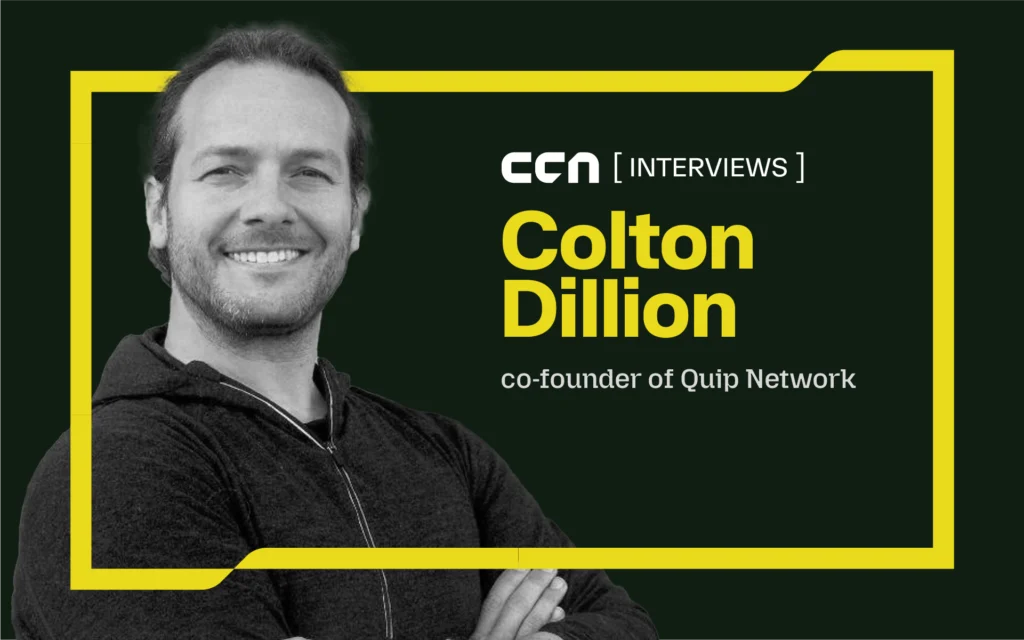
‘Quantum Clock Is Ticking’: Colton Dillion on Building the Worldwide Quantum Computer Before Crypto Breaks
Share
Quantum computing has long been treated as a distant, theoretical threat to modern cryptography. But according to Colton Dillion, co-founder of Quip Network, that timeline may be collapsing much faster than most of the crypto industry is prepared for.
Dillion believes the world is approaching a ‘Moore’s Law moment’ for quantum computing – one that could fundamentally reshape not just blockchain security, but logistics, AI, finance, and even the structure of the internet itself.
And his response? Build what he calls the world’s first ‘Worldwide Quantum Computer.’
Why Quantum Became Urgent Issue to Tackle
For years, quantum computing has existed in the background of crypto discussions. Even Bitcoin’s earliest architects acknowledged it as a future threat. But for most builders, it remained a distant problem.
That changed in November 2024. Dillion recalls the moment clearly.
“Everyone has known that quantum computers are going to be a threat for a long time. Even Satoshi in the early days of Bitcoin was talking about how quantum computers would be a threat, but it always felt really far off.”
Then Google released a breakthrough involving its Willow quantum chips, demonstrating that linking multiple processors reduced the number of physical qubits required for error correction, and that this improvement scaled exponentially.
For Dillion and his co-founder Rick Carback, it looked like the inflection point.
“We saw this and we said, well, this might be the Moore’s law moment for quantum computing.”
They began modeling progress across the industry, analyzing qubit counts, fidelity improvements, coherence times, and error correction across commercially available processors. The results were sobering.
“We decided to plot these factors on a line of best fit for an exponential growth curve… and it said we should expect that there’s a 10% chance that we have a cryptographically relevant quantum computer by March of 2028.”
Even a 10% probability was enough to change their thinking.
“If you think a 10% chance is not that much, take the one trillion dollar Bitcoin market cap and multiply that by 10%, you’re still looking at a hundred billion dollar issue.”
For Dillion, that wasn’t a theoretical risk. It was a call to action.
Why Waiting Is Dangerous
One of the biggest misconceptions, Dillion argues, is that crypto networks can simply upgrade when quantum computers arrive. In reality, migration timelines alone could take years.
“You can’t just flip a switch and upgrade your cryptography. If you tried to convince a bank to do that, they would tell you you’re crazy, you have to plan years in advance.”
The challenge becomes even more complicated in decentralized systems.
Quantum-resistant signatures are larger. Hardware requirements change. Mining economics shift. Consensus upgrades require coordination across global stakeholders.
“Six years is not a very long time to do an upgrade of this magnitude. The earlier we can get started, the less likely we are to have network disruptions.”
In other words, the quantum threat is not just about computing power, it’s about coordination, infrastructure, and migration risk.
Building the ‘Worldwide Quantum Computer’
Quip Network’s response is ambitious: build a global distributed quantum computing network.
Dillion describes the idea simply, but the implications are profound.
“When we say the worldwide quantum computer, we mean that literally.”
Quantum computers differ fundamentally from classical systems. Through entanglement, processors can operate together even when separated by distance.
“The output of one processor relies on the output of the other processor and it doesn’t matter if you separate these things by space and time.”
Today, quantum processors are connected within single facilities. Dillion believes the next stage is linking data centers and eventually, global infrastructure.
“In five to seven years, we’re hoping that we’re connecting them between two data centers; we’re working with universities and government labs to build the first legs of this quantum internet.”
Eventually, he envisions global quantum networks operating collaboratively, a computing infrastructure fundamentally different from anything that exists today.
Mining That Solves Real Problems
Unlike traditional crypto mining, Quip aims to use quantum compute power to solve real-world optimization problems.
The network’s initial proof-of-work uses the Ising model, a system rooted in physics that quantum processors are particularly good at solving.
Dillion explains this in practical terms:
“If you’re FedEx or DHL or UPS – how do I deliver these packages most efficiently? How do I pack as many as I can into a truck? How do I schedule deliveries so drivers wait around the least amount of time?”
These problems can be mapped directly into quantum optimization tasks.
“We can actually take all of those problems and transform them into this problem that the quantum computer is really good at.”
Early testing has produced surprising results.
“We can take a very large cluster of GPUs and the quantum processor will win 92% of the time based on our early testing.”
The team is now inviting external researchers to validate the findings.
Beyond Crypto: The Broader Quantum Future
While security is the immediate motivation, Dillion believes the long-term impact of quantum computing extends far beyond blockchain.
Logistics optimization is one early application. Finance is another, particularly portfolio optimization and risk modeling.
But one area generating the most excitement is materials science.
“When I want to produce the next material – I don’t have to spend $800 million on lab testing – I can predict the properties before we ever try to assemble it.”
AI is another major frontier. Quantum processors could dramatically reduce the energy requirements for training and inference.
“All these models that we’re spending gigawatts of energy on, quantum processors, once mature enough, will use kilowatts instead.”
Even today, Dillion says early quantum models show promising performance improvements.
Democratizing Quantum Access
One of the biggest challenges in quantum computing today is accessibility.
Dillion describes the current experience bluntly.
“If I want to get access to a quantum machine, it’s a $40,000 entry fee, and a three to six month consulting process.”
Quip’s goal is to remove that friction, allowing developers to access quantum compute through smart contracts and marketplace infrastructure.
“You don’t have to know anything – you don’t have to have a PhD – you just have to know the problem you want to solve.”
A Founder’s Pattern: Simple Ideas, Big Impact
Dillion’s career spans fintech, crypto, and now quantum. He credits success to focusing on ideas that resonate immediately.
“Make sure to choose a problem that resonates with people and create a one-liner that unlocks people’s imaginations.”
For Quip, that one-liner is clear:
“Build the worldwide quantum computer.”
When Quantum Breaks Crypto?
Dillion’s forecast remains bold.
“We stand by the quantum doom clock prediction… March 2028 is our 10% chance.”
He points to government planning as further evidence.
“Every new government contract has to be quantum resistant by 2028 – completely phased out by 2035.”
Recent research suggests accelerating timelines.
“Now we can expect the elliptic curve problem to be solved in under 10 minutes, which means every Bitcoin transaction is vulnerable.”
If Quip Succeeds
Toward the end of the conversation, Ciccomascolo asked Dillion what success would look like.
Dillion’s answer was sweeping.
“If Quip succeeds, the entire world will be different.”
He describes AI running locally on phones, new materials enabling breakthroughs in computing, decentralized global supply chains, and new forms of collaboration.
“It’s a step change in what we’re able to do as a civilization, solving problems that no other platform on Earth can solve.”
For Dillion, quantum computing isn’t just another technological upgrade. It’s the next computing paradigm.
Disclaimer:
The information provided in this article is for informational purposes only. It is not intended to be, nor should it be construed as, financial advice. We do not make any warranties regarding the completeness, reliability, or accuracy of this information. All investments involve risk, and past performance does not guarantee future results. We recommend consulting a financial advisor before making any investment decisions.
Giuseppe Ciccomascolo began his career as an investigative journalist in Italy, where he contributed to both local and national newspapers, focusing on various financial sectors.
Upon relocating to London, he worked as an analyst for Fitch's CapitalStructure and later as a Senior Reporter for Alliance News. In 2017, Giuseppe transitioned to covering cryptocurrency-related news, producing documentaries and articles on Bitcoin and other emerging digital currencies. He also played a pivotal role in establishing the academy for a cryptocurrency exchange website. Crypto remained his primary area of interest throughout his tenure as a writer for ThirdFloor.


 Easy
Easy