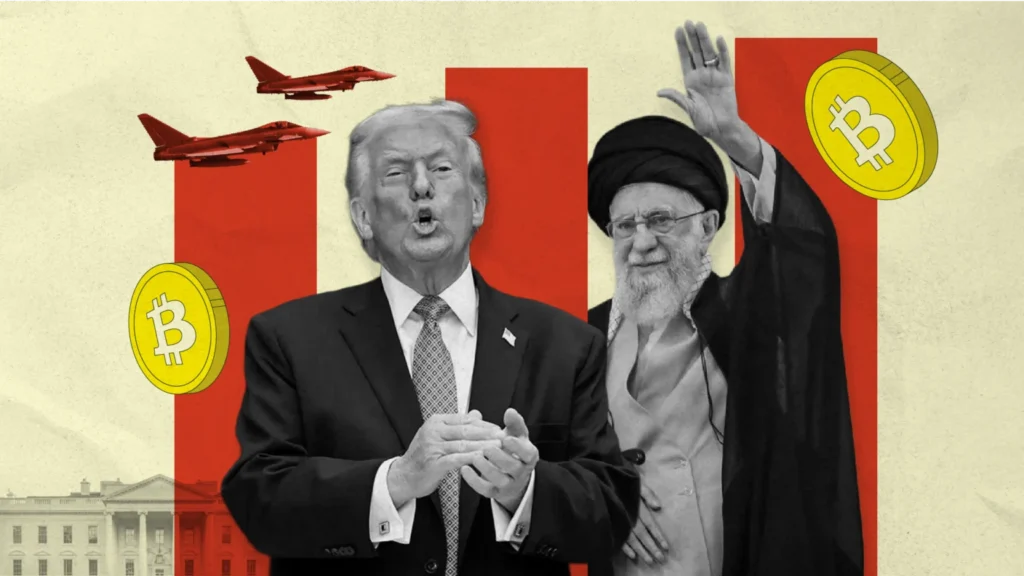
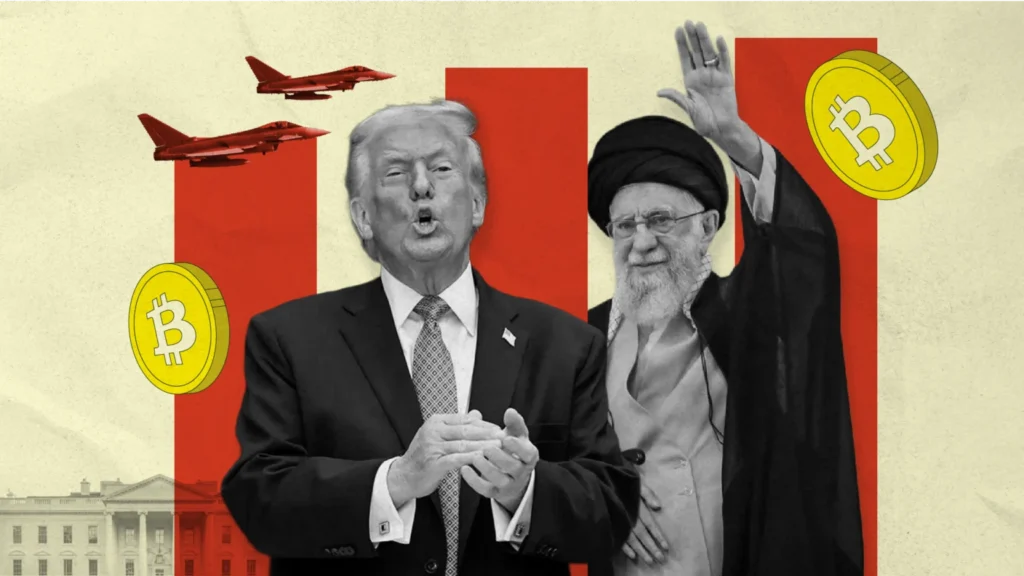
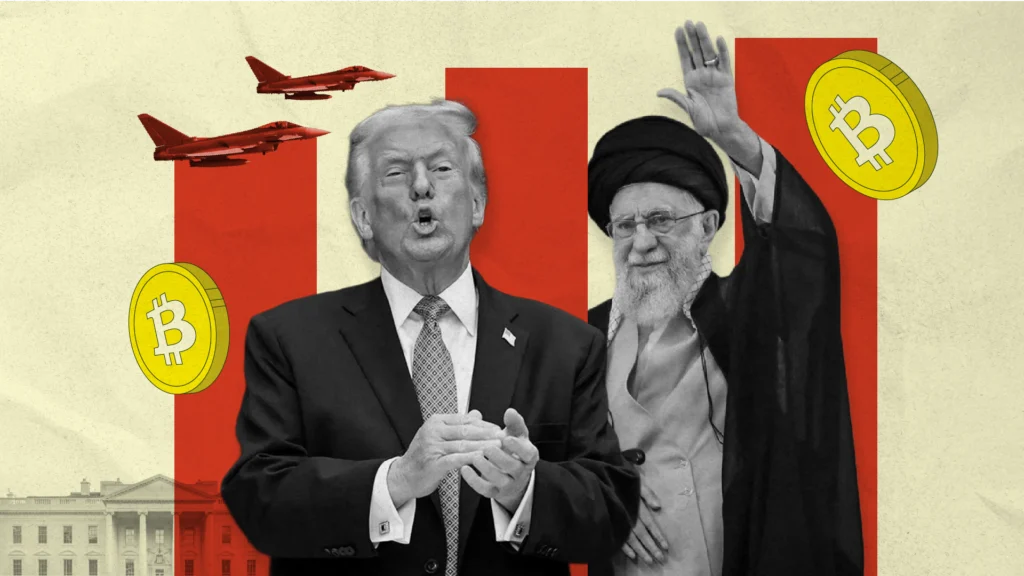
Are TACO (Trump Always Chickens Out) trades are at risk of ruining investor trust? | Source: CCN
Share
Key Takeaways
The “TACO trade” has driven repeated market rebounds, but analysts have warned of it eroding trust.
Bitcoin’s rally on U.S.-Iran ceasefire news reflects renewed risk appetite.
Potential downside risk remains.
Global markets have grown accustomed to a familiar pattern of sharp selloffs triggered by aggressive policy rhetoric, followed by equally swift rebounds once those threats are softened or delayed.
The dynamic—dubbed the “TACO trade” (short for “Trump Always Chickens Out”)—has extended beyond equities into crypto, where Bitcoin has recently rallied on easing geopolitical tensions.
But some analysts warn that it may eventually erode market trust.
Sponsored
Disclosure
We sometimes use affiliate links in our content, when clicking on those we might receive a commission at no extra cost to you. By using this website you agree to our terms and conditions and privacy policy.
Crypto analyst Benjamin Cowen said the current environment mirrors a previous phase in digital asset markets, when attention-driven narratives gradually lost their influence.
He pointed to the 2022–2023 period, when high-profile crypto commentators drew large audiences through increasingly extreme claims, only to see engagement fade as credibility weakened.
According to Cowen, a similar pattern may now be playing out at a macro level. Markets, he argued, have become conditioned to expect policy reversals after initial shocks.
Remember how back in 2022-2023 there were a lot of crypto influencers who went completely crazy and people tuned in because they wanted to watch the drama/train wreck?
Then over time people stopped caring about what they had to say, so in order to become relevant again, they…
This has created a reflexive cycle where investors “wait for the next TACO trade,” buying dips on the assumption that uncertainty will soon be resolved.
However, Cowen warned that repeated reversals can have a cumulative effect.
While short-term rallies persist, the constant reappearance of uncertainty may eventually wear down confidence.
“The risk is not immediate,” he suggested, but rather a future inflection point where market participants stop trusting official signals altogether.
What Is The TACO Trade?
The “TACO trade” is a Wall Street term that emerged in 2025 to describe a recurring policy-driven market pattern.
It refers to a sequence in which:
Aggressive announcements, often around tariffs or geopolitical actions, trigger market declines.
Policymakers subsequently delay, soften or reverse those measures.
Markets rebound sharply as uncertainty fades.
The phrase was introduced by Financial Times columnist Robert Armstrong and gained traction during the Trump administration’s 2025 tariff episodes, particularly the so-called “Liberation Day” measures.
During that period, repeated threats followed by partial retreats created a highly tradable environment, with investors buying dips in anticipation of policy backtracking.
The strategy proved effective for months, becoming one of the more consistent narrative-driven trades across global markets.
TACO Trade Skeptism Grows
While widely adopted, the trade has also drawn skepticism from economists and market participants who question its sustainability.
Economist Peter Schiff has suggested that investors increasingly assume policy threats will not be fully carried out.
In his view, if markets truly believed in worst-case outcomes, risk assets would fall more sharply while safe-haven assets would surge.
“Investors clearly believe today is Taco Tuesday,” Schiff said.
Investors clearly believe today is Taco Tuesday. If they believed there was a reasonable probability that Trump would actually kill Iranian civilization tonight, stocks would be a lot lower and oil a lot higher. If investors don't believe Trump, why would the Iranian leadership?
“If they believed there was a reasonable probability that Trump would actually kill Iranian civilization tonight, stocks would be a lot lower and oil a lot higher.”
Adding: “If investors don’t believe Trump, why would the Iranian leadership?”
That skepticism has broader implications.
If market participants begin to discount official statements altogether, the signaling power of policy announcements could weaken significantly.
Market veteran Fred Krueger echoed the sentiment, describing the pattern as a recurring bluff that traders have learned to anticipate.
“Everyone assumes this is just another episode of Art of the Bluff,” he wrote.
Others have argued that this dynamic could even influence policy strategy itself.
Former JPMorgan quant chief Marko Kolanovic has suggested that allowing markets to fall more materially—rather than cushioning declines—could restore credibility.
“Better strategy for Trump would be to let stock market drop 10% or more and show that he doesn’t care,” Kolanovic wrote.
Adding: “If Iranians see he is not a hostage to stock market, they would more quickly accept (even a worse) deal. Short term pain for long term gain.”
Bitcoin Jumps On Ceasefire Relief
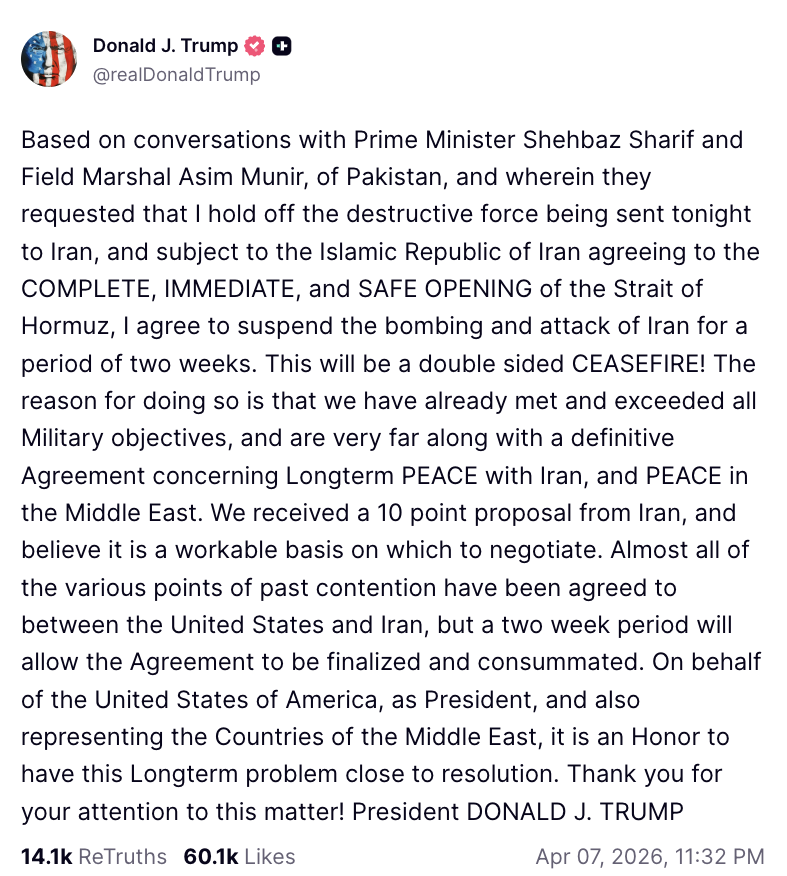
On Wednesday, U.S. President Donald Trump posted on Truth Social the country would “suspend the bombing and attack of Iran for a period of two weeks.”
The President added that it would be based on if Iran agreed to the “COMPLETE, IMMEDIATE, and SAFE OPENING of the Strait of Hormuz.”
Donald Trump announced a ceasefire on April 7 | Source: TruthSocial
Just hours earlier, Trump had written:
“A whole civilization will die tonight, never to be brought back again. I don’t want that to happen, but it probably will.”
According to The Guardian, B-52 bombers were on the way to Iran before Trump announced the ceasefire.
Bitcoin climbed to a three-week high after the U.S. and Iran agreed to an initial ceasefire, boosting risk appetite across global markets, according to Bloomberg.
The crypto rose as much as 4.9% to $72,738—its highest level since March 18—while Ethereum gained over 7% at one point, the publication reported.
“Bitcoin jumped up this morning on the temporary ceasefire and relief that further escalation had been averted for now,” Caroline Mauron, co-founder of Orbit Markets, told Bloomberg.
Not All Bullish
However, not all signals point to sustained bullish momentum.
He highlighted that Bitcoin’s long/short ratio has dipped below 1, indicating a growing preference for short positions even as prices trend higher.
According to Oladokun, this shift suggests traders are positioning for a potential pullback rather than an extended rally.
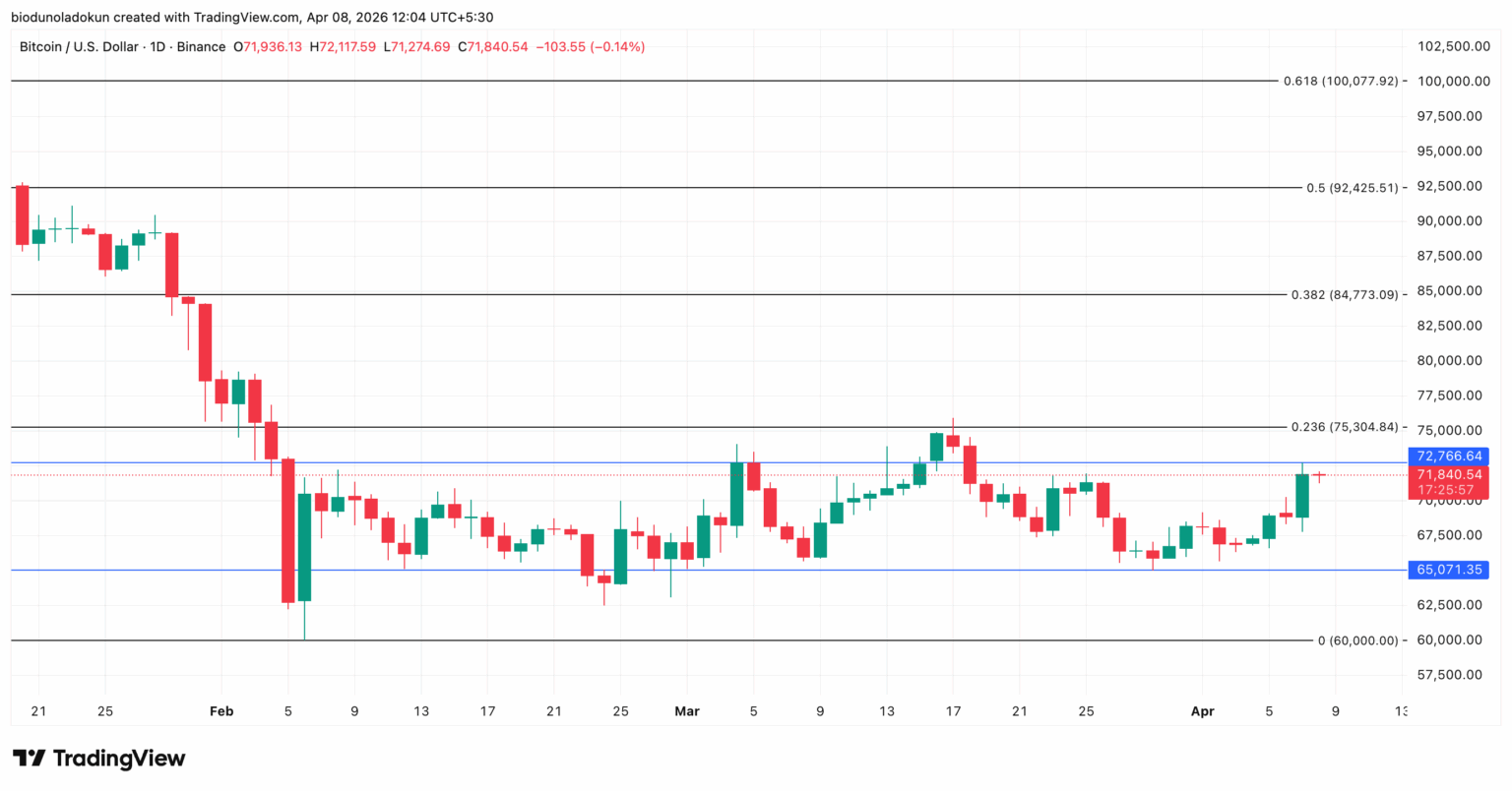
BTC/USDT Daily Chart | Credit: TradingView
“If the buy-side pressure on the coin’s spot market grows, a daily close above this price ceiling is possible in the near term. Should this happen, it could propel BTC further toward $75,304,” Oladokun said.
Adding: “If sentiment worsens, the coin could test the support floor at $65,071, a breach of which could result in a decline to $60,000.”
Kurt Robson is a London-based reporter at CCN, specialising in the fast-moving worlds of crypto and emerging technology. He began his career covering local news in Cornwall after graduating from Falmouth University with First Class Honours in Journalism. There, he cut his teeth on everything from council meetings to missing swans.
He quickly rose through the ranks to become a frontline journalist at several of the UK’s leading national newspapers. Over the years, he has interviewed musicians and celebrities, reported from courtrooms and crime scenes, and secured multiple front-page exclusives.
Following the upheaval of the COVID-19 pandemic, Kurt shifted his focus to technology journalism—just ahead of the AI boom. With a natural curiosity and a trained eye for emerging trends, he has found a new rhythm in reporting on innovation.
At CCN, Kurt's work focuses on the cutting edge of crypto, blockchain, AI, and the evolving digital world. Drawing on his background in people-first reporting and his deep interest in disruptive tech, Kurt delivers stories that are insightful, entertaining, and human-centric.