Morgan Stanley Bitcoin ETF (MSBT) Prospectus Flags Quantum Computing as Emerging Risk — Here’s What It Means
Share
Key Takeaways
Morgan Stanley’s proposed Bitcoin ETF prospectus warns that advances in quantum computing could weaken Bitcoin’s cryptography, potentially exposing wallets and affecting ETF investors.
BlackRock previously broadened quantum computing warnings in its iShares Bitcoin Trust filings, noting that future breakthroughs could break encryption and require network-wide protocol upgrades.
While Vitalik Buterin has warned that quantum risks could emerge within the next decade, Bitcoin pioneers like Adam Back and Nick Szabo believe the threat remains long-term and manageable.
With major asset managers including quantum risks in ETF filings, Bitcoin is increasingly being evaluated as long-term financial infrastructure, not just a volatile asset.
Wall Street’s newest Bitcoin ETF filings are quietly highlighting a risk that until recently lived mostly in academic papers: quantum computing.
In its March 17, 2026 preliminary prospectus, the Morgan Stanley Bitcoin Trust (MSBT) warned that technological breakthroughs, including quantum computing, could weaken Bitcoin’s cryptographic security, potentially allowing attackers to access wallets or disrupt the network. The ETF is designed to track bitcoin’s price and trade on NYSE Arca, pending SEC approval.
This disclosure marks one of the first times a major U.S. bank launching a Bitcoin ETF has explicitly acknowledged quantum computing as a long-term security risk.
But Morgan Stanley isn’t the first.
BlackRock Already Expanded Quantum Risk Warnings
Before Morgan Stanley’s filing, BlackRock expanded its quantum computing risk language in its iShares Bitcoin Trust (IBIT) prospectus. The asset manager broadened a brief mention into a detailed disclosure, warning that future quantum breakthroughs could threaten Bitcoin’s cryptographic foundations and potentially impact investor confidence.
The network might require protocol-level or network-wide upgrades
Market confidence and ETF value could be affected
The shift was subtle but meaningful: quantum risk moved from theoretical to institutional risk management.
Why Wall Street Is Raising Quantum Concerns Now
The timing of these disclosures aligns with a surge in quantum-related research and warnings.
Recent research from Google Quantum AI suggested that future quantum machines could derive private keys in nine minutes, significantly reducing previous estimates and potentially putting millions of Bitcoin at risk once such systems exist.
“Q-Day” – the point at which quantum computers could break today’s encryption, is estimated by some researchers to arrive as early as 2029–2032, increasing the urgency around developing post-quantum cryptography.
For ETF issuers like Morgan Stanley and BlackRock, these developments matter because Bitcoin ETFs are long-term investment vehicles, meaning risk disclosures must account for threats years or decades into the future.
Industry Voices Are Divided on the Quantum Timeline
While Wall Street is acknowledging the risk, crypto leaders remain divided on how urgent the threat really is.
Vitalik Buterin previously warned there is roughly a 20% chance quantum computers capable of breaking modern cryptography could emerge before 2030, arguing that preparation should begin early because blockchain upgrades take years.
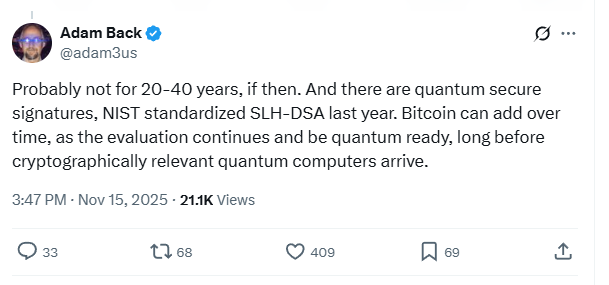
Meanwhile, Adam Back has taken a more cautious stance, arguing that quantum threats remain decades away and that rushed upgrades could introduce more risk than they solve.
Quantum is not an immediate threat to Bitcoin, per Adam Back. | Source: @adam3us on X
Nick Szabo warns Bitcoin is not safe from legal pressure. | Source: @NickSzabo4 on X
Even institutional analysts are starting to factor the risk into long-term models. Some strategists have already raised concerns that cryptographically relevant quantum computers could theoretically expose millions of Bitcoin, prompting broader discussion across traditional finance.
The growing diversity of opinions highlights one key point: quantum risk is no longer fringe, it’s entering mainstream financial analysis.
Bitcoin Is Already Preparing for the Quantum Era
Bitcoin infrastructure is already beginning to evolve for a post-quantum world. In March 2026, Blockstream researchers demonstrated quantum-resistant transaction signing on the Liquid Network, marking one of the first real-world deployments of post-quantum cryptography on a production Bitcoin sidechain.
According to Blockstream, the team successfully broadcast transactions secured with a post-quantum signature scheme on Liquid mainnet, protecting real assets, including bitcoin and other issued tokens. The milestone shows that quantum-resistant protections are no longer theoretical experiments but are beginning to move into live environments.
Quantum computers could eventually break Bitcoin's current signature schemes, threatening coins in certain address types.
The breakthrough was enabled by Simplicity, Blockstream’s smart contract language, which allows users to define custom spending conditions. Instead of requiring a complex network-wide upgrade, users can opt into quantum-resistant protection by locking their assets into contracts that require post-quantum signatures to spend. This opt-in model allows testing and gradual adoption without disrupting existing users.
The implementation uses a hash-based signature approach called SHRINCS, developed by Blockstream Research and optimized specifically for blockchain environments. The system includes both compact signatures for everyday use and a fallback recovery mode designed to ensure users can still access funds if key data is lost.
While quantum computers capable of breaking Bitcoin’s current cryptography do not yet exist, researchers widely agree that preparation must happen well in advance. Blockstream emphasized that this deployment does not make the entire Liquid Network quantum-resistant yet, but represents an important early building block.
More broadly, the experiment highlights how Bitcoin-like systems can gradually transition toward quantum-safe infrastructure. By testing these solutions on production networks today, developers aim to ensure that when quantum computing eventually becomes a real threat, Bitcoin’s security can evolve smoothly rather than react under pressure.
When Will Morgan Stanley’s Bitcoin ETF Launch?
Morgan Stanley’s ETF has not launched yet, but progress is accelerating.
Initial filing: January 6, 2026
Amended filings: March 2026
Ticker: MSBT
Exchange: NYSE Arca
Custody: Coinbase Custody
Cash administration: BNY Mellon
The ETF will launch once SEC approval is granted, with the filing also confirming $1 million in seed capital and initial share creation structure.
According to Bloomberg analyst Eric Balchunas, Morgan Stanley’s Bitcoin ETF ($MSBT) has received an official NYSE listing announcement, typically a sign that launch is imminent.
Morgan Stanley Bitcoin ETF $MSBT got an official listing announcement from NYSE, that typically means launch imminent.. pic.twitter.com/SDDVyAGfpJ
Morgan Stanley’s move is significant because it marks one of the first major U.S. banks launching its own spot Bitcoin ETF, expanding institutional competition with firms like BlackRock and Fidelity.
Wall Street Is Beginning to Treat Bitcoin Like Long-Term Infrastructure
Morgan Stanley flagging quantum computing risks, following BlackRock’s expanded warnings, signals a meaningful shift in how Bitcoin is being evaluated.
This isn’t just about price volatility anymore.
Instead, major financial institutions are now analyzing Bitcoin through the lens of long-term infrastructure durability.
They’re assessing:
Cryptographic resilience
Long-term technological risks
Potential upgrade requirements
Network and infrastructure robustness
This marks a significant evolution in Bitcoin’s narrative.
Bitcoin is no longer viewed solely as a speculative asset. It’s increasingly being treated as foundational financial infrastructure — something expected to operate securely for decades, not just market cycles.
And as quantum computing continues to advance, that infrastructure may eventually need to evolve alongside it.
In other words, Wall Street isn’t just asking “Will Bitcoin go up?”
They’re now asking:
“Will Bitcoin still be secure 20–30 years from now?”
That’s a very different conversation and a sign of growing institutional maturity around Bitcoin.
Why is Morgan Stanley mentioning quantum computing in its Bitcoin ETF?
Morgan Stanley included quantum computing in its risk disclosures because advanced quantum machines could potentially break Bitcoin’s cryptographic security. ETF filings must account for long-term technological risks that could impact investor holdings.
Has BlackRock also warned about quantum computing risks?
Yes. BlackRock expanded its quantum computing risk warnings in amended filings for its iShares Bitcoin Trust, highlighting that quantum breakthroughs could compromise wallets and require network-wide security upgrades.
Is quantum computing an immediate threat to Bitcoin?
No. Most experts agree quantum computers capable of breaking Bitcoin do not exist yet. However, blockchain upgrades can take years, which is why institutions and developers are preparing early.
When is Morgan Stanley’s Bitcoin ETF launching?
Morgan Stanley’s Bitcoin ETF has not launched yet. The filing was submitted in early 2026 and is currently awaiting SEC approval, with trading expected to begin after regulatory clearance.
Onkar Singh has three years of experience as a digital finance content creator. Throughout his career, he has collaborated with various DeFi projects and crypto media outlets. In his leisure time, he enjoys fitness activities at the gym and watching movies across different genres. Balancing his professional and personal interests, Onkar continues to contribute to the digital finance landscape while pursuing his hobbies.


 Easy
Easy