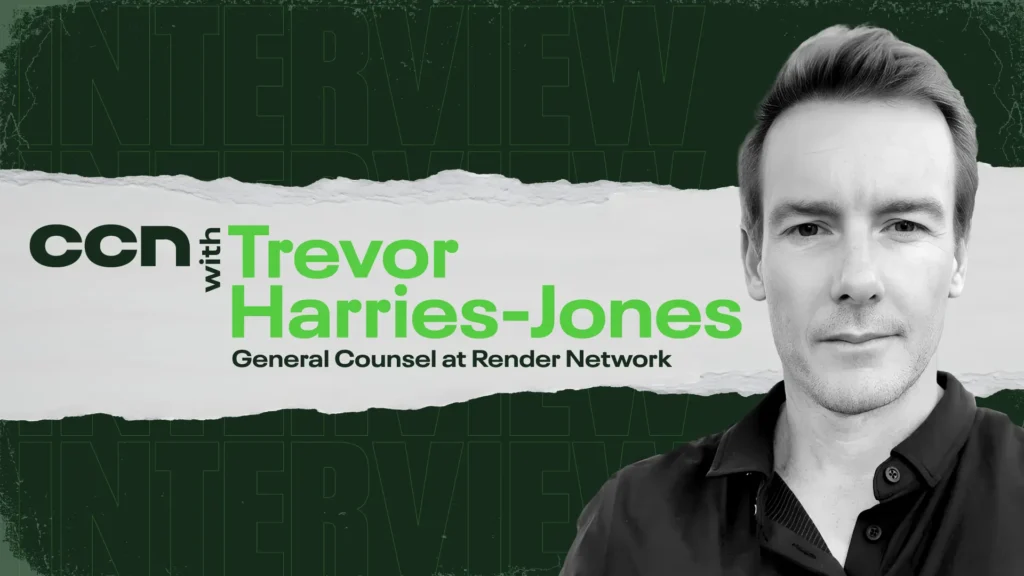
“Over eight years ago, we set about to prove that idle consumer GPUs could power cinematic-grade creativity at scale.”| Credit: CCN
Share
Decentralized infrastructure has expanded far beyond finance.
Today, it increasingly supports computing, graphics processing, and artificial intelligence, reshaping how creative and AI workloads scale outside traditional cloud models.
One network operating at this intersection is Render Network, a decentralized platform that connects GPU providers with creators and AI teams that need large-scale rendering and compute.
Over a few years, Render Network has grown from an experimental idea into a system that now renders around 1.5 million frames per month.
In this CCN interview, Dr. Lorena Nessi speaks with Trevor Harries-Jones, Director at the Render Network Foundation, about how the network works, why blockchain plays a structural role, how decentralized GPUs compare with centralized cloud services, and where AI-driven creation is heading next.
Watch the full interview here:
What Render Network Does and Why Rendering Still Bottlenecks Creation
Rendering remains one of the most resource-intensive stages of digital production. Each second of video consists of dozens of individual frames, many of which include rendered elements layered over live footage.
As formats have progressed from standard definition to 4K and now to immersive 3D environments, compute demand has increased accordingly.
“Over eight years ago, we set about to prove that idle consumer GPUs could power cinematic-grade creativity at scale,” said Trevor.
That goal was driven by a widening gap between creative ambition and available compute. Improvements in GPU performance have been matched, and often outpaced, by rising expectations for visual fidelity, realism, and immersion.
“We’ve gone from, you know, grainy images to better images to videos to 4K video and now to immersive and, you know, 3D or holographic videos,” Trevor said.
“Each one of those is a huge step up in the computer power needed.”
A Scaling Constraint That Changed the Architecture
The shift toward a decentralized model was triggered by a concrete capacity problem. While working on a large-format display project tied to Madison Square Garden, the Render team calculated that conventional cloud infrastructure could not meet the delivery timeline.
“We realized it would take 6 months of all of Amazon’s West Coast GPU compute to do the render and they only had 3 months,” Trevor said.
That calculation exposed a structural limitation. Even hyperscale providers can become bottlenecks during demand spikes.
Render Network’s response was to distribute workloads across multiple machines, allowing individual frames to be processed in parallel rather than sequentially on a single system.
This approach formed the basis of Render Network’s architecture and reduced reliance on upfront hardware investment by artists and studios.
Why Blockchain Coordinates the Render Network
Render Network uses blockchain-based coordination rather than a centralized scheduling and billing system. At the center of this design is the RNDR token, which facilitates job execution and payment across the network.
“The central fuel of the render network is the render token,” Harries-Jones said.
One motivation for this structure was to avoid inserting a central intermediary between creators and GPU providers. Smart contracts allow jobs and payments to be coordinated directly across the network.
Another consideration was transaction structure. Rendering involves high volumes of small jobs, making traditional payment rails inefficient at scale.
A third motivation relates to authorship and provenance in a creative economy increasingly shaped by artificial intelligence (AI).
“When he was looking at a creator economy where um the cost of creation tends towards zero or very low which is what we’re seeing now with AI,” Trevor said, referring to Render founder Jules Urbach, “the belief was that um in order for real creativity to rise to the top um you needed to be able to prove creation and provenence.”
For Render Network, blockchain provides a way to link creation, attribution, and potentially royalties to on-chain records as creative output becomes easier to generate.
How Motion Graphics Artists Use the Network
Render Network primarily serves motion graphics artists and studios already working within professional digital content creation workflows.
“You need to be a motion graphics artist,” Harries-Jones said. “These motion graphics artists need to go to some form of training to learn how to create animations.”
Artists typically build scenes using digital content creation tools and render them with engines such as OctaneRender, Redshift, or Blender Cycles.
Render Network integrates directly with these engines, allowing final renders to be offloaded to a distributed GPU pool.
Instead of waiting hours or days for local machines to finish rendering, creators submit jobs to the network, where thousands of nodes process frames in parallel.
Harries-Jones cited real-world results from large-scale immersive projects.
Pricing, Tokens, and Network Participation
Although RNDR underpins the network, creators typically interact with Render Network through fiat-priced services.
“Our offering is priced in fiat and you know, we really view this as a flywheel,” Harries-Jones pointed out.
Over time, some users also become node operators, contributing their own GPUs to the network and earning credits or tokens for processing jobs.
“If I just leave this node on the whole time and, you know, treat it as a battery, I can earn render,” Harries-Jones explained this as a common shift in usage patterns.
This dual role strengthens network capacity while allowing creators to offset their own rendering costs.
Centralized Cloud Services Versus Decentralized GPUs
Render Network does not position itself as a replacement for centralized cloud providers.
“You will have centralized clouds and data centers forever going forward.”
Large-scale AI training, particularly for models with billions of parameters, remains better suited to centralized infrastructure. However, decentralized GPU networks are increasingly relevant for inference-heavy workloads.
Harries-Jones also pointed out that “8% of AI work is inference, not training,” noting that inference often does not require the most advanced hardware available.
As models become smaller and more efficient, decentralized compute can support a growing share of AI workloads at lower cost.
Outsourcing rendering and AI workloads raises concerns around data protection, particularly for high-value creative content.
“When you’re creating a Hollywood movie, you don’t want part of that movie leaked,” Harries-Jones said.
He explained that Render Network streams encrypted jobs to nodes rather than installing software locally, reducing exposure risks.
Decentralized compute also involves trade-offs between cost and speed. According to Harries-Jones, batch jobs and non-immediate workloads tend to benefit most from this model.
“If you don’t need the speed, decentralized can be significantly better,” he said.
Dispersed and the Expanding AI Audience
Alongside Render Network, the ecosystem includes an AI-focused platform called Dispersed, which provides decentralized GPU access for AI workloads.
Render Network primarily serves artists and studios, while Dispersed supports AI developers, integrators, and companies running models as a service.
Harries-Jones said much of the network’s growth is expected to come from integrators whose customers may never directly interact with the underlying GPU marketplace.
Harries-Jones described AI and traditional rendering as historically separate processes that are now converging.
Traditional 3D creation has long offered precision and repeatability, while AI-based tools have favored speed over consistency. Harris Jones explained that this gap has limited the adoption of AI inside professional production workflows. One development starting to bridge the two approaches is the use of Gaussian splats.
These AI-generated objects can be imported into established 3D pipelines and rendered alongside conventional assets, allowing creators to combine AI-generated elements with controlled, production-grade workflows.
Another development is the rise of world models, which generate navigable 3D environments rather than isolated images or videos.
For Render Network, these developments align with a long-term vision of immersive, real-time digital environments.
Why Timelines in AI Creation Are Becoming Harder to Predict
Predicting timelines for AI-driven creation remains difficult.
“If anyone can predict where this is going in more than 3 months, he doesn’t trust him because they can’t keep up inside with the rate of change,” Harries-Jones said.
What remains consistent is the expectation that decentralized GPUs, AI-native formats, and blockchain coordination will continue to shape how creative and AI workloads scale.
“I can’t wait to see what people can create when you unlock these tools in a way that we know is coming,” he said.
Disclaimer:
The information provided in this article is for informational purposes only. It is not intended to be, nor should it be construed as, financial advice. We do not make any warranties regarding the completeness, reliability, or accuracy of this information. All investments involve risk, and past performance does not guarantee future results. We recommend consulting a financial advisor before making any investment decisions.
Dr. Lorena Nessi is an award-winning journalist and media technology expert with 15 years of experience in digital culture and communication. Based in Oxfordshire, UK, she combines academic insight with hands-on media practice.
She holds a PhD in Communication, Sociology, and Digital Cultures, and an MA in Globalization, Identity, and Technology.
Lorena has taught at Fairleigh Dickinson University, Nottingham Trent University, and the University of Oxford. She is a former producer for the BBC in London, with additional experience creating television content in Mexico and Japan.
Her research focuses on digital cultures, social media, technology, capitalism, and the societal impact of blockchain innovation.
She has written extensively on digital media and emerging technologies, with her work featured in both academic and media platforms. Her Web3 expertise explores how blockchain technologies shape culture, economics, and decentralized systems.
Outside of work, Lorena enjoys reading science fiction, playing strategic board games, traveling, and chasing adventures that get her heart racing. A perfect day ends with a relaxing spa and a good family meal.


 Easy
Easy