Vitalik Buterin Warns 20% Quantum Risk by 2030 — Are Bitcoin and Ethereum Truly in Danger?
Share
Key Takeaways
December 9, 2024: Google unveils Willow, a 105-qubit chip that ran a benchmark in under five minutes.
October 22, 2025: Google announced Quantum Echoes, the first verifiable quantum advantage on hardware, about 13,000x faster on Willow than the world’s fastest supercomputers.
This is useful and replicable science, but Bitcoin is not at risk today.
Practice proper transaction hygiene, such as avoiding address reuse and paying attention to quantum computing developments.
On Dec. 9, 2024, Google revealed its “Willow” quantum chip. At the time, it took five minutes to perform a computation that would take one of the world’s fastest supercomputers 10 septillion years.
Google made history once again on Oct. 22, 2025, announcing its Quantum Echoes algorithm, an algorithm that has achieved the first verifiable quantum advantage on hardware. It runs “13,000 times faster on Willow than the best classical algorithm on one of the world’s fastest supercomputers.”
In simple terms, while Willow successfully outperformed supercomputers at its reveal, it was simply passing a test. Quantum Echoes marks a successful real-world use case, and the algorithm being “quantum verifiable” means other quantum computers can achieve the same result.
Now, quantum computing is often named as a true threat to Bitcoin, but how valid are these claims, and does Willow mean Bitcoin is no longer secure?
Try Our Recommended Crypto Exchanges
Sponsored
Disclosure
We sometimes use affiliate links in our content, when clicking on those we might receive a commission at no extra cost to you. By using this website you agree to our terms and conditions and privacy policy.
The short answer is no. Bitcoin uses elliptic-curve cryptography (ECC) to protect your private keys. The known quantum attack that could threaten ECC is called Shor’s Algorithm. To run Shor in a way that could break Bitcoin-strength keys, you’d need thousands of error-corrected (logical) qubits, or quantum bits, working reliably over a long sequence of steps.
What is a Qubit?
Qubits are an evolution of the classical computer bits, which exist as either 0 or 1 (off or on, think of a light switch) as needed. The quantum alternative can exist as either 0 or 1 simultaneously (also known as superposition), allowing algorithms to explore various solutions before providing an answer.
Qubits also battle errors, meaning they must be corrected to achieve “logical” status. While Google is targeting long-lived logical qubits, or a qubit that can perform “one million computational steps with less than one error”, it still has a long way to go.
And while Google aims to achieve 1 million qubits by the end of the 2020s, Willow is currently at around 105 qubits, and they’re not all error-free.
How Far Quantum Computers Are From Breaking Bitcoin?
Willow is like a fast kayak winning a river race! It’s an impressive device, but to beat all of Bitcoin’s security, it would need an armada of kayaks performing just as well. Google is nowhere near that.
Credible sources show that to crack a 256-bit ECC key within a practical attack window, or the period in which a transaction confirms, you’ll likely need a 300-million-qubit computer to break it within an hour.
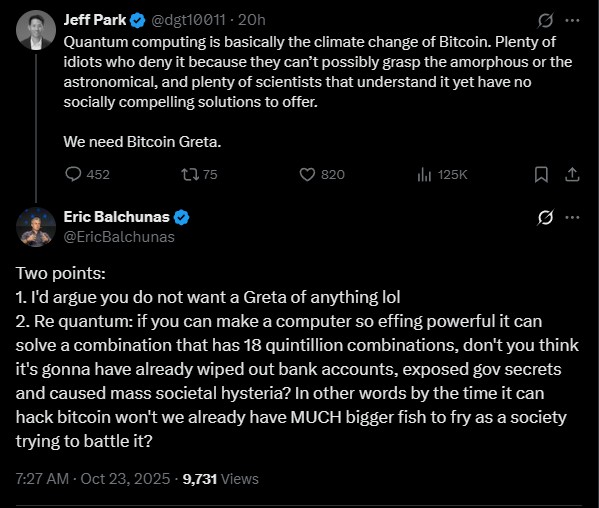
This isn’t to mention that even if bad actors got a hold of quantum computing powerful enough to take down Bitcoin, they’d go after other systems, such as governments and data centers, such as Google’s, long before Bitcoin is in their sights.
Will Willow really be the first to break Bitcoin? | Source: @EricBalchunas on X
Scott Aaronson (quantum complexity theorist) cautions against hype and sees no near-term crypto break; progress is real, but practical, error-corrected machines that can run deep algorithms like Shor at useful scales are still out of reach.
On the contrary, Dan Boneh (Stanford cryptographer) emphasizes the pragmatic answer: migrate to post-quantum cryptography in advance; precise dates are guesses and could shift with national-scale investment, but there’s no evidence of an imminent “Manhattan Project” for code-breaking.
Where Could Bitcoin Be Vulnerable to Quantum Computers?
Should bad actors take advantage of quantum computing, here’s how it could affect your Bitcoin holdings:
When your public key is visible: Your public key is generated from your private key. This means there’s some sort of trail. In a distant future with a Shor-capable quantum computer, a bad actor could take your public key and uncover that trail, deriving your private key from it.
Address reuse: If you reuse the same address, you keep exposing the same public key. That paints a target on your coins whenever quantum becomes a real threat. Good crypto hygiene means regularly switching addresses to minimize risk.
During migration periods: Even if Bitcoin does come up with a quantum-resistant algorithm, it will likely be an opt-in, time-consuming implementation.
So… Does Willow’s Quantum Power Mean Bitcoin Isn’t Secure?
Willow and Quantum Echoes show that useful quantum computing is on its way, but that’s a reason to plan instead of panic.
Basically, Google proved a quantum chip can solve a problem scientists actually care about, faster than classical machines, with results that are verifiable and repeatable.
Bitcoin is still secure, at least for now, but that doesn’t mean you can’t prepare. The resource gap between today’s machines and a Bitcoin-breaking Shor computer is still massive, requiring thousands to millions of physical qubits vs. Willow’s 105 today.
Just make sure to practice healthy transaction hygiene. Integrating these habits will keep your assets as safe as they can be.
Is Quantum Echoes Google’s chip, or its algorithm?
It’s the algorithm. Google ran Quantum Echoes on the Willow chip. The company’s big claim is a verifiable quantum advantage, meaning others can reproduce the solution on their own quantum hardware.
If quantum computers advance, which Bitcoin are at highest risk first?
Coins tied to public keys that have already been used are at the highest risk.
Are altcoins safer from quantum than Bitcoin?
Not by default. Most major chains use a similar ECC. Safety may come from migrating to other hashing algorithms.
Could a quantum attacker steal from cold storage?
Cold storage protects against online theft. Quantum threats target cryptography. If your public key never appears on-chain, your risk is much lower, even in a future quantum world.
Disclaimer:
The information provided in this article is for informational purposes only. It is not intended to be, nor should it be construed as, financial advice. We do not make any warranties regarding the completeness, reliability, or accuracy of this information. All investments involve risk, and past performance does not guarantee future results. We recommend consulting a financial advisor before making any investment decisions.
Max Moeller is a Chicago‑based writer and video editor passionate about games, tech, and crypto. Whether it’s crafting clear, insightful articles or piecing together engaging video retrospectives, he’s driven by curiosity and takes pride in keeping things human. Since 2017, Max has been published in a variety of notable crypto magazines.


 Intermediate