Key Takeaways
- Frederik Lund says the industry can no longer rely on narratives and speculation as investors and users are increasingly demanding real fundamentals.
- Projects with high valuations but little or no fee generation are unlikely to survive long term, regardless of user growth or TVL.
- For Lund, instead of avoiding compliance, projects that embrace regulation early can gain market access, trust, and long-term defensibility.
- Projects that focus on profitability, compliance, and real user demand will outperform those built purely on hype.
For an industry built on decentralization and disruption, crypto still struggles with a surprisingly traditional problem: separating vision from reality.
Over the past decade, blockchain has produced groundbreaking innovations, from Bitcoin’s monetary system to the rise of stablecoins as global payment rails. But beyond a handful of proven use cases, much of the sector continues to operate in a cycle of hype, inflated valuations, and fragile business models.
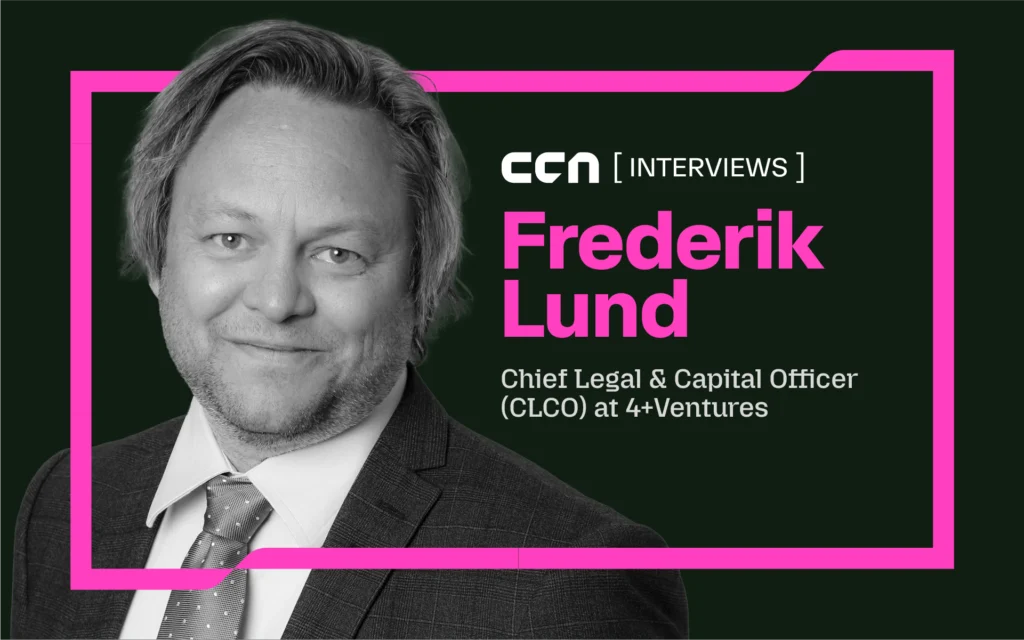
According to Frederik Lund, Chief Legal & Capital Officer at 4+Ventures, that disconnect is no longer sustainable.
Speaking to Crypto Citizen Network (CCN)’s Senior Editor Dr. Guneet Kaur, Lund argued that crypto is entering a phase where fundamentals, not narratives, will determine which projects survive. The industry, he suggests, needs a reality check.
Why Crypto’s Hype Cycle Is No Longer Sustainable for Long-Term Growth
Crypto has always thrived on optimism. Bull markets are fueled by promises of mass adoption, revolutionary infrastructure, and exponential returns. But Lund believes that culture has come at a cost.
“The industry is full of noise,” he said. “It’s full of people talking about higher highs, and it’s not grounded enough in reality.”
That lack of grounding has been particularly visible in how projects are valued. During the last cycle, it was not uncommon for protocols with minimal revenue, or none at all, to command multi-billion-dollar valuations.
The concept of the “utility token,” once the backbone of Web3 fundraising, is no longer enough on its own.
For Lund, “projects cannot continue to rely on token narratives without demonstrating real economic activity.”
Why Crypto Projects Need Real Revenue Models, Not Just Token Valuations
At the heart of Lund’s argument is a simple principle: at some point, every project must be profitable.
Crypto has long embraced the idea that profitability can come later. But Lund questions whether that model truly translates to blockchain.
“You cannot have a situation where something is valued at billions and it earns less than a small shop on the corner,” he said.
“Industry data supports this concern. Only a handful of networks, such as Ethereum and Tron, generate significant fee revenue. Meanwhile, many projects with high TVL or strong community engagement produce negligible income.”
Lund explained that several high-profile failures illustrate the risk. Protocols that once attracted billions in capital have struggled to survive once incentives dried up, exposing the lack of sustainable demand underneath.
Crypto Regulation in 2026: Why Avoiding Compliance Is a Losing Strategy
If weak fundamentals are one problem, regulatory avoidance is another.
Crypto has historically treated regulation as something to escape. But as the industry matures, that approach is becoming increasingly ineffective.
“The instinct is always: how do we avoid it? That’s not the right instinct,” Lund said.
Many projects still rely on jurisdiction arbitrage—moving to regions with lighter regulations such as the Cayman Islands or Dubai. While this can reduce short-term costs, it rarely solves long-term challenges.
“The customers are not in Dubai,” Lund noted. “So eventually, you need to be regulated where your users are.”
Regulation, in this context, is not just a burden. It also creates barriers to entry. Once companies secure licenses, they often face less competition and can operate with stronger market positioning.
Why Tokenomics, Legal Structure, and Business Models Must Align in Web3
One of the most overlooked issues in crypto is structural misalignment.
“Many founders treat tokenomics, legal structure, and business model as separate components. In reality, they are tightly interconnected.”
A small change, such as whether a platform holds custody of user funds, can completely alter its regulatory classification. Token design can influence both revenue generation and compliance obligations.
“The lawyer will tell you what you need for that business model,” Lund explained. “But they won’t necessarily tell you that if you change the model, everything changes.”
This disconnect is particularly problematic in a global industry. Crypto projects often operate across jurisdictions, while advisors remain localized. The result is fragmented guidance and inefficient structures.
Importance of Product-Market Fit in Crypto Startups
Despite all the complexity, Lund highlights a fundamental issue: many crypto projects are built without real demand.
“Technology can be great, but nobody asked for it,” he said.
This is a recurring pattern in Web3. Projects gain traction through token incentives rather than genuine user need. Metrics such as TVL and wallet growth can appear strong, but they often collapse once incentives disappear.
“Product-market fit remains the most critical factor. Without it, even the best tokenomics or legal structure cannot create a sustainable business.”
What Crypto Use Cases Actually Work Today: Bitcoin, Stablecoins, and Beyond
Despite his criticisms, Lund acknowledges that parts of the crypto ecosystem are already successful.
“Bitcoin remains the most robust use case, functioning as a decentralized monetary system. Stablecoins have emerged as a critical infrastructure layer, enabling global payments and digital settlement.”
Beyond these, the picture is still developing.
“Tokenization of real-world assets is one area with strong potential,” Lund said.
“Earlier attempts at security tokens failed due to regulatory barriers, but improved frameworks could unlock significant growth.”
At the same time, the convergence of crypto and AI is opening new possibilities. As autonomous agents begin to transact, crypto may become the default infrastructure for machine-driven economies.
Web3 Future: From Speculation to Sustainable Business Models
Crypto’s next phase will likely look very different from its past cycles. The industry is moving away from pure speculation toward sustainable business models.
Projects will need to demonstrate real demand, generate consistent revenue, and operate within structured regulatory frameworks.
Tokenomics will need to support business models, not replace them. Founders will need to think beyond hype and focus on execution.
Crypto is not running out of ideas. But it is running out of tolerance for ideas that never translate into real-world value.
If Web3 is to mature, it must move beyond narratives, and start building businesses that actually work.
The information provided in this article is for informational purposes only. It is not intended to be, nor should it be construed as, financial advice. We do not make any warranties regarding the completeness, reliability, or accuracy of this information. All investments involve risk, and past performance does not guarantee future results. We recommend consulting a financial advisor before making any investment decisions.

Giuseppe Ciccomascolo began his career as an investigative journalist in Italy, where he contributed to both local and national newspapers, focusing on various financial sectors.
Upon relocating to London, he worked as an analyst for Fitch's CapitalStructure and later as a Senior Reporter for Alliance News. In 2017, Giuseppe transitioned to covering cryptocurrency-related news, producing documentaries and articles on Bitcoin and other emerging digital currencies. He also played a pivotal role in establishing the academy for a cryptocurrency exchange website. Crypto remained his primary area of interest throughout his tenure as a writer for ThirdFloor.


 Easy
Easy