Will Quantum Computers Break Bitcoin’s SHA-256 by 2030? Here’s What ChatGPT, Grok & Gemini Predict
Share
Key Takeaways
Quantum algorithms like Grover’s can only halve their adequate security, leaving 128-bit security, still far beyond what foreseeable quantum hardware can handle.
Shor’s algorithm could, in theory, crack Bitcoin’s elliptic curve signatures once quantum computers reach thousands of logical qubits.
Vitalik Buterin warns of a 20% chance of crypto risk by 2030, while consensus estimates stretch closer to 2040.
Satoshi Nakamoto anticipated algorithmic risks as early as 2010, noting that Bitcoin could transition to new hashing or signature schemes if needed.
With the rapid rise of quantum computing, many are asking the billion-dollar question: Can Bitcoin’s SHA-256 be broken within the next five years?
Tech giants, cryptographers, and even AI models are weighing in and the predictions might shock you. From Vitalik Buterin’s 20% probability warning to industry timelines pointing closer to 2040, the debate is heating up.
Interestingly, Bitcoin’s creator Satoshi Nakamoto addressed this very issue back in 2010. He described SHA-256 as “very strong,” likely to last for decades unless a “massive breakthrough attack” occurred, and even outlined how Bitcoin could transition to a new hashing function if needed. In other words, adaptability was built into Bitcoin’s DNA from the start.
At the same time, it’s worth noting that AI models like ChatGPT, Grok, and Gemini have limitations in making predictions. They can analyze current research and expert consensus, but they cannot foresee black swan breakthroughs in quantum hardware or cryptography. Their insights are guides, not guarantees.
This article cuts through the noise and reveals what the leading AI models, including ChatGPT, Grok, and Gemini, predict about Bitcoin’s future in the quantum era.
Here is the quick summary:
AI Model
SHA-256 Outlook by 2030
Biggest Concern
Timeline for Quantum Threat
Bottom Line
ChatGPT
Safe beyond 2030 (Grover’s only halves security)
ECDSA signatures (Shor’s algorithm)
Early–mid 2030s (20% chance by 2030, most forecasts later)
Action needed: migrate to post-quantum cryptography soon
Grok
Safe, 2^128 brute force still impossible
ECDSA (requires 1,600 logical qubits → millions physical)
More realistic: 2035–2040
Bitcoin remains secure past 2030, unless a “black swan” breakthrough occurs
Gemini
Safe, SHA-256 quantum mining is irrational
ECC signatures & exposed public keys
10–20 years away, likely 2035–2045
Plenty of time to transition to quantum-resistant solutions
Now let’s delve deeper into each of these AI model’s responses in detail.
What ChatGPT Thinks About Bitcoin, SHA-256 and Quantum Computers
We sometimes use affiliate links in our content, when clicking on those we might receive a commission at no extra cost to you. By using this website you agree to our terms and conditions and privacy policy.
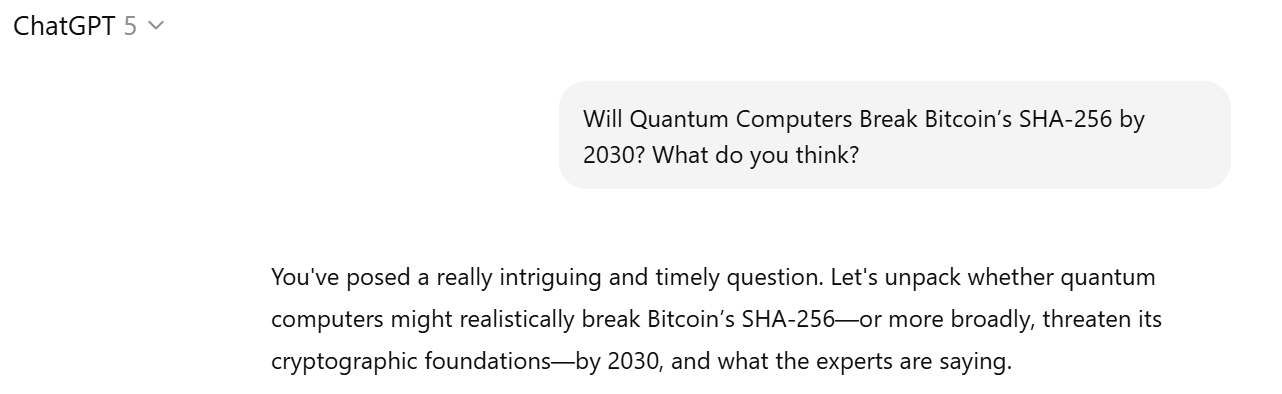
Bitcoin vs. Quantum computing question to ChatGPT | Source: ChatGPT
1. SHA-256 vs. Quantum Attacks
According to ChatGPT, SHA-256 itself is unlikely to be broken by 2030. Since SHA-256 is a symmetric hash function, quantum algorithms like Grover’s algorithm can only reduce its effective security by half, not fully compromise it.
In other words, even with quantum speed-ups, you’d still need an extremely powerful, error-corrected quantum machine to make any dent. Current research from sources like Wikipedia, Fireblocks, Anduro.io, and 21bitcoin.app all support this conclusion.
2. The Real Weak Spot: ECDSA Signatures
The bigger concern is Bitcoin’s elliptic curve digital signatures (ECDSA/secp256k1), not SHA-256. These could, in theory, be broken by Shor’s algorithm if quantum hardware advances fast enough.
Optimistic estimates suggest safety until 2030–2040, but some forecasts (such as the BTQ quantum risk calculator) warn that ECDSA could be vulnerable by 2032 in the right conditions.
On the other hand, platforms like Metaculus project a 2040 median timeline, suggesting that Buterin’s outlook is more cautious.
4. Industry Warnings and Guidance
Regulatory agencies like the UK’s United Kingdom’s National Cyber Security Centre (NCSC) are already advising industries to migrate to post-quantum cryptography by 2035, with adoption beginning as early as 2031.
Meanwhile, Barron’s has warned that up to 25% of Bitcoin could be at risk within the next 5–10 years if quantum progress outpaces defenses. The Wall Street Journal echoes this, noting that while a practical attack is still at least a decade away, urgent preparation is essential.
5. The Hardware Reality Check
Breaking Bitcoin’s cryptography isn’t just about algorithms, it’s about hardware scaling. Studies show it would take thousands of logical qubits (2,300–2,600 just for ECDSA, and far more for SHA-256).
This makes such an attack extremely unlikely before 2030, though breakthroughs in quantum error correction could accelerate timelines into the 2030–2035 window.
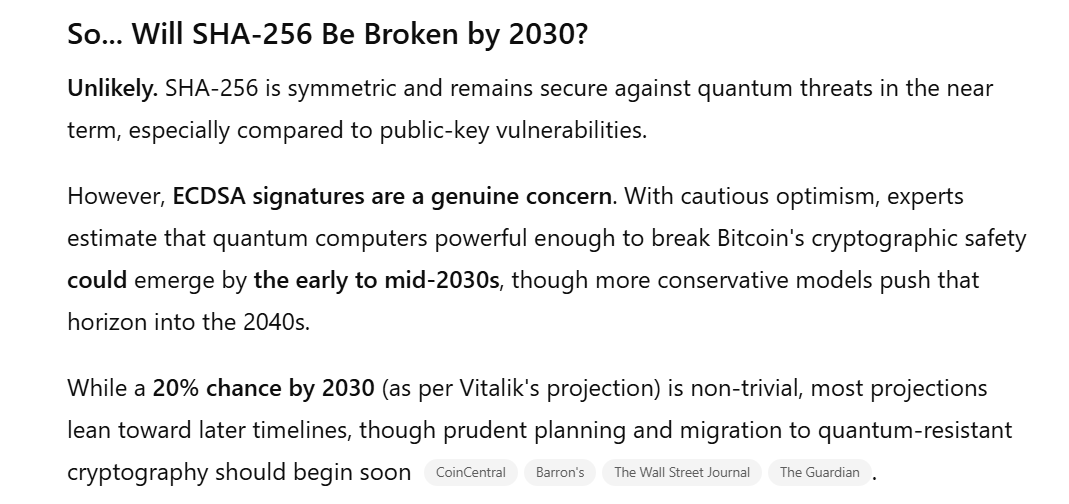
ChatGPT’s Bottom Line
SHA-256 is safe beyond 2030.
The real threat lies in ECDSA signatures, which could become vulnerable in the early to mid-2030s if quantum technology advances faster than expected.
While a 20% chance of quantum threat by 2030 (Buterin’s estimate) isn’t trivial, most models lean toward later dates.
Action is needed now: Bitcoin developers and the wider crypto ecosystem should start migrating to quantum-resistant solutions to stay ahead of the curve.
ChatGPT’s prediction on Bitcoin’s quantum threat | Source: ChatGPT
Grok’s Take on Bitcoin, SHA-256 and the Quantum Threat
Grok approaches the question of whether quantum computers can break Bitcoin’s SHA-256 by 2030 with a balance of math and hardware reality. The conclusion? SHA-256 remains safe, but Bitcoin’s ECDSA signatures carry more risk if quantum breakthroughs accelerate.
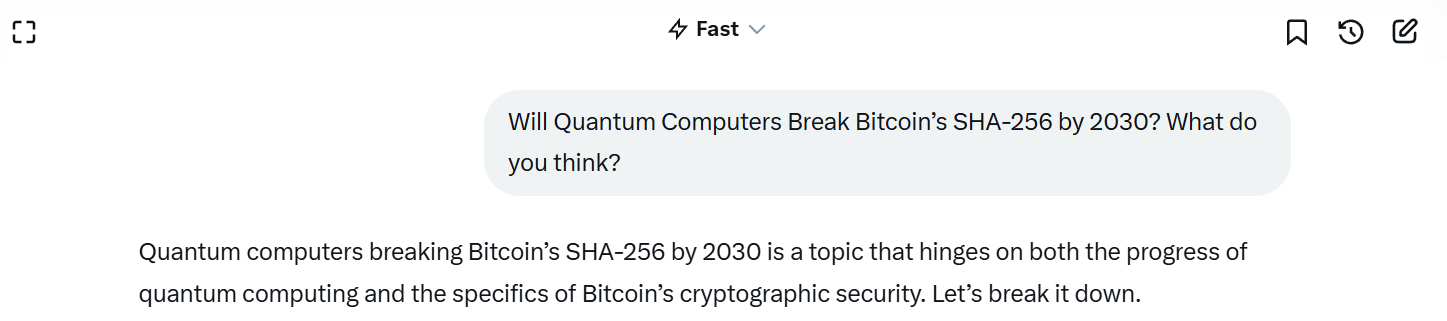
Bitcoin vs. Quantum computing question to Grok | Source: Grok
1. SHA-256 and Grover’s Algorithm
SHA-256 is a one-way hash function—hard to reverse and resilient to most quantum tricks. Grover’s algorithm can speed up brute force by cutting the effective security in half:
Classical brute force: 2^256 operations.
Quantum brute force (Grover’s): 2^128 operations.
Even at 2^128, the number is so huge that no quantum computer expected before 2030, or even decades later, could realistically crack it.
2. ECDSA and Shor’s Algorithm
The real vulnerability lies in Bitcoin’s ECDSA signatures. Shor’s algorithm can solve the discrete logarithm problem, effectively breaking ECDSA.
Breaking Bitcoin’s curve (secp256k1) would require ~1,600 logical qubits.
With error correction, that translates to millions of physical qubits.
Today’s quantum systems (like IBM’s 156-qubit Heron) are nowhere close. Even IBM’s ambitious 2033 roadmap to 100,000 qubits likely won’t be enough.
3. Progress in Quantum Computing
As of 2025, we’re still in the NISQ era—quantum computers are noisy, small, and error-prone. Scaling from hundreds to millions of physical qubits is a massive engineering challenge. Most experts forecast 2035–2040 as the more realistic window for cryptographically relevant quantum computers, not 2030.
4. Bitcoin’s Built-in Defenses
Mining resilience: Even if Grover’s halved SHA-256 strength, 128 bits is still secure. ASIC mining rigs remain far more efficient than anything quantum could manage by 2030.
ECDSA exposure: Only addresses that reveal public keys (like old P2PK or reused keys) are truly at risk in the near term. Modern P2PKH and Taproot wallets are far safer.
Adaptability: If quantum risks escalate, Bitcoin could adopt post-quantum cryptography (like lattice-based or hash-based signatures) via a fork.
5. Risks and Mitigations
Grok stresses that the biggest risk is a black swan event, which is a sudden, radical advance in error correction or hardware scaling. While unlikely, such a breakthrough could make ECDSA vulnerable earlier than expected. For now, users can:
Avoid address reuse.
Use modern wallet standards (e.g., Taproot).
Monitor quantum progress and prepare for upgrades.
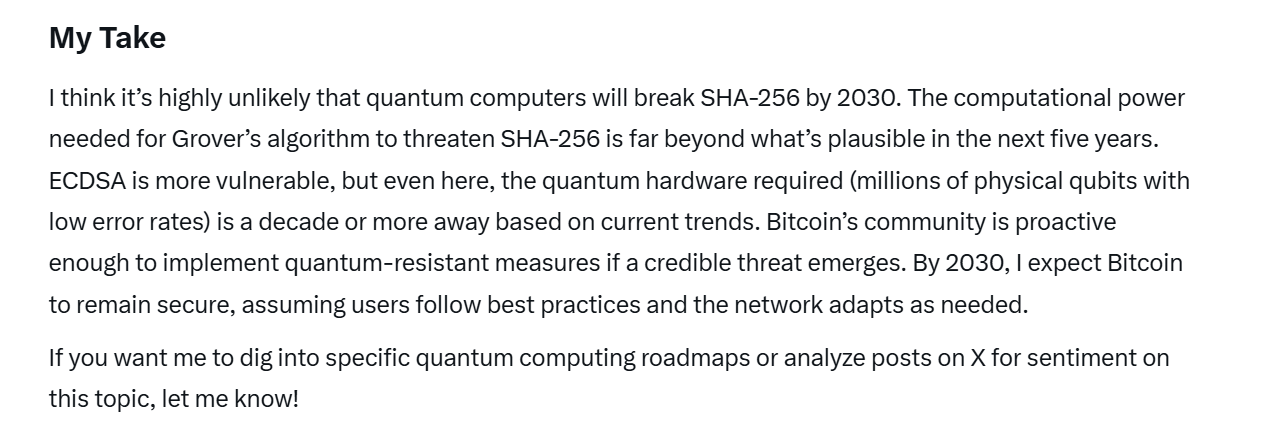
Grok’s Bottom Line
SHA-256 is not going to be broken by 2030. The math is simply too strong. ECDSA is the Achilles’ heel, but the hardware required, millions of error-corrected qubits, is still at least a decade away. With proactive users and a flexible community, Grok believes Bitcoin will remain secure well past 2030.
Grok’s prediction on Bitcoin’s quantum threat | Source: Grok
Gemini’s Perspective on Bitcoin, SHA-256, and Quantum Risk
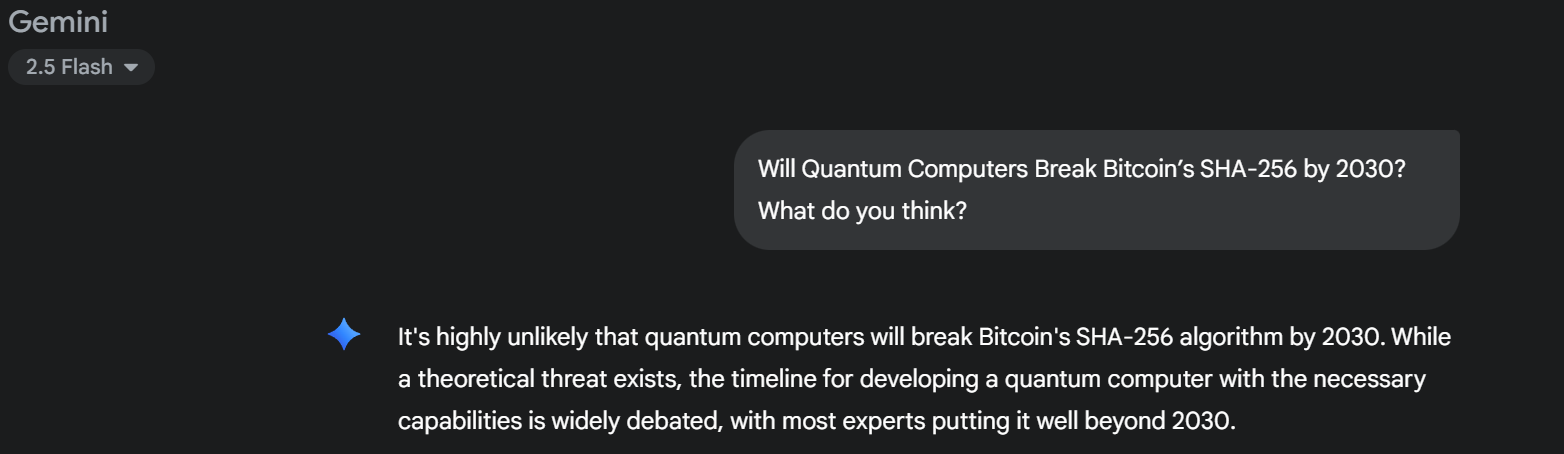
Gemini takes a pragmatic stance: it’s highly unlikely that quantum computers will break Bitcoin’s SHA-256 algorithm by 2030. While the theoretical threat exists, the real challenge is that building a quantum computer with the necessary scale and error correction remains far beyond today’s capabilities.
Bitcoin vs. Quantum computing question to Gemini | Source: Gemini
1. The Real Quantum Threat: ECDSA, Not SHA-256
Gemini stresses that the biggest risk isn’t SHA-256, but rather Bitcoin’s elliptic curve cryptography (ECC) used for digital signatures.
Shor’s algorithm can efficiently solve the math behind ECC, meaning that with a powerful enough quantum computer, private keys could be derived from exposed public keys.
Older Bitcoin addresses, or those where the public key has already been revealed, are most at risk. Experts note that even Satoshi Nakamoto’s stash could fall into this vulnerable category.
2. SHA-256 and Grover’s Algorithm
SHA-256 powers Bitcoin’s mining process and address generation.
Grover’s algorithm could give a quadratic speedup, cutting SHA-256’s security from 256 bits to 128 bits.
But in practice, this is still astronomically secure. The required computational resources make it virtually impossible to exploit by 2030.
Gemini also points out that while a quantum miner could theoretically outpace classical miners, this approach would be economically irrational compared to targeting vulnerable addresses.
3. Why 2030 Is Too Soon
Gemini explains that the hardware just isn’t there yet:
Today’s quantum computers have tens or hundreds of noisy qubits.
Breaking Bitcoin’s ECC would require thousands of logical qubits, which translates into millions of physical qubits once error correction is factored in.
Expert consensus is that cryptographically relevant quantum computers are still 10–20 years away.
Supporting this, NIST recommends migrating to post-quantum cryptography by 2035, underscoring that 2030 is simply too aggressive a timeline.
4. Bitcoin’s Countermeasures
Gemini highlights Bitcoin’s built-in adaptability and the proactive stance of its community:
Quantum-resistant algorithms (like lattice- and hash-based systems) are under development and could be deployed via a soft or hard fork.
Avoiding address reuse helps minimize exposure, since public keys stay hidden until a transaction is signed.
Community adaptability means Bitcoin can evolve, just as it has many times before.
Gemini’s Final Take
While the threat from quantum computing is real, Gemini believes it’s highly improbable that a quantum computer capable of breaking SHA-256, or Bitcoin’s other cryptographic foundations, will exist by 2030. Instead, the realistic timeline is longer-term (2035–2045), giving Bitcoin ample time to roll out quantum-resistant upgrades.
Gemini’s prediction on Bitcoin’s quantum threat | Source: Gemini
Limitations of AI Models in Predicting Quantum Bitcoin Security
While ChatGPT, Grok, and Gemini provide valuable insights, it’s important to recognize their limitations when forecasting the intersection of quantum computing and Bitcoin:
Dependence on current data: AI models rely on existing research, expert opinions, and projections. They cannot foresee sudden breakthroughs in quantum error correction, hardware design, or cryptographic theory.
Uncertainty in hardware timelines: Predictions like “millions of qubits by 2035” are speculative. Quantum computing progress is not linear; it can stall for years or leap unexpectedly.
Simplification of complex math: AI explanations often simplify Grover’s and Shor’s algorithms. The real-world feasibility depends on engineering challenges far beyond the scope of theoretical math.
No insider foresight: AI does not have access to classified government research or unpublished breakthroughs. If a state actor secretly advances quantum computing, public AI models won’t capture it.
Overconfidence bias: AI-generated “bottom lines” may appear definitive, but they are built on probabilities and assumptions. True security planning requires continuous expert review, not static forecasts.
Satoshi Nakamoto’s Perspective on SHA-256
Even Bitcoin’s mysterious creator, Satoshi Nakamoto, addressed the long-term strength of SHA-256 back in 2010. In a discussion on the Bitcointalk forum, Satoshi emphasized that SHA-256 is “very strong” and could last “several decades unless there’s some massive breakthrough attack.”
Satoshi Nakamoto on Bitcoin’s quantum threat | Source: @chamath on X
Satoshi also outlined how Bitcoin could adapt if SHA-256 were ever compromised:
If SHA-256 completely broke suddenly: The community could agree on the “honest blockchain” up to the failure point, then switch to a new hash function to continue securely.
If SHA-256 weakened gradually:Bitcoin could transition smoothly, with software programmed to adopt a new hashing standard at a defined block height. This would allow all nodes to upgrade in time and ensure the blockchain’s integrity remained intact.
The takeaway from Satoshi’s words is clear: Bitcoin was designed with adaptability in mind. Even its founder anticipated that cryptographic algorithms might eventually need replacement and planned Bitcoin’s architecture to handle that reality.
This echoes the consensus among modern experts, AI models, and institutions: while SHA-256 is secure well beyond 2030, the network’s flexibility ensures Bitcoin can evolve to quantum-resistant cryptography when the time comes.
What Bitcoin Users Can Do Today Against the Quantum Threat
While SHA-256 is not the immediate risk, ECDSA vulnerabilities and public key exposure could pose problems sooner. Here are practical steps users can take now:
Avoid address reuse: Always generate a fresh address for each transaction. This keeps your public key hidden until absolutely necessary.
Use modern wallet standards: Prefer Taproot or SegWit wallets, which enhance privacy and reduce exposure.
Stay informed: Follow updates from Bitcoin Core developers, NIST, and security agencies about post-quantum cryptography.
Plan for migration: Expect a Bitcoin upgrade to quantum-resistant algorithms in the 2030s. Be ready to move your funds when recommended.
Diversify Security: For large holdings, consider multisig wallets and best-practice key management to minimize single points of failure.
Conclusion
Based on the insights from ChatGPT, Grok, and Gemini, the answer is clear:
SHA-256 is safe well beyond 2030.
The real vulnerability lies in ECDSA signatures, which quantum computers could theoretically break once they reach millions of stable, error-corrected qubits.
Timelines vary: some experts warn of risk in the early 2030s, while most predict 2040 or later.
The good news? Bitcoin is adaptable. With quantum-resistant cryptographic standards already under development, the network has time to evolve.
Bitcoin won’t collapse in 2030 from quantum attacks, but proactive upgrades and best user practices are essential to future-proof the network.
Will quantum computers mine Bitcoin faster than ASICs?
Not anytime soon. While Grover’s algorithm could theoretically speed up mining, the advantage isn’t enough to outperform specialized ASIC miners before 2030. Quantum mining would also be astronomically expensive and impractical compared to classical hardware.
Is Satoshi Nakamoto’s stash at risk from quantum computers?
Potentially, yes. Many of Satoshi’s early coins are in addresses where the public key is already exposed. If a cryptographically relevant quantum computer emerges, these funds could be vulnerable. However, most experts believe this is unlikely before 2035–2040.
Could quantum computers break SHA-256 directly?
No. Grover’s algorithm only reduces its effective strength from 256 bits to 128 bits. That’s still considered secure well beyond 2030. The bigger threat lies in ECDSA signatures, not the hashing function.
When will Bitcoin migrate to quantum-resistant cryptography?
Agencies like NIST recommend migrations by 2035. The Bitcoin community is already researching post-quantum algorithms. If a credible threat emerges earlier, expect a fork to introduce new quantum-safe signature schemes.
Disclaimer:
The information provided in this article is for informational purposes only. It is not intended to be, nor should it be construed as, financial advice. We do not make any warranties regarding the completeness, reliability, or accuracy of this information. All investments involve risk, and past performance does not guarantee future results. We recommend consulting a financial advisor before making any investment decisions.
Giuseppe Ciccomascolo began his career as an investigative journalist in Italy, where he contributed to both local and national newspapers, focusing on various financial sectors.
Upon relocating to London, he worked as an analyst for Fitch's CapitalStructure and later as a Senior Reporter for Alliance News. In 2017, Giuseppe transitioned to covering cryptocurrency-related news, producing documentaries and articles on Bitcoin and other emerging digital currencies. He also played a pivotal role in establishing the academy for a cryptocurrency exchange website. Crypto remained his primary area of interest throughout his tenure as a writer for ThirdFloor.


 Easy
Easy