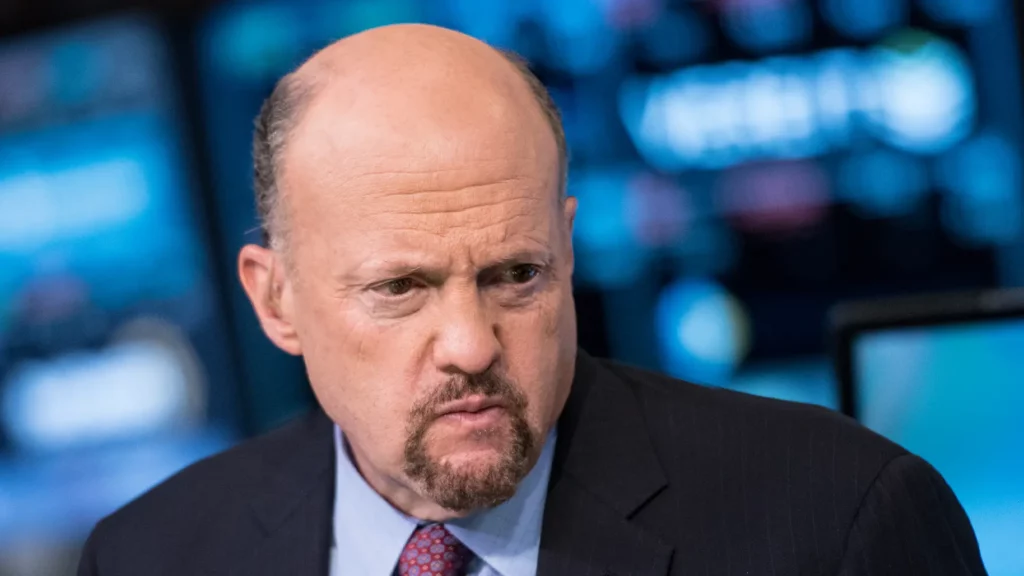
Jim Cramer admits his premonitions on BTC were a bit 'premature' | Credit: Getty Images
Share
Key Takeaways
Jim Cramer’s flip-flopping on crypto recommendations has led to the development of the “Inverse Cramer Signal.”
Cramer’s recent misjudgment of Bitcoin has further fueled the “Cramer Effect.”
The “Cramer Effect” is not always reliable, but it has proven to be profitable in some cases.
The Inverse Cramer Signal, a phenomenon frequently utilized, involves buying stocks that TV host Jim Cramer has suggested are likely to decline.
This time, Cramer put all his cons on Bitcoin – and was wrong – again. However, he did admit his premonitions were a little bit “premature.”
Jim Cramer Admits Misjudgment of Bitcoin
Markets commentator Jim Cramer admitted to misjudging Bitcoin’s trajectory, acknowledging that his previous advice to sell the cryptocurrency was premature. In a recent CNBC Mad Money segment, Cramer responded to a caller’s query about investing in Bitcoin miner CleanSpark by encouraging those optimistic about Bitcoin to increase their holdings.
“Look, if you like Bitcoin, buy Bitcoin. That has always been my view. And for a while, I liked it, and I decided that money had been made, but I was premature,” Cramer said.
Cramer further mentioned that although his past calls on Bitcoin may not have been flawless, he emphasized that he had still generated significant profits from his investment in the cryptocurrency.
On December 5, 2022, when Bitcoin was priced at $17,150, Jim Cramer advised investors to liquidate all their crypto holdings. He argued that it was “never too late to sell an awful position.” Since then, Bitcoin has surged by 118%, with the current BTC price at $37,390.
‘Cramer Effect’ Gains Traction
Cramer’s predictions, coupled with his fluctuating relationship with crypto, have turned into a well-known meme within investment circles in recent years. Many highlight his seemingly inconsistent ability to make accurate calls during critical moments.
In August 2022, a crypto trader claimed to have doubled the size of their portfolio by simply trading in the opposite direction of Cramer’s recommendations.
Officially doubled the inverse @jimcramer account, for those who are not aware i started the account with 50k
Two months later, on October 6, an investment fund filed for an “inverse Cramer ETF,” a financial instrument designed to yield results opposite to the investments recommended by Jim Cramer, before fees and expenses.
Cramer’s track record with crypto has led many investors to believe that the opposite of his recommendations may be more profitable. This phenomenon has been dubbed the “Cramer Effect.“
While the “Cramer Effect” is not always reliable, it has proven to be profitable in some cases. Investors who are considering trading crypto may want to keep an eye on Cramer’s recommendations, but they should also be aware of the potential for the “Cramer Effect” to work against them.
Cramer’s Cryptic Conundrum: A History of Flip-Flopping on Crypto
Cramer’s fluctuating relationship with crypto began in 2017 when he called Bitcoin a “bubble” and warned investors to stay away from it. However, he later changed his tune and began recommending crypto to his viewers.
In 2021, Cramer once again warned investors about crypto, saying that it was “too late” to get in. However, he once again reversed his position in 2022, saying that crypto was a “buy.”
Cramer’s inconsistent recommendations have led to confusion among investors. Many are unsure whether to trust his advice, especially when it comes to crypto.
Finally happened: Cramer ETFs
Inverse Cramer ETF $SJIM Long Cramer ETF $LJIM Eff Dec 19
20-25 equal-weighted stocks/ETFs based on Cramer's Twitter & TV recommendations and market views. Positions exited if Cramer has no view & once profit targets met.https://t.co/ZvA5G2zoTXpic.twitter.com/tY9yBMt15s
Teuta is a seasoned writer and editor with more than 15 years of experience. She has expertise in covering macroeconomics and technology as well as the cryptocurrency and blockchain industries. She has worked for several publications as a journalist and editor, including Forbes, Bloomberg, CoinTelegraph, Coin Rivet, CoinSpeaker, VRWorld and Arcane Bear.
Teuta began her professional career in 2005, working as a lifestyle writer at Cosmopolitan in Croatia. From there, she branched out to several other publications, covering mainly business and the economy. She then turned her attention to the world of cryptocurrency and blockchain, believing that crypto is among the most important inventions in the history of humanity. Her involvement in fintech began in 2014 and she has since lent her expertise in writing, editing and gathering information about the world of crypto, blockchain, NFTs and Web3.
An all-round news hound, mentor, editor, and writer, Teuta enjoys teamwork and good communication. She holds a WSET2 diploma and has a thing for chablis, punkrock music and shoes. She also holds a double MA in Political science and Entrepreneurship.