“Last chance” headlines can push rushed decisions.
Liquidity and steady demand help, but dips can still happen.
A plan (DCA, sizing, security) matters more than perfect timing.
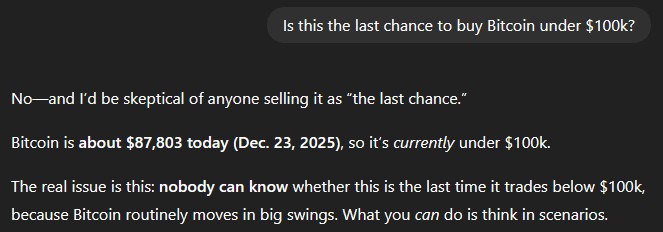
As of the Christmas Eve in 2025, Bitcoin is trading around the $90,000 mark. This puts it well below the psychological $100,000 line, which is why you may be seeing “last chance” framing around the internet.
But considering Bitcoin regularly swings between 20%-50% in either direction at any given point, “last chance” might not be the best way to think about a buy decision. The more productive question to consider is:
What would need to happen for Bitcoin to stay above $100k for a long time, and what could pull it back under?
Let’s break it down.
Why Bitcoin Price at $100,000 Feels Like the Line in the Sand
Humans love round numbers. Traders do too. $100k is a prime example because it:
Makes for an easy headline.
Creates a simple “goal line” for buyers and a “danger line” for sellers.
Can attract heavy trading near the level, which can increase volatility.
One can consider Bitcoin’s current price structure to be fragile, meaning many who bought at a higher rate may sell to cut their losses. This isn’t necessarily bullish or bearish. It’s a warning that reclaiming $100k and staying there may take time and repeated attempts. It won’t happen in a clean breakout.
Source: ChatGPT
Instead, ChatGPT treats Bitcoin like a scenario market, not a “one headline, one outcome” market.
New Trending Crypto Wallet Offers
Sponsored
Disclosure
We sometimes use affiliate links in our content, when clicking on those we might receive a commission at no extra cost to you. By using this website you agree to our terms and conditions and privacy policy.
What Would Make This Christmas Actually The “Last Chance” to Buy Bitcoin Under $100k?
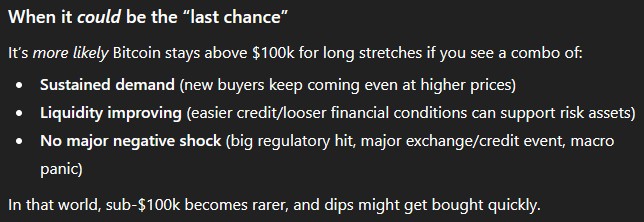
For Bitcoin to move above $100k and not look back, you’d likely need a mix of these factors:
Sustained Liquidity
Risky assets like Bitcoin tend to do better when money is cheaper, and investors feel empowered to take risks.
In December 2025, the Federal Reserve cut rates while central banks around the world did the same.
Think of it like this:
When money is expensive, people act cautiously.
When money is cheaper, people are braver.
This doesn’t mean Bitcoin will always go up, as a rate cut does not mean an automatic bull run, but it means that the situation can improve.
Strong Demand That Lasts
To hold above $100k, Bitcoin needs steady buyers, not just a quick rush of money.
One reason this topic keeps coming up is exchange-traded funds (ETFs). In the US, the Securities and Exchange Commission (SEC) approved the listing and trading of spot Bitcoin exchange-traded products (ETPs) in January 2024.
Put simply, ETFs allow people to buy Bitcoin exposure inside their regular brokerage accounts, without holding Bitcoin directly. This can help demand, but keep in mind that ETF interest can rise and fall like everything else.
Fewer Panic Sellers
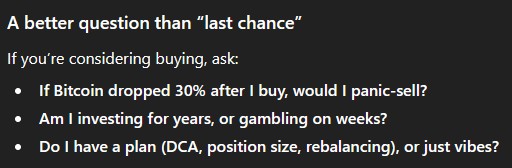
If fewer people feel “forced” to sell due to volatility, Bitcoin can hold higher levels more easily. That’s one reason investors might practice dollar-cost averaging (DCA) as a way to invest in steps instead of through one big buy. It can lower the chances of you buying the top by accident.
Basically, if these foundations grow, you’re much less likely to see under $100k again. That said, dips can always happen, so be wary.
Source: ChatGPT
What Could Keep Bitcoin Under $100k?
For Bitcoin to remain under $100k long-term, the following may be true:
The Market Runs out of Buyers
Sometimes the price drops for a boring reason: not enough buyers. If whales decide to sell and no one steps in to buy the dip, the price can drop even further.
A Sudden Risk-Off Shock
A risk-off shock is when investors get scared fast. When this happens, they sell risky investments first.
This can occur during:
Bad inflation news.
A surprise policy move.
A major company blowup.
A big leverage wipeout.
Bitcoin can also crash hard during normal market cycles, even if a total market collapse looks unlikely.
This is a big one. A lot of last-chance talk is just marketing. It’s headlines creating urgency to make you act before you think. If you buy or sell because you feel rushed into it, you might:
Make too big of a buy or sell investment.
Buy or sell at a bad time.
Panic buy or sell later to rectify your mistake.
What ChatGPT Thinks: 3 Realistic Paths From Here
GPT predicts three paths that may happen in real markets.
Path A: Sideways Chop
Bitcoin moves up and down in a range for weeks or months. It tests $100k, fails, dips, then tries again.
In this world, prices just under $100k will keep showing up, even if Bitcoin occasionally moves above it.
Path B: Breakout and Hold
Bitcoin breaks above $100k and holds there because:
Money is easier to acquire.
Buyers remain active.
Sellers don’t overtake the positive move.
This is the “last chance” dream. It can happen, but it needs follow-through, not just headlines pushing a narrative.
Path C: Bigger Dip First
Bitcoin drops again because:
Demand dries up.
Fear rises.
Leverage drops.
In this world, you get plenty of chances to buy under $100k, but most people are too scared to get involved.
Is this really the last chance to buy under $100K?
It might be, but you should never assume this. Bitcoin often revisits big psychological levels many times.
Why do people focus so much on $100K?
Because round numbers shape behavior. Traders place buys and sells around them.
Do rate cuts guarantee Bitcoin goes up?
No. Rate cuts can help, but the details matter, and markets can still turn risk-off.
Do ETFs mean Bitcoin will keep rising?
No. ETFs can support demand, but they don’t stop Bitcoin from dropping. The SEC approval mainly made access easier for some investors.
Disclaimer:
The information provided in this article is for informational purposes only. It is not intended to be, nor should it be construed as, financial advice. We do not make any warranties regarding the completeness, reliability, or accuracy of this information. All investments involve risk, and past performance does not guarantee future results. We recommend consulting a financial advisor before making any investment decisions.
Max Moeller is a Chicago‑based writer and video editor passionate about games, tech, and crypto. Whether it’s crafting clear, insightful articles or piecing together engaging video retrospectives, he’s driven by curiosity and takes pride in keeping things human. Since 2017, Max has been published in a variety of notable crypto magazines.


 Easy
Easy