We Asked ChatGPT If Bitcoin Could Collapse — The Answer Isn’t What Bulls Or Bears Want To Hear
Share
Key Takeaways
A major price crash remains possible, as Bitcoin has historically suffered deep drawdowns during volatile market cycles.
A total collapse appears unlikely because the network, miners, liquidity, and infrastructure remain operational and resilient.
Regulation may pressure prices and slow adoption, but no coordinated global effort exists to eliminate Bitcoin.
The greatest risk comes from sentiment and liquidity shifts, where leverage and narratives can trigger sudden repricing.
Bitcoin has survived for more than 15 years, endured multiple boom-and-bust cycles, and repeatedly defied predictions of its demise. But with volatility still defining crypto markets and sentiment able to flip overnight, the question keeps coming back: could Bitcoin collapse?
CCN asked ChatGPT to assess the risk based on current market conditions as of Dec. 18, 2025, the answer is blunt, but not alarmist.
Could Bitcoin collapse?. | Source: ChatGPT
What Does “Collapse” Really Mean?
The most important clarification is semantic. A collapse can mean very different things:
Only the first is clearly plausible under current conditions.
Bitcoin Has Crashed Before — And It Can Happen Again
Bitcoin’s history is marked by extreme drawdowns. In multiple cycles, BTC has lost 70% or more of its value from peak to trough. Those crashes were driven by combinations of macro tightening, leverage unwinds, regulatory shocks, and collapsing sentiment.
That precedent matters. Even today, Bitcoin remains a high-volatility asset that reacts strongly to liquidity conditions, risk appetite, and narrative shifts. A deep drawdown would not be unprecedented, nor would it require a single catastrophic event.
In other words, a major price decline is always on the table.
Why A Zero-Value Bitcoin Collapse Looks Unlikely
Where the answer turns “brutal” is in rejecting the more dramatic version of collapse.
As of now, there is no credible evidence that Bitcoin is on the verge of disappearing or becoming worthless:
The Bitcoin network continues to operate without interruption, secured by a global, decentralized mining base.
The protocol itself has not shown signs of existential failure or unresolved critical vulnerabilities.
Bitcoin still has deep global liquidity, active derivatives markets, custody infrastructure, and integration into traditional financial rails.
For Bitcoin to collapse to zero, it would require a near-total loss of users, miners, developers, and market access, something that would almost certainly be visible well in advance. That signal is not present today.
Regulation Remains A Risk, Not An Extinction Event
Regulatory pressure remains one of Bitcoin’s most cited threats. And it matters. Policy decisions can affect access, liquidity, and institutional participation.
However, current regulatory trends are fragmented, not universally hostile. While some jurisdictions tighten oversight, others pursue formal frameworks rather than outright bans. There is no coordinated global effort underway to eliminate Bitcoin outright.
Regulation can hurt prices. It can slow adoption. But under present conditions, it does not point to systemic collapse.
Liquidity And Sentiment Are The Real Pressure Points
The more realistic danger lies in market structure, not technology.
Bitcoin is increasingly sensitive to:
Global liquidity cycles
Risk-on vs. risk-off sentiment
Leverage build-ups and unwinds
These forces can amplify moves in both directions. When sentiment turns, it often turns fast. Liquidity can dry up quickly, and narratives can reverse in days, not years.
That makes Bitcoin vulnerable to sudden, violent repricings, even if the long-term network remains intact.
What Proponents and Critics Say About a Potential Bitcoin Collapse
Critics Warn Bitcoin Could Ultimately Fail
A number of prominent economists and financial thinkers argue that Bitcoin’s price could ultimately collapse or even go to zero over the long term. Nobel laureate Eugene Fama has publicly stated that Bitcoin’s extreme volatility, lack of intrinsic value, and failure to meet basic monetary criteria could make it fundamentally unsustainable, suggesting a “close to 100%” chance it becomes worthless within the next decade.
Other high-profile skeptics, such as economist Peter Schiff, describe Bitcoin as more akin to speculative bubbles (like tulip mania) than a reliable store of value, and contend that its appeal as a hedge or safe haven is unproven in real markets.
Proponents Emphasize Resilience and Structural Demand
Supporters of Bitcoin counter that repeated predictions of collapse have historically been proven wrong, pointing to decades-long price appreciation and ongoing adoption by institutional and retail users. Analysts note Bitcoin’s massive cumulative gains over the past decade as evidence that critics have repeatedly underestimated its resilience.
Advocates also argue that Bitcoin’s decentralized design, scarcity, and resistance to censorship make it robust against catastrophic failure, even if price volatility is high, and that dramatic downcycles are part of its normal risk-return profile rather than evidence of imminent structural collapse.
In short, critics highlight theoretical and economic objections to Bitcoin’s long-term viability, while proponents point to historical performance and network fundamentals as evidence of endurance rather than an impending collapse.
Bitcoin’s Future Is Not Binary
The final takeaway is uncomfortable for both maximalists and critics: Bitcoin’s future is not binary.
A “collapse” does not have to mean zero. It could also mean:
Years of underperformance
Shrinking relevance compared with other financial assets
Remaining a niche or regional store of value rather than a global one
Those outcomes are harder to dramatize, but far more realistic than a sudden disappearance.
The bottom line
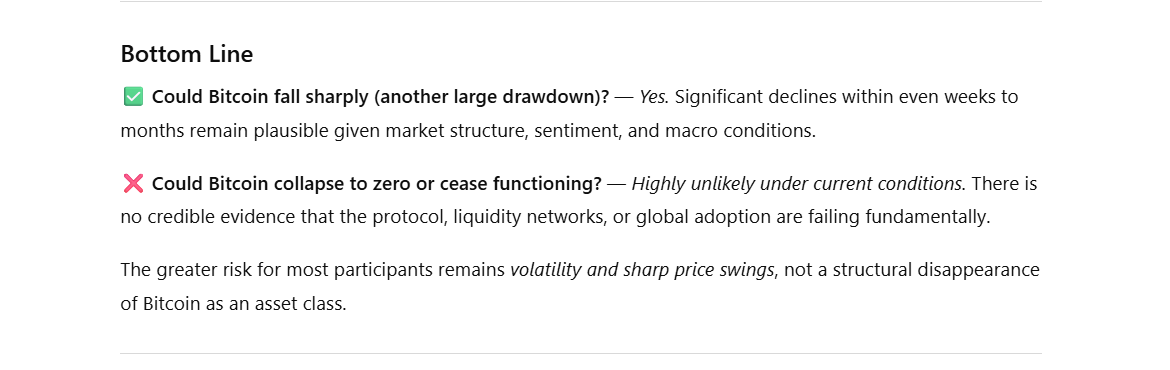
So, could Bitcoin collapse?
Could it crash hard? Yes. History says it can, and will, again.
Could it vanish or break entirely? Under current conditions, that outcome looks highly unlikely.
ChatGPT’s take on Bitcoin’s collapse. | Source: ChatGPT
The brutal truth is this: Bitcoin’s biggest risk is not death, but volatility and market manipulation. And as always in crypto, sentiment, not code, can change faster than most participants expect.
For investors and observers alike, that distinction matters.
Disclaimer:
The information provided in this article is for informational purposes only. It is not intended to be, nor should it be construed as, financial advice. We do not make any warranties regarding the completeness, reliability, or accuracy of this information. All investments involve risk, and past performance does not guarantee future results. We recommend consulting a financial advisor before making any investment decisions.
Onkar Singh has three years of experience as a digital finance content creator. Throughout his career, he has collaborated with various DeFi projects and crypto media outlets. In his leisure time, he enjoys fitness activities at the gym and watching movies across different genres. Balancing his professional and personal interests, Onkar continues to contribute to the digital finance landscape while pursuing his hobbies.


 Easy
Easy