Learn how to invest in the new Solana ETFs SOLC and FSOL. This complete 2025 guide covers fees, staking rewards, brokers, taxes, and key differences. | Credit: CCN.
Share
Key Takeaways
SOLC and FSOL offer exposure to Solana through traditional brokerage accounts, eliminating the need for wallets, exchanges, or private keys.
Each ETF incorporates Solana staking, allowing shareholders to receive staking-linked rewards through a regulated investment structure.
SOLC applies an estimated 0.50% management fee plus staking-related deductions, while FSOL uses a fee-waiver period followed by a 0.25% fee and a staking reward fee.
Investors may encounter different access rules, tax classifications, and reporting requirements depending on their country and brokerage platform.
The launch of new Solana (SOL) exchange-traded funds (ETFs) has created significant excitement across both the crypto and traditional finance worlds. Two of the most recent releases, SOLC by Canary Capital and FSOL by Fidelity Investments, offer investors an easier way to gain exposure to Solana without needing to directly buy, store, or manage cryptocurrency.
In this guide, you’ll learn exactly how to invest in these new Solana ETFs, what makes each fund unique, and what beginners should know before buying.
What Are Solana ETFs and Why Are They Important?
A Solana ETF is a fund traded on a stock exchange that holds Solana (SOL) or Solana-related assets. Instead of buying Solana through a crypto exchange and managing a wallet, an ETF lets you invest through a traditional brokerage, just like buying a stock.
Why Solana ETFs Are a Big Deal
They reduce barriers to crypto investing
They allow institutional money to enter the Solana market
They add regulatory clarity and investor protection
They bring staking rewards (depending on the fund) into a traditional financial wrapper
With the launch of SOLC and FSOL, investors finally have regulated, accessible methods to gain exposure to Solana through the stock market.
Overview of the Two New Solana ETFs (SOLC and FSOL)
SOLC – Canary Marinade Solana ETF
The SOLC ETF from Canary Capital provides spot exposure to Solana and integrates staking rewards through a partnership with Marinade Finance, one of the largest Solana staking protocols.
Solana ETF flow in USD. | Credit: CryptoCurb
Key features include:
Direct exposure to SOL
Staking rewards distribution
Professional custody and secure staking management
A higher-risk, higher-yield structure
FSOL – Fidelity Spot Solana ETF
The FSOL ETF by Fidelity Investments is another spot Solana fund that also incorporates staking benefits. Coming from a major asset manager, FSOL offers:
Institutional-grade custody and security
Competitive fees
Staking participation with rewards
Strong regulatory compliance
Fidelity Solana ETF details. | Credit: Eric Balchunas X profile
FSOL is expected to become the mainstream choice due to Fidelity’s brand trust and track record.
Features
SOLC (Canary Capital)
FSOL (Fidelity Investments)
Ticker
SOLC
FSOL
Issuer
Canary Capital
Fidelity Investments
Underlying asset
Spot exposure to Solana (SOL)
Spot exposure to Solana (SOL)
Staking mechanism
Uses Marinade Finance for staking via its network
Will stake up to 100% of SOL holdings via custodians and validators
Fee structure
Management fee 0.50% per year (approx) + staking-related deductions
Fee waived initially; afterwards 0.25% per year + 15% of staking rewards
Custody and infrastructure
Built with BitGo infrastructure + Marinade Select protocol
Institutional custody via Fidelity’s infrastructure
Launch date
November 18, 2025
November 18, 2025
Regulatory structure
Exchange-traded product (ETP) not under 1940 Act standard ETF registration
Exchange-traded product with full institutional backing
Investor accessibility
Trades on NASDAQ (or similar U.S. exchange)
Trades on NYSE Arca (U.S. exchange)
How to Buy Solana ETFs SOLC and FSOL Through Your Brokerage Account
This section offers a detailed, SEO-optimized explanation for beginners: how to buy Solana ETFs such as SOLC and FSOL.
1. Make Sure the ETFs Are Available on Your Brokerage
Because some platforms take longer to list new ETFs, availability may differ by region.
2. Search for the ETF Ticker Symbol
Once your brokerage supports the fund, type the ticker into the search bar:
SOLC → Canary Marinade Solana ETF
FSOL → Fidelity Spot Solana ETF
This will pull up the fund profile, performance chart, fee information, and purchase options.
3. Understand the Fee Structure and Staking Rewards
Fees are an important part of evaluating any ETF, especially those designed for long-term exposure. SOLC and FSOL have different approaches to management fees, staking participation, and operational costs.
SOLC (Canary Capital) Fees
Management fee: Approximately 0.50% per year
Staking-related deductions: The fund stakes Solana through Marinade Finance, and a portion of staking rewards is distributed to shareholders after internal deductions
Operational expenses: Additional fund-level costs apply, though published details may vary
Staking rewards: Investors receive a share of staking yield generated by the fund’s Solana holdings
Standard management fee (after waiver): 0.25% per year
Staking reward fee: Once the waiver period ends, Fidelity applies a 15% fee on staking rewards earned by the fund
Custodial and operational framework: Managed under Fidelity’s institutional infrastructure, which includes security, staking arrangements, and administration
4. Choose How Much You Want to Invest
Decide whether you want to buy:
Full shares
Fractional shares (depending on broker)
A fixed amount (e.g., $50 / £50)
A recurring investment (e.g., weekly or monthly)
Because crypto-based assets can be volatile, beginners often start small.
5. Choose Your Order Type
Most brokerages offer different order types:
Market order: Executes instantly at the current market price. Ideal for beginners or anyone who wants quick, immediate entry.
Limit order: Executes only when the ETF reaches a specific price you set. Ideal for conservative investors and those who want precise price control.
Stop-loss / take-profit order: Automatically buys or sells when your preset price is hit. Ideal for managing volatility and protecting your investment.
6. Confirm the Purchase and Monitor Your Investment
Once the order fills, you officially own shares of the ETF.
From here, monitor:
NAV (net asset value) vs market price
Solana (SOL) price movements
Fund performance
Staking yield updates
Fee structure changes
Unlike buying crypto directly, you don’t need to manage wallets, private keys, or staking setups.
Which Solana ETF Should You Buy? SOLC vs FSOL
Both funds provide exposure to Solana, but they are structured differently and may appeal to different preferences.
SOLC (Canary Capital) – Features
SOLC includes:
Participation in Solana staking via Marinade Finance
The potential for staking-related yield
A structure closely tied to the Solana ecosystem
A more crypto-native design
These characteristics may appeal to investors who prioritize staking integration and ecosystem alignment.
FSOL (Fidelity) – Features
FSOL includes:
Management by a large, well-established asset manager
Institutional-grade custodial infrastructure
A framework that may be viewed as more traditional
A structure designed with broad market accessibility in mind
These features may appeal to investors who prefer established institutions and a more conventional ETF experience.
Some investors may choose one fund or the other based on these structural differences, while others may hold both depending on their portfolio approach.
Is Investing in a Solana ETF Right for Beginners?
Solana ETFs can simplify access to the Solana ecosystem by removing the need to:
Buy SOL directly
Create or manage a crypto wallet
Handle private keys
Set up staking manually
Use cryptocurrency exchanges
At the same time, it’s important to understand that Solana ETFs come with notable risks, including:
High volatility in the broader crypto market
Risks associated with staking mechanisms
Evolving regulatory environments
Exposure to a single underlying asset
Beginners often evaluate these advantages and risks carefully to determine whether this type of investment aligns with their goals, risk tolerance, and overall strategy.
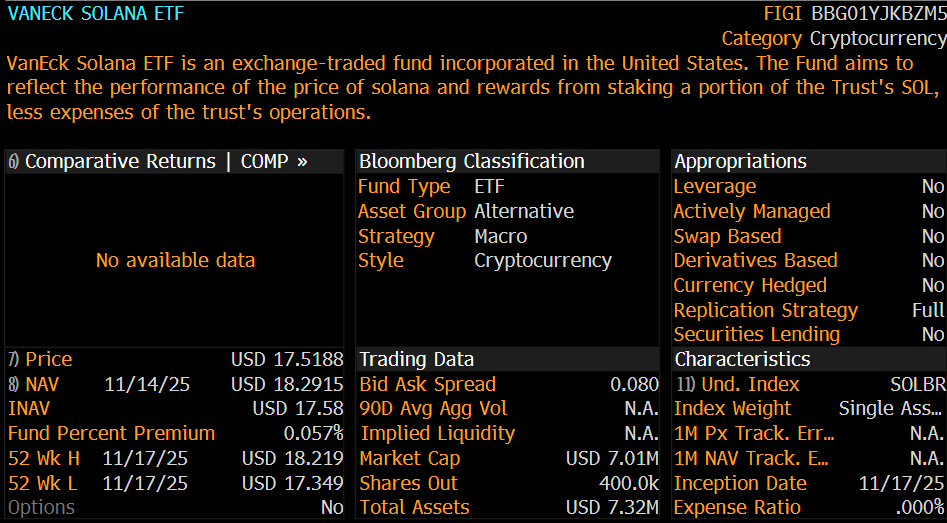
VanEck Solana ETF details. | Credit: James Seyffart X profile
Pros and Cons of Investing in Solana ETFs
Pros
Easy to access through traditional brokerage accounts
Some funds incorporate staking rewards (such as SOLC and FSOL)
No need for a crypto wallet or technical setup
Operate within a regulated investment framework
Provide institutional-grade custody and security
Cons
Fees can be higher compared to holding SOL directly
Staking yields may vary over time
Subject to the high volatility of the crypto market
Availability may differ depending on region and brokerage
Tax Considerations When Investing in Solana ETFs (SOLC and FSOL)
Tax treatment is an important factor to consider when investing in Solana ETFs such as SOLC and FSOL. Because these products hold cryptocurrency and may include staking rewards, the tax rules can differ from those that apply to traditional equity ETFs.
1. Capital Gains Tax on ETF Shares
In most regions, buying and selling ETF shares may trigger capital gains tax when:
You sell the shares at a profit
You switch between ETFs
You redeem or transfer your holdings
The tax rate depends on local regulations, holding period, and personal circumstances.
2. Staking Rewards May Be Taxable
Both SOLC and FSOL incorporate staking mechanisms.
When staking rewards are distributed by the fund, many jurisdictions treat them as:
Taxable income, or
Distributions that may increase your cost basis
The exact classification varies by country, and official treatment of staking rewards is still evolving in many regions.
Reporting requirements depending on account type (taxable account vs retirement account)
Solana ETFs are exchange-traded products (ETPs), not ’40 Act mutual funds, so they may not have the same tax efficiencies as equity ETFs.
5. Tax Treatment in the United Kingdom
UK investors may face:
Capital gains tax on disposals
Income tax on staking-related distributions
No automatic eligibility for ISAs or SIPPs (varies by broker and classification)
Some brokers restrict access to crypto-linked products for retail UK clients, so availability and tax treatment may differ.
6. Tax Treatment in Europe
EU rules vary widely, but common considerations include:
Capital gains tax at disposal
Income tax on staking-related distributions
Possible reporting obligations for foreign assets
Each country applies its own tax code to crypto-related products.
7. ETFs Held in Tax-Advantaged Accounts
Where permitted, holding Solana ETFs inside tax-advantaged accounts (such as U.S. IRAs or certain European wrappers) may alter:
Taxation of distributions
Tax reporting
Exposure to capital gains tax
Availability depends on local regulation and brokerage policy.
Increasing Solana (SOL) Exposure Through Regulated, Exchange-Listed Funds
The launch of SOLC by Canary Capital and FSOL by Fidelity represents a significant development for broader Solana accessibility. These funds provide a regulated, exchange-listed format through which investors can gain exposure to Solana, with both products incorporating staking mechanisms within their structures.
SOLC emphasizes deeper integration with the Solana ecosystem through its use of Marinade Finance for staking. FSOL, issued by Fidelity, reflects an approach backed by a large, established asset manager. Each fund is structured differently, and individuals may compare features such as staking design, issuer background, fees, and custodial frameworks when evaluating them.
Both ETFs make Solana exposure available through traditional brokerage platforms, reducing the need for direct interaction with crypto exchanges or wallet management.
Do Solana ETFs like SOLC and FSOL actually hold Solana (SOL)?
Yes. Both SOLC and FSOL are designed as spot Solana products, meaning they hold actual SOL rather than futures or synthetic exposure.
How do staking rewards work inside these ETFs?
The funds stake their Solana holdings through approved validators or platforms. Staking rewards are collected at the fund level, expenses are applied, and the remainder may be distributed to shareholders or reflected in NAV depending on the structure.
Can international investors buy these Solana ETFs?
Availability varies by country and brokerage. Some regions may restrict access to U.S.-listed crypto-linked products, while others list them normally. Investors should check their platform’s supported securities.
Are SOLC and FSOL considered traditional ETFs?
These products function similarly to ETFs but are classified as exchange-traded products (ETPs). They do not fall under the 1940 Act mutual fund structure and may have different regulatory characteristics.
Disclaimer:
The information provided in this article is for informational purposes only. It is not intended to be, nor should it be construed as, financial advice. We do not make any warranties regarding the completeness, reliability, or accuracy of this information. All investments involve risk, and past performance does not guarantee future results. We recommend consulting a financial advisor before making any investment decisions.
Dr. Guneet Kaur is a senior editor at CCN.com and a Science Fellow at Exponential Science. She is a fintech and blockchain expert with extensive experience in digital finance education, blockchain ecosystems, and cryptocurrency markets. She has worked with global media such as Cointelegraph, as well as education and blockchain platforms, to design and lead strategic content and learning initiatives. As an educator and assessor for top-tier executive programs, she bridges real-world fintech trends with academic insight.
Dr. Kaur is also a published researcher and peer reviewer across fintech and data science journals, including Financial Innovation Journal and International Journal of Big Data Intelligence and Applications. Her work spans data-driven analysis, Web3 innovation, and technical content development. With a strong foundation in both industry and academia, she translates complex financial technologies into practical applications, empowering learners, professionals, and institutions across the rapidly evolving digital finance landscape.
Giuseppe Ciccomascolo began his career as an investigative journalist in Italy, where he contributed to both local and national newspapers, focusing on various financial sectors.
Upon relocating to London, he worked as an analyst for Fitch's CapitalStructure and later as a Senior Reporter for Alliance News. In 2017, Giuseppe transitioned to covering cryptocurrency-related news, producing documentaries and articles on Bitcoin and other emerging digital currencies. He also played a pivotal role in establishing the academy for a cryptocurrency exchange website. Crypto remained his primary area of interest throughout his tenure as a writer for ThirdFloor.


 Easy
Easy