Solana (BSOL) vs. Litecoin (LTCC) ETFs: Which One Could Supercharge Your Crypto Portfolio?
Share
Key Takeaways
BSOL and LTCC mark the first-ever U.S. spot ETFs for Solana and Litecoin, expanding crypto access beyond Bitcoin and Ethereum.
BSOL offers staking rewards (7%) and lower fees, appealing to growth-focused investors in Solana’s ecosystem.
LTCC provides simple, secure exposure to Litecoin, ideal for long-term holders seeking a reliable, battle-tested asset.
These ETFs reflect rising demand for regulated crypto investment options, with more altcoin ETFs expected in the near future.
The crypto world has reached another milestone: Solana (SOL) and Litecoin (LTC) now each have their own U.S. spot exchange-traded fund (ETF).
Bitwise’s BSOL (Solana ETF) and Canary Capital’s LTCC (Litecoin ETF) both launched on Oct. 28, 2025, marking the first time American investors can buy funds tracking these altcoins just like any stock.
This is a major step forward for the growing crypto market, coming on the heels of the first Bitcoin and Ether spot ETFs approved in 2024.
If you’re a beginner curious about crypto or ETFs, don’t worry, this guide breaks down what these funds are, why Solana and Litecoin were chosen, and what it all means for you as an investor.
Why Are Solana and Litecoin Appealing for ETFs?
After Bitcoin and Ethereum, Solana and Litecoin emerged as logical next choices for standalone crypto ETFs. Both assets offer distinct advantages that make them appealing to fund issuers and investors:
Established market demand: Solana and Litecoin each have large investor communities and significant trading volume. Analysts had been predicting a high chance of approval for SOL and LTC ETFs even months before launch.
Diversification beyond Bitcoin/Ether: Investors were seeking ways to diversify into other top cryptos through traditional markets. Solana brings exposure to a fast-growing smart contract platform, while Litecoin offers exposure to a long-standing payment-focused coin. They represent two very different use cases.
Regulatory and structural fit: Litecoin, in particular, has a profile similar to Bitcoin (decentralized proof-of-work with no central issuer), which likely gave regulators comfort treating it as a commodity-like asset. Solana, being a major platform with a large market cap, also garnered multiple ETF filings indicating industry interest. Both assets could be custodied securely, addressing SEC concerns about safe storage and pricing data integrity.
Crypto market momentum: The successful launch of Bitcoin and Ether spot ETFs in 2024 opened the door for more. By late 2025 there were over 150 crypto ETF filings covering around 35 different cryptocurrencies. Solana and Litecoin were simply among the first of these “next wave” assets to get the green light, riding a broader momentum of crypto integration into traditional finance.
BSOL is the ticker for the Bitwise Solana Staking ETF. Launched on Oct. 28, 2025, BSOL began trading on the NYSE Arca exchange. Bitwise Asset Management, a leading crypto asset manager with over $15 billion in client assets, is the fund’s issuer.
Exposure: The fund provides 100% direct exposure to Solana (SOL), it holds actual SOL tokens in a trust. Uniquely, Bitwise stakes all the SOL holdings in-house to capture Solana’s staking rewards (around 7% annually) for the fund.
Launch and trading: BSOL went live on Oct. 28, 2025. In its first day, it saw strong interest, about $10 million in trading volume within the first half hour.
Management fee: Bitwise set a competitive expense ratio of 0.20%. As a promotional move, the fee is waived (0%) for the first three months on up to $1 billion in assets.
Fund strategy: The combination of spot SOL exposure and staking makes BSOL a novel product. Bitwise partnered with Helius (a top Solana staking tech provider) to run its own validators and stake the SOL securely. Any staking rewards accrued are reflected in the fund’s NAV.
Convenience: Like any ETF, BSOL can be bought through regular brokers, making Solana accessible to those who can’t or prefer not to hold crypto directly.
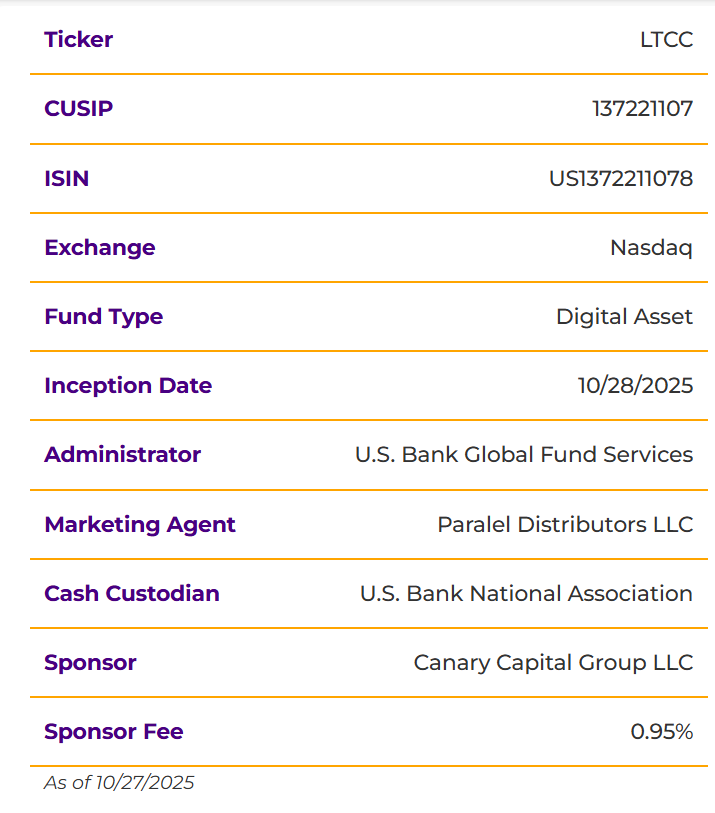
LTCC is the ticker for the Canary Litecoin ETF, which also debuted on Oct. 28, 2025. It trades on the Nasdaq exchange, making it the first U.S. spot Litecoin ETF to hit the market. Canary Capital, a crypto-focused asset manager, is the sponsor and issuer of LTCC.
Exposure: LTCC holds physical Litecoin (LTC) coins in custody to mirror Litecoin’s market price. The fund tracks LTC’s price by holding actual LTC tokens. Unlike BSOL, there is no staking component.
Launch and trading: LTCC began trading on Nasdaq on the same day as BSOL. Initial trading volume for LTCC was modest, about $400,000 in the first 30 minutes.
Management Fee: The LTCC fund carries an annual expense ratio of 0.95%. This is higher than BSOL but in line with other niche or commodity-based ETFs.
Custody and structure: Canary’s ETF uses custodians like Coinbase Custody Trust Co. and BitGo Trust Co. The fund’s NAV is calculated daily based on a pricing index.
Significance: The launch of LTCC marks a major milestone for Litecoin, a cryptocurrency with a 14-year track record of being secure and globally accessible. The ETF opens up LTC exposure to both institutions and individuals.
Bloomberg’s Eric Balchunas on the Strong Debut of the Bitwise Solana ETF ($BSOL)
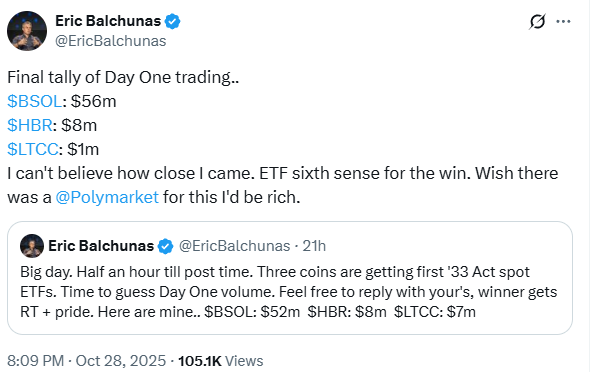
Bloomberg Senior ETF Analyst Eric Balchunas highlighted the impressive debut of the Bitwise Solana ETF ($BSOL), which recorded $56 million in first-day trading volume, the largest of any ETF launch this year.
Balchunas noted that BSOL’s performance outpaced other recent crypto ETF debuts, including $XRPR, $SSK, $IVES, and $BMNU. Remarkably, the fund was seeded with $220 million, and if that capital had been invested immediately on launch day, total assets could have reached around $280 million, surpassing even $ETHA’s debut figures.
He called it a “strong start either way,” underscoring the market’s enthusiasm for Solana exposure through a regulated ETF format.
Final day-one trading volumes:
$BSOL: $56 million
$HBR: $8 million
$LTCC: $1 million
Balchunas added humorously that his “ETF sixth sense” was spot-on this time, joking that if prediction markets like Polymarket covered ETF launches, he’d be “rich.”
Final tally of Day one trading of $BSOL, $HBR and $LTCC | Source: @EricBalchunas on X
BSOL vs. LTCC: Key Comparison
Now that we’ve introduced both ETFs, let’s compare their key attributes side by side. Despite both being crypto spot ETFs, BSOL and LTCC have some notable differences in their strategy and terms:
Features
BSOL (Bitwise Solana ETF)
LTCC (Canary Litecoin ETF)
Ticker
BSOL
LTCC
Underlying asset
Solana (SOL)
Litecoin (LTC)
Investment type
Spot crypto ETF with staking component
Spot crypto ETF tracking LTC
Key highlight
Earns staking rewards from SOL holdings
Direct price exposure to LTC
Expense ratio
0.20% (first 3 months fee-free on initial assets)
0.95%
Issuer
Bitwise Asset Management
Canary Capital
Exchange
NYSE Arca
NASDAQ
Risk highlights
Staking adds tax and operational complexity
Higher fees, single-asset exposure
Target investor
Investors seeking Solana exposure with yield potential
Investors seeking simple Litecoin price exposure
Both ETFs give beginners a simple way to invest in their respective coins. BSOL offers a more advanced strategy with staking and lower fees. LTCC is a simpler buy-and-hold fund, offering access to a proven crypto asset with broader appeal.
Key Differences Between BSOL and LTCC
Technology and use case: Solana powers smart contracts and decentralized apps, while Litecoin is mainly used for peer-to-peer payments.
Volatility and market cap: Solana is more volatile and has a larger market cap than Litecoin. Its ETF saw significantly more trading activity at launch.
ETF strategy: BSOL includes staking yield; LTCC does not. BSOL may involve more tax complexity due to staking rewards.
Fees: BSOL is more affordable (0.20% vs 0.95%).
Issuer reputation: Bitwise is a large, established crypto asset manager. Canary is newer but nimble in launching innovative ETFs.
Significance of These ETF Launches
Expansion of crypto ETF offerings: These are among the first ETFs to offer exposure to major altcoins beyond Bitcoin and Ethereum.
Regulatory breakthrough: A new SEC rule allowed these ETFs to go live automatically after a 20-day registration period, showing a more open regulatory posture.
Investor access: BSOL and LTCC make it easier for retail and institutional investors to access SOL and LTC from their brokerage accounts.
Legitimization of Altcoins: U.S.-listed ETFs lend credibility to Solana and Litecoin as investable assets.
What’s next: ETFs for XRP, Polygon, and Cardano are expected soon as more crypto projects seek ETF exposure.
How to Buy BSOL and LTCC
These ETFs offer easy access to crypto through familiar channels, removing the complexity of crypto wallets or exchanges while offering a new path for investors to engage with digital assets.
Brokerage account: Use a U.S.-based brokerage that supports ETF trading.
Find the ticker: Search for BSOL (Bitwise Solana ETF) or LTCC (Canary Litecoin ETF).
Place an order: Use market or limit orders as appropriate.
Monitor and hold: Prices will move with SOL or LTC. ETFs can be held long-term like any stock.
These ETFs offer easy access to crypto through familiar channels, removing the complexity of crypto wallets or exchanges while offering a new path for investors to engage with digital assets.
Risks and Considerations for Beginner Investors
While crypto ETFs provide convenient access to digital assets, they still carry the same underlying risks as the crypto market itself, along with some unique considerations tied to the ETF structure. Investors should review the following factors before buying:
Crypto volatility: Prices can swing sharply. ETF format does not eliminate this risk.
No ownership of actual crypto: You cannot use, stake, or transfer the coins in the ETF.
Management fees and costs: Higher fees can eat into returns, especially with LTCC.
Liquidity and premium/discount risk: New ETFs may have wider bid-ask spreads. Use limit orders.
Custodial risk: Funds depend on secure third-party custodians.
Tax implications: Staking rewards in BSOL may introduce complexity.
Market hours limitation: ETFs trade only during market hours, while crypto trades 24/7.
What’s Next for Crypto ETFs
The launch of BSOL and LTCC was just the beginning of a broader trend. As crypto ETFs prove popular with investors, more products are expected to enter the market. Several developments are worth watching:
More altcoin ETFs: With Solana and Litecoin paving the way, other cryptocurrencies like XRP, Cardano, and Polygon are likely candidates for future ETFs. Multiple asset managers have already filed applications.
Multi-asset crypto funds: We could soon see ETFs that offer diversified exposure to multiple cryptocurrencies in one fund, similar to index ETFs in traditional finance.
Institutional adoption: As regulated products become more available, institutional investors like pension funds and hedge funds may increase their crypto allocations.
Global expansion: While the U.S. leads in ETF development, other countries may soon follow with their own crypto ETF products, adding more liquidity and international participation.
Regulatory evolution: Continued clarity from the SEC and other regulators will shape which types of crypto products get approved next and under what conditions.
Investors interested in the space should stay informed as the ETF landscape evolves. New launches could offer different combinations of cost, yield, exposure, and blockchain focus.
Yes. BSOL automatically stakes its SOL holdings and adds the rewards to the fund’s value, giving investors passive yield.
Is one ETF better for beginners?
LTCC is simpler with fewer tax and staking complexities. BSOL offers more upside potential but may require more research.
How do I buy BSOL or LTCC?
You can buy either ETF using any U.S. brokerage account by searching for the ticker symbols: BSOL or LTCC.
Will more altcoin ETFs be launched soon?
Yes. ETFs for XRP, Cardano, and other top altcoins are expected as regulatory approvals continue.
Disclaimer:
The information provided in this article is for informational purposes only. It is not intended to be, nor should it be construed as, financial advice. We do not make any warranties regarding the completeness, reliability, or accuracy of this information. All investments involve risk, and past performance does not guarantee future results. We recommend consulting a financial advisor before making any investment decisions.
Onkar Singh has three years of experience as a digital finance content creator. Throughout his career, he has collaborated with various DeFi projects and crypto media outlets. In his leisure time, he enjoys fitness activities at the gym and watching movies across different genres. Balancing his professional and personal interests, Onkar continues to contribute to the digital finance landscape while pursuing his hobbies.


 Easy
Easy