Ripple Prime Explained: XRP, RLUSD and the New Era of Brokerage
Share
Key Takeaways
XRP-Gemini Card rewards everyday spending with crypto, up to 4% back on gas, EV charging, and rideshares, plus a $200 XRP welcome bonus.
Integration with Ripple’s RLUSD stablecoin reduces volatility and offers seamless switching between stable and speculative assets.
Regulatory clarity after Ripple’s SEC case and pending XRP ETF applications provide a stronger environment for mainstream adoption.
Competition is heating up, with Coinbase, Crypto.com, Venmo, Fold, and Robinhood all pushing crypto rewards cards in 2025.
Cryptocurrency has entered a thrilling new phase, and nowhere is that clearer than with XRP. In mid-2025, XRP soared to a refreshingly new all-time high of $3.67, triggering renewed attention from institutions and investors alike. Analysts are now forecasting bullish targets ranging from $5 to $15 by year-end, driven by regulatory clarity and possible ETF approvals.
That’s not all: Ripple is stepping up its enterprise game. Just this August, supply-chain fintech giant Linklogis launched a major partnership with the XRP Ledger (XRPL) to build tokenized trade finance solutions, bringing real-world assets like invoices and receivables onto blockchain rails.
In parallel, Ripple and SBI Holdings have signed a memorandum of understanding to distribute Ripple USD (RLUSD), Ripple’s dollar-backed stablecoin, in Japan by the first quarter of 2026. This initiative aims to expand the availability of stablecoins in the Japanese market and promote the convergence of finance and digital technology .
In this hot crypto landscape, with XRP at fresh highs, ETFs on the horizon, and institutional logos stacking up, the launch of the XRP-Gemini Credit Card gains new significance.
An XRP rewards credit card out in the world?! What a time to be alive, XRP family…
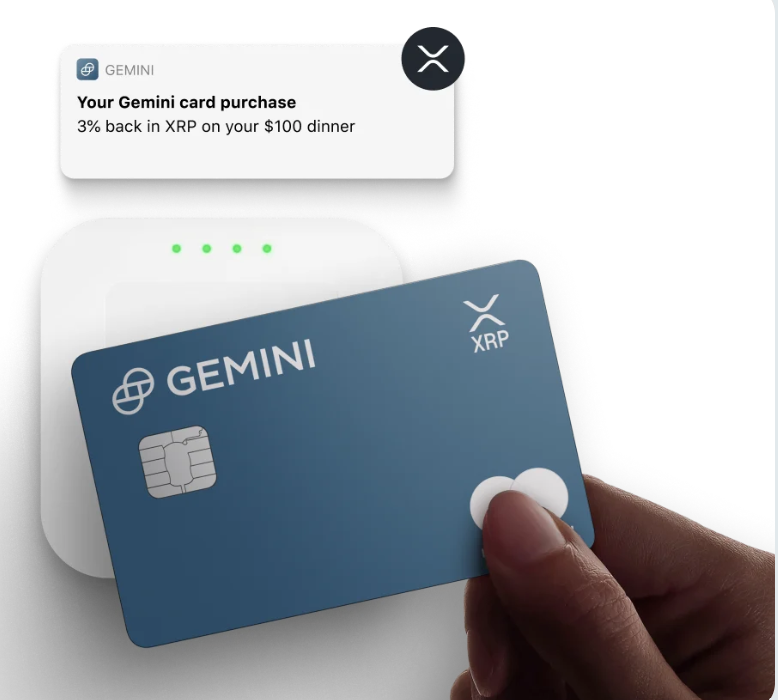
It isn’t just another rewards card. It lets consumers earn XRP instantly while spending on gas, dining, or rides, at a time when Ripple’s technology is gaining global traction.
What Is the XRP-Gemini Credit Card?
The XRP-Gemini Credit Card is a Mastercard issued by WebBank in collaboration with Gemini and Ripple. Unlike traditional rewards cards that pay out in cash or points, this one allows cardholders to earn XRP or any of 50+ supported cryptocurrencies instantly after each purchase.
New Trending Crypto Wallet Offers
Sponsored
Disclosure
We sometimes use affiliate links in our content, when clicking on those we might receive a commission at no extra cost to you. By using this website you agree to our terms and conditions and privacy policy.
4% back on gas, EV charging, and rideshares (capped at $300/month, then 1%)
3% back on dining
2% back on groceries
1% back on all other purchases
$200 XRP welcome bonus after spending $3,000 in the first 90 days
Instant rewards settlement in crypto (no waiting for statement cycles)
No annual fee and no foreign transaction fees
Compatibility with Apple Pay, Google Pay, and Samsung Pay
XRP-Gemini Card. | Source: Gemini
This makes it one of the first crypto rewards credit cards in 2025 directly branded with a leading blockchain network.
However, crypto credit cards, such as the XRP-Gemini Mastercard, carry unique risks compared to traditional cards. The value of rewards paid in cryptocurrency can fluctuate rapidly, meaning your earned XRP could lose value immediately after being credited.
Regulatory changes or network issues with the issuing platform (Gemini) or the underlying cryptocurrency (XRP) could affect usability or accessibility of funds.
Additionally, crypto credit cards may expose users to higher tax reporting complexity, as each reward transaction may be considered a taxable event. Users should also be aware of security risks, including account hacks or phishing, since rewards are directly linked to crypto wallets.
Why the XRP-Gemini Card Matters
The launch of the XRP-Gemini Card comes at a critical moment for both Ripple and the broader crypto industry:
Regulatory clarity: The long-running SEC lawsuit against Ripple ended in August 2025, with the court confirming that XRP itself is not a security. This outcome removes a major barrier for consumer-facing products.
Institutional growth: Ripple’s On-Demand Liquidity (ODL) is now used by more than 300 financial institutions worldwide, highlighting XRP’s utility in cross-border payments.
ETF momentum: At least seven XRP ETF applications are pending before the SEC, with analysts assigning a high probability of approval in late 2025. Approval could significantly increase institutional demand.
By linking XRP directly to daily transactions like fuel, dining, and groceries, the card represents an attempt to move cryptocurrency from speculative trading into mainstream financial habits.
Stablecoin Integration: The Role of RLUSD
Another innovation is the card’s integration with Ripple USD (RLUSD), a stablecoin fully backed by U.S. dollars.
For users seeking stability, RLUSD functions as digital cash with a fixed value.
For those interested in appreciation potential, XRP rewards offer market exposure.
The ability to switch seamlessly between RLUSD and XRP without conversion fees reduces friction, creating a hybrid model attractive to both cautious and risk-tolerant users.
This feature addresses one of the long-standing criticisms of crypto cards: reward volatility.
Key Regulatory Considerations for the XRP-Gemini Credit Card
Despite progress, regulatory challenges remain:
The GENIUS Act now mandates audits for stablecoins, adding oversight but increasing compliance costs for issuers.
The SEC previously fined Gemini $5 million for misleading statements, demonstrating regulators’ ongoing scrutiny of crypto platforms.
ETF approval remains a double-edged sword: if approved, XRP could see a major price boost; if delayed or rejected, adoption momentum may slow.
For now, the XRP-Gemini Card benefits from a more favorable environment than crypto credit cards launched earlier in the decade.
Who the XRP-Gemini Card Targets
Ideal fit:
U.S. cardholders with regular spending in gas, EV charging, rideshares, dining, and groceries.
Consumers interested in earning XRP or other cryptocurrencies as rewards.
Users attracted to a no-annual-fee credit card with Mastercard protections.
Spend dollars, earn XRP via XRP-Gemini card. | Source: Gemini
Limitations:
Availability is currently restricted to U.S. residents.
Rewards are tied to crypto market fluctuations, which may affect value over time.
The structure may not appeal to those who prefer flat-rate cashback cards without category caps.
Compared to these, the XRP-Gemini Card stands out for its tiered crypto rewards, stablecoin integration, and direct co-branding with Ripple.
Can XRP-Gemini Credit Card Drive Mass Adoption?
The XRP-Gemini Card represents more than a loyalty perk, it’s part of a strategic effort to:
Embed crypto into daily routines like fueling a car, buying groceries, or dining out.
Create a positive feedback loop: users earn XRP, hold it for appreciation, and reinvest in the ecosystem.
Support broader market developments such as ETFs and stablecoin adoption.
Analysts project XRP could trade in the $7–$15 range by year-end 2025 if ETFs are approved. Regardless of price outcomes, the card demonstrates that crypto is no longer confined to exchanges, it’s becoming part of ordinary financial life.
Conclusion
The XRP-Gemini Credit Card combines traditional credit functionality with the growing world of digital assets. With up to 4% crypto rewards, a $200 XRP bonus, and stablecoin integration, it sets a new benchmark for crypto-linked financial products in 2025.
Whether it accelerates mainstream adoption will depend on regulatory clarity and ETF approvals, but as a consumer product, it highlights a clear trend: crypto is moving from speculation into everyday spending.
Can I choose which cryptocurrency I earn with the XRP-Gemini Card?
Yes. While the card is branded around XRP, users can select XRP or over 50 other supported cryptocurrencies as their rewards option.
Are crypto rewards from the card taxable?
Generally, credit card rewards are treated as rebates, not income. However, once spent, sold, or exchanged, they may trigger taxable events. Users should consult a tax professional for details.
Is the XRP-Gemini Card available outside the U.S.?
No. As of 2025, the XRP-Gemini Credit Card is limited to U.S. residents.
How does the XRP-Gemini Card compare to flat-rate cashback cards?
Flat-rate cards typically offer 1.5–2% cash back with no caps. The XRP-Gemini Card provides higher rates in specific categories but with a $300 monthly cap on its 4% tier, making it more rewarding for targeted spenders.
Disclaimer:
The information provided in this article is for informational purposes only. It is not intended to be, nor should it be construed as, financial advice. We do not make any warranties regarding the completeness, reliability, or accuracy of this information. All investments involve risk, and past performance does not guarantee future results. We recommend consulting a financial advisor before making any investment decisions.
Onkar Singh has three years of experience as a digital finance content creator. Throughout his career, he has collaborated with various DeFi projects and crypto media outlets. In his leisure time, he enjoys fitness activities at the gym and watching movies across different genres. Balancing his professional and personal interests, Onkar continues to contribute to the digital finance landscape while pursuing his hobbies.


 Easy
Easy