Critics argue India’s landmark ban on real-money online gambling will lead to a rise in illegal iGaming and a loss of thousands of jobs. | Credit: Getty Images.
Share
Key Takeaways
India’s new online gambling bill has been passed and is expected to be signed into law, criminalizing platforms and promoters of real-money games.
India’s iGaming sector, worth billions and supporting over 200,000 jobs, is expected to face severe economic and employment consequences.
Critics argue the ban will drive people towards unregulated, illegal gambling platforms.
India’s landmark ban on real-money online gambling has faced immense backlash from the industry, with critics claiming it will lead to a rise in illegal gambling and a loss of thousands of jobs.
The ban, which was passed in the lower Parliament on Aug. 19, aims to limit the negative effects of gambling, such as addiction and debt.
Get These Top Crypto Casino Offers Now!
Sponsored
Disclosure
We sometimes use affiliate links in our content, when clicking on those we might receive a commission at no extra cost to you. By using this website you agree to our terms and conditions and privacy policy.
The bill proposing to ban all real-money online gambling in India has been quickly passed through the country’s government.
The Promotion and Regulation of Online Gaming Bill has been approved by both the lower and upper houses of Parliament and is now waiting for a signature from Indian President Droupadi Murmu.
However, according to reports, Murmu has already stated that she plans to sign the bill into law.
Under the landmark bill, all gambling websites and apps will be banned from offering games “played by a user paying fees or depositing money or other stakes.”
The law will make any platform offering these services subject to jail for up to three years and a fine of up to 10 million rupees ($114,000).
Equally, anyone promoting real-money games could face up to two years in prison with a fine of 5 million rupees ($57,000).
A Billion-Dollar Industry Under Threat
Over the past few years, iGaming in India has grown into an industry generating billions of dollars in revenue.
Talking to the BBC, Mumbai-based gaming lawyer Jay Sayta slammed the ban as a “massive setback” for investors who had spent millions backing startups in the country.
India was home to approximately 400 real-money gaming startups, which brought in over $2 billion in annual taxes and supported over 200,000 jobs, according to the publication.
Many of the startups had reached mainstream success, with Dream11, valued at $8 billion, becoming the lead sponsor of India’s national cricket team.
Sayta said that while some regulation of the industry was needed, the new law had been introduced without proper consultation.
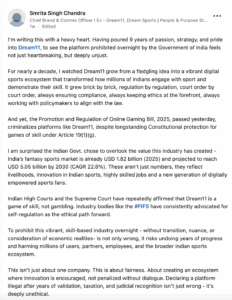
Smrita Singh Chandra called the ban “heartbreaking” | Credit: LinkedIn
Smrita Singh Chandra, former manager of policy communications at Dream11, wrote on LinkedIn that the ban was “heartbreaking” and “wrong.”
Chandra claimed the law had been passed without “transition, nuance, or consideration” and risked harming “millions of users, partners, employees, and the broader Indian sports ecosystem.”
“To the Government: please recognize the difference between fantasy sports and betting/gambling,” she wrote. “This is not a vice, it’s a modern, inclusive form of sport engagement.”
A Push to Illegal iGaming
Several gaming associations have claimed the new law will drive more people to illegal online gambling platforms.
Gaming law firm Segev LLC said the blanket ban “sidelines proven regulatory models that channel demand into transparent, well‑supervised markets that protect players and generate tax revenue.”
“Instead, it risks driving activity underground, where consumer harm is harder to prevent and oversight is minimal,” it added.
Many of India’s citizens make bets through local bookies who operate with no oversight.
According to the BBC, wagers at these bookies are often placed over WhatsApp and Telegram, with links being shared with hundreds of people at a time.
Skill-Based Gaming
A major point of debate within the Indian gaming industry revolves around the legal distinction, or lack thereof, between “games of skill” and “games of chance.”
While games of skill are characterized by elements such as strategic decision-making, knowledge, and talent, games of chance rely predominantly on luck or random outcomes.
Current legislation, however, often does not differentiate between the two, leading to the blanket prohibition of both categories in certain contexts.
Several high courts across India have previously recognized the inherent skill involved in online gaming, particularly in formats that require strategic thinking and expertise.
For instance, judicial authorities in Karnataka and Tamil Nadu previously struck down state-level bans on online gaming platforms, emphasizing that penalizing games of skill alongside games of chance was legally flawed.
Kurt Robson is a London-based reporter at CCN, specialising in the fast-moving worlds of crypto and emerging technology. He began his career covering local news in Cornwall after graduating from Falmouth University with First Class Honours in Journalism. There, he cut his teeth on everything from council meetings to missing swans.
He quickly rose through the ranks to become a frontline journalist at several of the UK’s leading national newspapers. Over the years, he has interviewed musicians and celebrities, reported from courtrooms and crime scenes, and secured multiple front-page exclusives.
Following the upheaval of the COVID-19 pandemic, Kurt shifted his focus to technology journalism—just ahead of the AI boom. With a natural curiosity and a trained eye for emerging trends, he has found a new rhythm in reporting on innovation.
At CCN, Kurt's work focuses on the cutting edge of crypto, blockchain, AI, and the evolving digital world. Drawing on his background in people-first reporting and his deep interest in disruptive tech, Kurt delivers stories that are insightful, entertaining, and human-centric.