The U.S. dollar slides to 2022 lows as policy uncertainty, yen intervention talk, and shutdown risks revive fears of a disorderly dollar decline. | Credit: CCN.com
Share
Key Takeaways
Broad selling has pushed the U.S. dollar to levels last seen in early 2022 as confidence in U.S. policy coherence weakens.
Reports of U.S.-Japan rate checks have fueled speculation of coordinated intervention, triggering a sharp yen rally and accelerating dollar losses.
Trade threats, tariff escalation, and renewed U.S. government shutdown concerns are increasing policy uncertainty and pressuring the dollar.
While conditions differ from the Plaza Accord era, coordinated intervention talk is reviving fears of a disorderly dollar adjustment.
The U.S. dollar is under mounting pressure, and markets are increasingly asking a question that would have seemed extreme just a few years ago: could the greenback be heading toward a shock reminiscent of the 1985 Plaza Accord?
While no formal agreement exists today, recent price action, political uncertainty, and growing signs of possible coordinated intervention between the U.S. and Japan have reignited fears of a disorderly dollar decline.
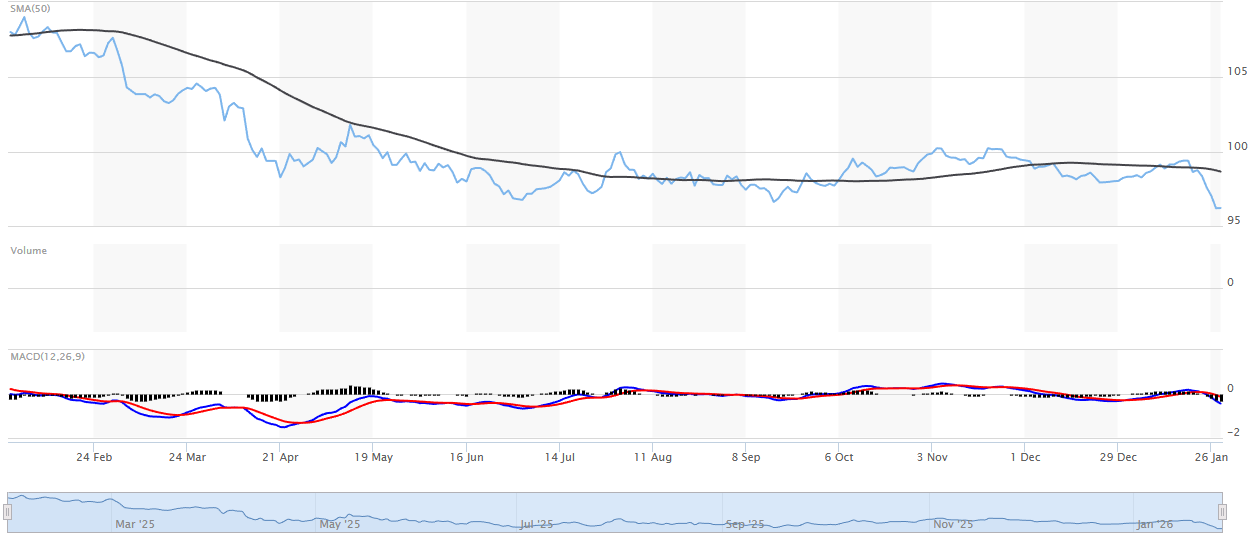
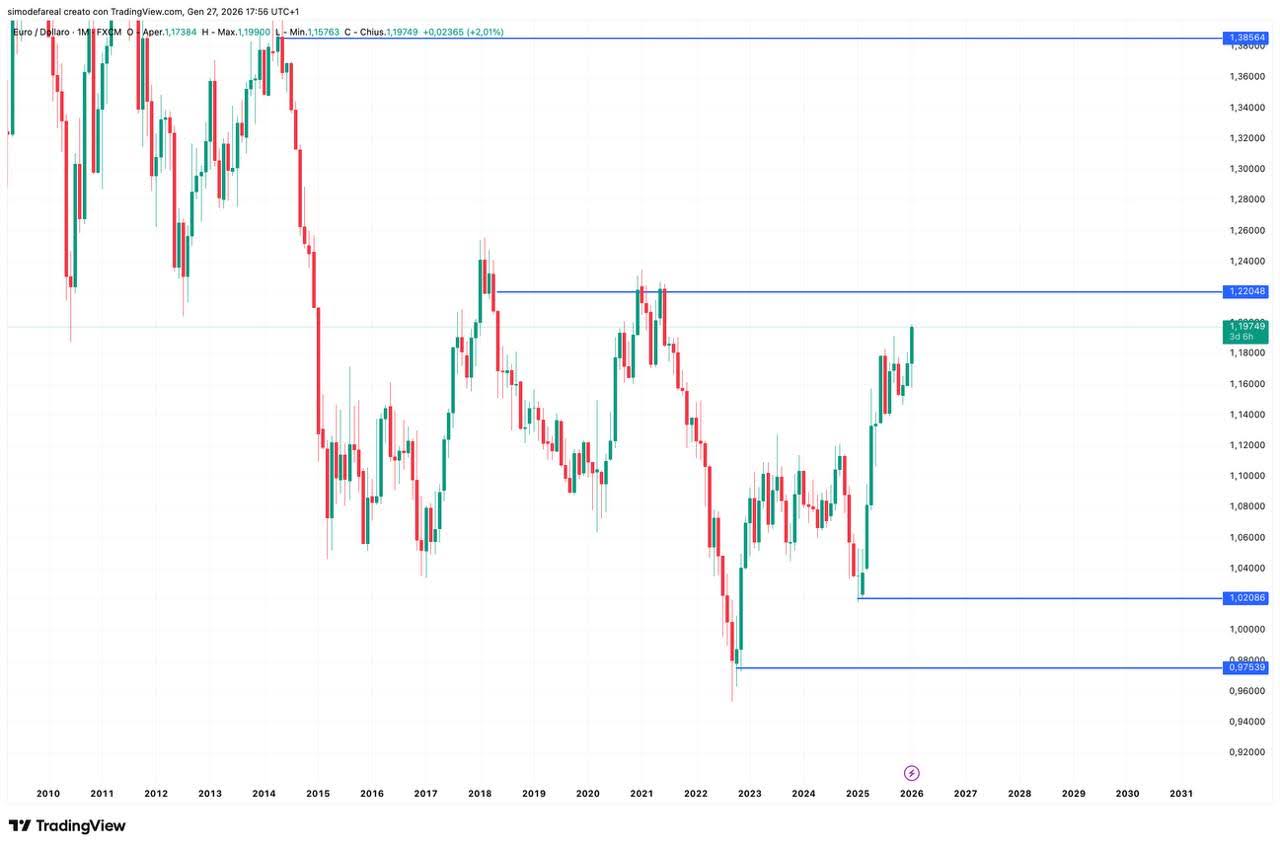
On Tuesday, Jan. 27, the dollar fell to its lowest level in nearly four years against a basket of major currencies, sliding to 96.212. The move reflects a convergence of political, monetary, and geopolitical risks that are steadily eroding confidence in U.S. policy consistency.
Why the Dollar Is Under Pressure
The current wave of dollar weakness is not driven by a single catalyst, but by a cluster of reinforcing risks.
Concerns over Federal Reserve independence, as Trump continues to publicly urge rate cuts.
Renewed government shutdown risk amid partisan disputes over funding for the Department of Homeland Security.
Escalating trade threats, including proposed tariffs on South Korea and warnings toward Canada over China ties.
Trump’s rhetoric has unsettled currency markets accustomed to treating dollar stability as a core pillar of U.S. economic credibility. When asked about the weak dollar, Trump also said: “It’s great.”
Dollar index is down to below 100. | Credit: MarketWatch
As Karl Schamotta, chief market strategist at Corpay, explained: “With the ‘tariff man’ showing no sign of repentance and the U.S. government headed into another shutdown, economic policy uncertainty is soaring once again, leading to an intensification in the ‘Sell America’ trade that has dominated markets for the better part of a year.”
He added: “Positive fundamentals should eventually reassert themselves, but for now, no one is willing to catch the falling chainsaw that is the U.S. dollar.”
This rally followed market chatter around possible “rate checks”, a technical step often viewed as a precursor to official currency intervention.
Important developments fueling intervention speculation:
Reports that the New York Federal Reserve checked USD/JPY rates with dealers.
Statements from Japanese officials confirming close coordination with U.S. authorities.
Rising concern in Tokyo over rapid yen depreciation and imported inflation.
Jonas Goltermann, deputy chief markets economist at Capital Economics, said: “While there are several potential culprits for the dollar’s drop, the main driver is the fallout from reports that the US Treasury is considering direct currency intervention.”
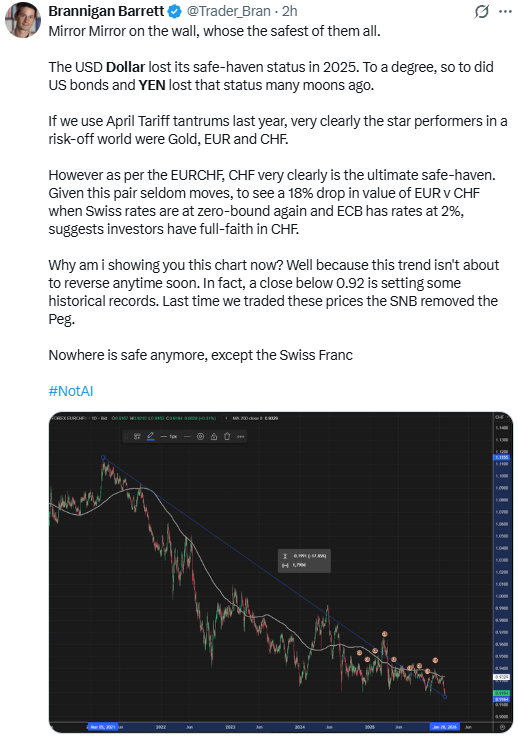
Has USD lost its safe-haven status? | Credit: Brannigan Barrett X profile
Historically, coordinated intervention between the U.S. and Japan has had a significant market impact, most famously during the Plaza Accord of 1985, which triggered a sharp and sustained decline in the dollar.
The Federal Reserve: Decision vs. Perception
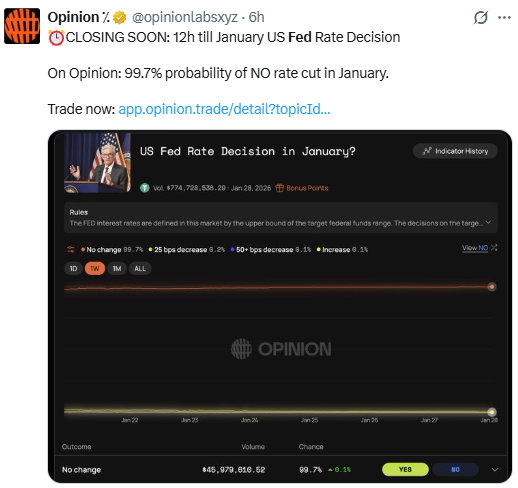
Markets are widely confident that the Federal Reserve will hold rates unchanged at this week’s meeting. But the rate decision itself is not what traders are focused on.
Nick Rees, head of macro research at Monex, warned: “The big risk, as we see it, is not in the rate decision. We’re pretty confident that the Fed is going to hold rates unchanged. But Trump is not going to like that.”
He added that Trump could announce a successor to Chair Jerome Powell soon after the meeting, particularly if the president opposes the Fed’s stance.
Bets on Fed show a high ‘hold’ opinion among traders. | Credit: Opinion X profile
Abdelaziz Albogdady, Market Research & Fintech Strategy Manager at FXEM, noted: “The US dollar stabilized to a certain extent after sliding to its weakest level in multiple years, but continued to face downside risks.”
He continued: “Concerns are growing that Trump may favour a more dovish candidate at the helm of the Federal Reserve, potentially aligned with looser monetary policy and less institutional independence.”
Is This Becoming a Structural Shift?
Some market participants believe the current sell-off reflects more than short-term volatility.
Nigel Green, CEO of deVere Group, warned that confidence in the dollar is being tested: “Currency markets are flashing red. The dollar sits at the centre of the global financial system, and moves of this scale signal a serious loss of confidence in America’s policy direction.”
He added: “President Trump’s dismissal of the dollar’s fall alarms investors. FX markets trade credibility and discipline.”
According to Green, the sell-off reflects a broader reassessment of U.S. macro risk driven by:
Green also highlighted shifting behavior among reserve managers and institutional investors:
Central banks quietly diversifying away from dollar reserves.
Rising allocations to non-dollar assets.
Increased interest in commodities and digital assets.
“Even incremental shifts out of dollar reserves can move markets when private capital mirrors the same trend.”
Spillovers Into Crypto and Risk Assets
The weaker dollar has supported risk assets, including cryptocurrencies.
Joel Kruger, Markets Strategist at LMAX Group, observed: “Over the past 24 hours, crypto markets have traded with a firmer tone, supported by broad-based US dollar selling and a renewed surge in global equities.”
He added: “From a technical perspective, both bitcoin and ether continue to show signs of recovery from their critical November lows.”
Kruger emphasized that macro policy remains the key driver: “The main focus for the day now turns squarely to the Federal Reserve decision.”
And warned: “A dovish-leaning hold could further support the recovery narrative, while any hawkish surprise risks could undermine the current rebound.”
Could This Resemble 1985?
Most analysts stop short of predicting a Plaza Accord-style collapse. The dollar remains deeply embedded in global finance, trade, and reserves.
However, several warning signs are flashing:
Policy credibility is being questioned.
Currency volatility is rising.
Coordinated intervention is being discussed.
Capital is actively hedging U.S. exposure.
As Nigel Green concluded: “The dollar will remain central to global finance, but its supremacy has been cracking in recent years.”
Whether this episode marks a turning point, or simply another stress test, will depend on how policymakers respond. For now, markets are watching the yen, the Fed, and Washington closely, aware that confidence in reserve currencies can erode faster than it is rebuilt.
The dollar is under pressure due to a mix of political uncertainty, renewed tariff threats, concerns about Federal Reserve independence, and rising risk of a U.S. government shutdown. Reports of possible U.S.-Japan currency coordination have added to the sell-off.
What does “yen intervention” mean?
Yen intervention refers to actions by Japanese authorities, sometimes coordinated with the U.S., to influence the yen’s exchange rate, typically by buying yen and selling dollars. “Rate checks” with banks are often an early signal that intervention may be considered.
Is the Federal Reserve expected to cut rates?
Markets expect the Fed to hold rates steady at this meeting. The focus is on forward guidance, especially signals about inflation, growth, and potential rate cuts later in the year or in 2026.
Why are traders comparing this to 1985?
The comparison comes from fears of coordinated action to weaken the dollar, similar to the 1985 Plaza Accord. While today’s conditions are different, the possibility of joint U.S.–Japan intervention has revived memories of that episode.
Disclaimer:
The information provided in this article is for informational purposes only. It is not intended to be, nor should it be construed as, financial advice. We do not make any warranties regarding the completeness, reliability, or accuracy of this information. All investments involve risk, and past performance does not guarantee future results. We recommend consulting a financial advisor before making any investment decisions.
Giuseppe Ciccomascolo began his career as an investigative journalist in Italy, where he contributed to both local and national newspapers, focusing on various financial sectors.
Upon relocating to London, he worked as an analyst for Fitch's CapitalStructure and later as a Senior Reporter for Alliance News. In 2017, Giuseppe transitioned to covering cryptocurrency-related news, producing documentaries and articles on Bitcoin and other emerging digital currencies. He also played a pivotal role in establishing the academy for a cryptocurrency exchange website. Crypto remained his primary area of interest throughout his tenure as a writer for ThirdFloor.


 Easy
Easy