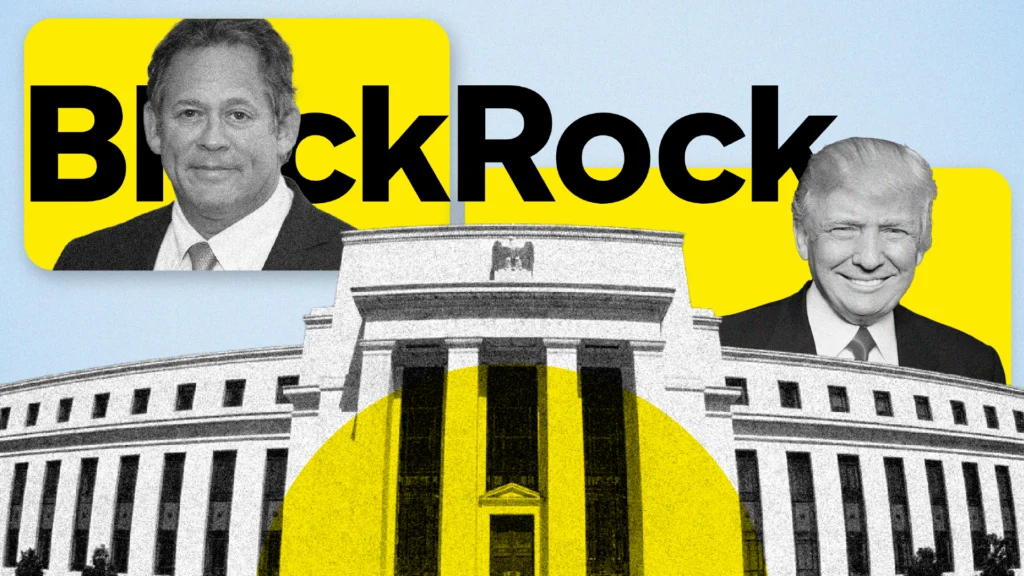
Meet Rick Rieder: The BlackRock Executive in the Running to Lead the Federal Reserve
Share
Key Takeaways
Rick Rieder, a senior BlackRock executive, is a finalist for U.S. Federal Reserve Chair.
He leads BlackRock’s global fixed-income investments, overseeing trillions in bond assets.
Rieder’s Wall Street background makes him a non-traditional Fed chair candidate.
His potential appointment raises questions about Fed independence and market impact.
President Donald Trump is expected to name his pick to lead the Federal Reserve by the end of January, according to Treasury Secretary Scott Bessent, the White House has narrowed the search to four finalists and that an announcement could come “as early as next week.”
One of those four names stands out because he has never held a top public monetary-policy post: Rick Rieder, a senior BlackRock executive best known on Wall Street as a bond-market heavyweight.
In case you don’t realize what’s coming:
The Chief Investment Officer of BlackRock is now expected to be the next Fed Chair.
And, Trump says cutting rates is a “requirement” for the next Fed Chair and is actively calling for 1% interest rates.
Prediction markets have recently boosted Rieder’s odds sharply (e.g., 59.9% on Polymarket), with traders indicating he may be the most likely pick among Trump’s finalists compared with other candidates like Kevin Warsh.
BlackRock’s Rick Rieder jumps to 60% odds on Polymarket for next Fed Chair. | Source: @GarrettBullish on X
If Trump chooses Rieder, it would be a major signal that the administration is looking outside the traditional pool of central bankers and academic economists, while also testing how investors, lawmakers, and Fed insiders react to placing a global asset manager at the helm of the world’s most influential central bank.
Below is what’s publicly known about Rieder’s background, his career path, and the kind of reputation he has built, plus a look at the other three contenders.
Why This Moment Matters: The Fed Chair Job, the Timeline and the Politics
The chair of the Federal Reserve is the public face and internal manager of the U.S. central bank: the person who guides interest-rate decisions, builds consensus among governors and regional bank presidents, and communicates policy to markets and the public. Trump has repeatedly criticized current chair Jerome Powell, and the administration’s push to identify a successor has become a major market storyline ahead of the end of Powell’s chair term in May.
Bessent said the vetting process began in September, started with 11 candidates, and is now down to four: Kevin Hassett, Kevin Warsh, Christopher Waller, and Rick Rieder. Trump has also publicly indicated he is nearing a decision, and Reuters has reported him saying he may already be down to one candidate.
In that context, Rieder’s emergence is notable. The Financial Times reported that he has been gaining traction as a leading contender, with growing attention from market participants and political observers.
Who is Rick Rieder?
Rick Rieder is a Senior Managing Director at BlackRock and serves as the firm’s Chief Investment Officer of Global Fixed Income, Head of Fundamental Fixed Income, and Head of the Global Allocation Investment Team.
He is one of the senior investors responsible for steering how BlackRock invests in bonds and credit markets across the world, including government debt, corporate bonds, mortgages, and other fixed-income instruments that sit at the center of how modern financial systems fund themselves.
BlackRock’s corporate biography says Rieder is responsible for managing roughly $2.4 trillion in assets and sits on senior internal leadership bodies, including the firm’s Global Executive Committee and investment sub-committee, while also chairing the BlackRock Investment Council.
That scale matters because fixed income is where central banking and investing collide most directly. Fed policy sets the baseline for the risk-free rate, which ripples through Treasury yields and then across mortgages, corporate borrowing costs, municipal finance, and global capital flows. A chair with deep bond-market instincts could bring a very different feel to Fed leadership, especially on communication and how policy is “priced” by markets.
Rieder’s Early Life and Education
Rieder’s public bios emphasize a conventional finance-and-business educational path:
BBA in Finance, Emory University (1983)
MBA, Wharton School, University of Pennsylvania (1987)
Those credentials place him in a classic pipeline for high finance, business school, then investment banking and markets, rather than the more common modern Fed-chair routes (academic macroeconomics, central banking, or Treasury policy leadership).
Rieder’s Career: From Credit Analyst to Wall Street Power Broker
Suntrust: Learning Credit From the Ground Up
Before his long stint at Lehman Brothers, Rieder worked as a credit analyst at SunTrust Banks in Atlanta, according to BlackRock and Emory.
Credit analysis, understanding whether borrowers can repay, how collateral behaves, and how downturns change default risk, is foundational to bond investing. It’s also a lens that can shape how a policymaker thinks about financial stability: not just inflation and jobs, but how stress spreads through lenders, borrowers, and balance sheets.
Lehman Brothers (1987–2008): Running Credit Businesses and Proprietary Investing
Rieder then spent 1987 to 2008 at Lehman Brothers, ultimately leading major parts of the firm’s credit operations. BlackRock’s biography states that at Lehman he headed the firm’s Global Principal Strategies team (a global proprietary investment platform), served as global head of the firm’s credit businesses, and chaired key capital commitment committees tied to corporate bonds and loans.
That period is important historically. It spans multiple cycles: the 1990s bond market, the dot-com boom and bust, the early-2000s credit expansion, and the run-up to the 2008 financial crisis, ending with Lehman’s collapse in 2008. Rieder left Lehman before joining BlackRock, but his senior roles there suggest he was deeply embedded in the credit system during the years that forced policymakers to rethink everything from bank regulation to emergency liquidity tools.
R3 Capital Partners: CEO Role Before Joining Blackrock
After Lehman, Rieder became President and Chief Executive Officer of R3 Capital Partners, before joining BlackRock in 2009.
Blackrock (2009–Present): Global Fixed Income Leadership
Rieder joined BlackRock in 2009 and rose into top fixed-income leadership. Today he runs global fixed income investing and sits near the top of the firm’s investment governance structure.
At Blackrock, Rieder is responsible for managing about $2.4 trillion in assets focused on bonds and other fixed-income investments for clients around the world. This massive portfolio under his leadership spans government debt, corporate bonds, mortgages, and other credit instruments, putting Rieder in charge of one of the largest fixed-income desks in global finance at the world’s biggest asset manager.
BlackRock also lists a string of industry recognitions, including being nominated by Morningstar as Outstanding Portfolio Manager (2021), being named Institutional Investor’s Global Unconstrained Fixed Income Manager of the Year (2015), and being inducted into the Fixed Income Analysts Society Fixed Income Hall of Fame (2013).
Rieder’s Government and Quasi-Public Roles: Not a Policymaker, but Not a Stranger to Washington Either
Although Rieder has never held elected office or a Senate-confirmed policymaking role, he has served in several advisory positions that connect him closely to public finance and government markets.
🚨BREAKING:
BLACKROCK CIO RICK RIEDER’S ODDS TO BECOME FED CHAIR JUMP 46%
This includes serving as Vice Chairman and a member of the Borrowing Committee for the U.S. Treasury, and as a member of the Federal Reserve’s Investment Advisory Committee on Financial Markets.
These kinds of advisory roles matter for two reasons:
They suggest he has experience engaging with the plumbing of government finance – how Treasury issues debt, how markets absorb it, and how liquidity functions under stress.
They may offer a partial response to the common critique of private-sector nominees: “Do they understand public obligations and Fed governance?”
Still, moving from advisory committees to chairing the Fed is a giant leap in responsibility, visibility, and political scrutiny.
Rieder’s Public Reputation: “Bond Guy,” Market Pragmatist and Communicator
One reason Rieder’s name keeps surfacing is that, unlike many finance executives, he’s a widely quoted market commentator and a familiar figure to investors.
Trump himself described Rieder as “very impressive,” and that Kevin Hassett (one of the other contenders) praised Rieder publicly, calling him “the best bond guy,” in a TV interview.
The Financial Times has also described Rieder as gaining momentum and being perceived by market participants as pragmatic and data-driven, at a time when investor confidence in Fed independence is a major issue.
That “market trust” angle could cut both ways: investors may like the idea of a chair who speaks their language, but critics may worry about conflicts of interest, the optics of appointing a large asset manager executive, or the risk that Fed decisions appear too aligned with Wall Street preferences.
What Would Rick Rieder as a Fed ChairMean in Practice?
It’s important to separate what is documented from guesswork. Public reporting so far mainly establishes:
He is a finalist in a short list cited by the Treasury Secretary.
Trump has spoken positively about him.
He is a major bond-market investor with deep experience in credit and rates.
I asked Grok to give me an overview Rick Rieder's thought leadership. Amongst others, he has suggestedhigher rates might exacerbate inflation, suggesting rates should be cut. pic.twitter.com/xKaoq4Vdmi
Beyond that, any prediction about how he would vote on interest rates would be speculative unless anchored to specific public statements. What you can say with confidence is that a chair with decades in global fixed income would likely be unusually focused on:
Financial conditions transmission (how rate changes spread into mortgages, corporate borrowing, and risk assets).
Market functioning and liquidity (especially during stress).
Communication that markets can “price” (clear reaction functions, strong forward guidance discipline).
But those are reasonable inferences from his career profile, not promises of a particular policy direction.
Other Contenders for Fed Chair: Hassett, Warsh, and Waller
Bessent’s four-name shortlist includes three figures with more direct government or central bank backgrounds.
Kevin Hassett: White House Economic Adviser and Longtime Conservative Economist
Kevin Hassett is currently a top White House economic adviser and has served in senior roles during Trump’s administrations, including chairing the Council of Economic Advisers in the first term and leading the National Economic Council in the second.
Hassett has emphasized Fed independence publicly, saying the chair should be “an independent person” who respects the mandates, while also praising Rieder.
Supporters see Hassett as aligned with the administration’s growth agenda; critics worry that placing a close political aide at the Fed could intensify concerns about political pressure on monetary policy.
Kevin Warsh: Former Fed Governor With Crisis-Era Experience
Kevin Warsh served as a Federal Reserve governor from 2006 to 2011, a period that includes the global financial crisis and the early years of post-crisis reforms.
The Federal Reserve’s own history site documents his tenure dates.
Warsh is often viewed as a candidate with the “Fed résumé” to reassure traditionalists while still fitting a Republican policy ecosystem.
Christopher Waller: Sitting Fed Governor and Monetary-Policy Specialist
Christopher Waller is currently a member of the Federal Reserve Board of Governors, with an economics background and past leadership at the St. Louis Fed.
His official Fed biography describes an academic career and senior research roles inside the Federal Reserve System.
As a sitting governor, Waller would represent the most continuity with current Fed institutional culture among the four finalists.
The Key Question Hanging Over All Four: Independence vs. Alignment
Any Fed chair nominee faces two overlapping tests:
Markets and the public want independence – confidence that decisions are driven by inflation and employment goals, not political timelines.
Presidents want alignment – someone they believe understands their economic strategy and will communicate in a way that doesn’t undermine it.
That tension is especially visible right now because the selection process is unfolding alongside open political criticism of the current Fed chair and broader debates about the Fed’s role.
For Rieder, the “independence” debate may look different: he’s not a politician, but he is a Wall Street executive. For Hassett, the challenge is the reverse: a government insider who must convince skeptics he can operate at arm’s length. Warsh and Waller each come with Fed credentials, but differ in how closely they are perceived to sit within the administration’s orbit.
Why Rieder’s Candidacy Is a Serious Story
Rick Rieder is not a household name in the way a sitting Fed governor might be, but in fixed income he is a major figure: a senior investor overseeing trillions in bond assets with decades of credit-market experience, elite business credentials, and a reputation for market savvy.
With Trump and Bessent publicly signaling a near-term decision and listing Rieder among four finalists, his candidacy is no longer speculative chatter, it’s a real possibility with real consequences for markets, Fed culture, and political norms around central bank leadership.
Why would Trump consider a Wall Street executive instead of a career central banker?
Presidents are not required to choose Fed chairs from within the Federal Reserve System. Trump may favor someone who understands how markets react in real time to policy decisions and who aligns with his focus on economic growth and financial conditions, rather than academic models alone.
Would Rick Rieder need to leave BlackRock if he became Fed chair?
Yes. If appointed, Rieder would be required to resign from BlackRock and divest financial holdings that could pose conflicts of interest, following federal ethics rules that apply to senior government officials, especially at independent agencies like the Federal Reserve.
Could Rieder legally serve as Fed chair without being a current Fed governor?
Yes. Presidents often nominate an existing governor, but the law allows the president to appoint someone from outside the Board of Governors, subject to Senate confirmation. The nominee would first be appointed to the Board and then designated as chair.
How might Rieder’s bond-market background influence Fed decisions?
While interest-rate votes depend on committee consensus, a chair with deep fixed-income experience may place stronger emphasis on market liquidity, credit spreads, and financial stress signals when evaluating how policy affects the real economy, especially during periods of volatility.
Disclaimer:
The information provided in this article is for informational purposes only. It is not intended to be, nor should it be construed as, financial advice. We do not make any warranties regarding the completeness, reliability, or accuracy of this information. All investments involve risk, and past performance does not guarantee future results. We recommend consulting a financial advisor before making any investment decisions.
Onkar Singh has three years of experience as a digital finance content creator. Throughout his career, he has collaborated with various DeFi projects and crypto media outlets. In his leisure time, he enjoys fitness activities at the gym and watching movies across different genres. Balancing his professional and personal interests, Onkar continues to contribute to the digital finance landscape while pursuing his hobbies.


 Easy
Easy