The Friday crypto market blood bath led to the largest liquidation event in crypto history. Credit: (Photo by Nicolas Economou/NurPhoto via Getty Images)
Share
Key Takeaways
On Oct. 10, the crypto market suffered its largest liquidation in market history.
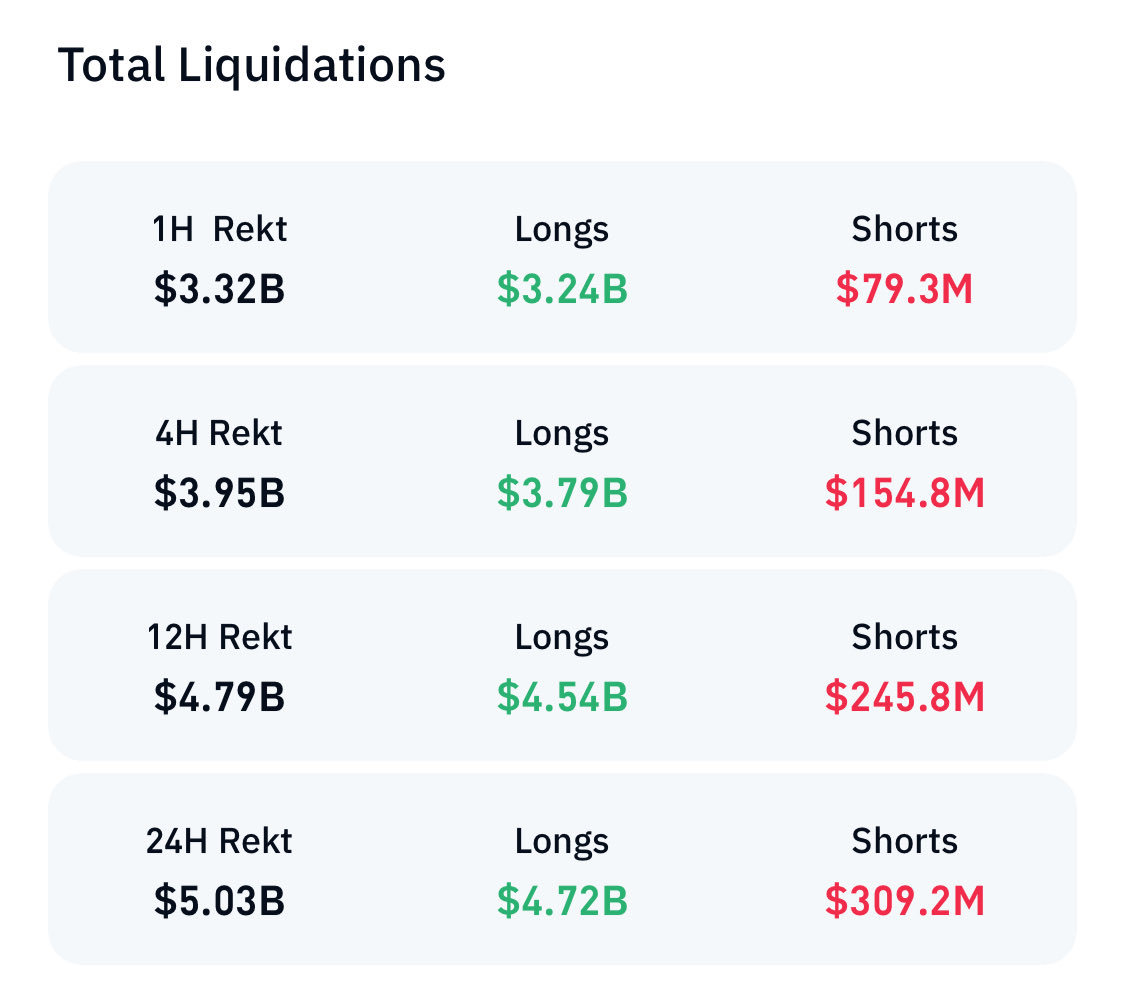
Over $7 billion in positions were erased in a single hour, seven times larger than the biggest 2022 wipeout.
Who’s behind the crash? Donald Trump, China, or Binance.
Markets live and die on trust, but in crypto, confidence can evaporate in minutes.
On Friday, Oct. 10, that fragility was on full display when the crypto market suffered its largest-ever liquidation event, erasing over $40 billion in 24 hours.
Bitcoin (BTC) and Ethereum (ETH) collapsed by double-digits in under an hour, altcoins cratered by up to 50%, and exchanges struggled under the strain.
The shock spilled into traditional finance, dragging the S&P 500 down 2.7% in its worst day of the year.
In the aftermath, traders were left grasping for answers.
Was this the inevitable result of Trump’s trade war rhetoric? A liquidity mishap inside Binance? Or even a coordinated exploit?
The search for a culprit became as dramatic as the crash itself.
Try Our Recommended Crypto Exchanges
Sponsored
Disclosure
We sometimes use affiliate links in our content, when clicking on those we might receive a commission at no extra cost to you. By using this website you agree to our terms and conditions and privacy policy.
On Friday, Oct. 10, at 18:00 UTC, the global crypto market entered uncharted territory.
A cascade of liquidations, totaling more than $40 billion in just 24 hours, made it the largest wipeout in the industry’s history.
Bitcoin, which had set a new all-time high above $126,000 just days earlier, plummeted to $102,000 within minutes.
Crypto leverage traders lost $7 billion in an hour. Source: DBNews on X
Ethereum plunged 16% to under $3,700, while altcoins like Solana and Dogecoin shed 20–40% in minutes.
According to CoinGlass, more than $7 billion in leveraged positions were liquidated in just one hour, a pace seven times larger than the worst moments of 2022.
Bitcoin leverage traders were hit the hardest, followed by Ethereum.
The scale of Friday’s liquidation dwarfed FTX’s $1.6 billion collapse in 2022 and the $1.2 billion COVID crash in March 2020, which were nearly 10–20 times larger in dollar terms.
Over-leveraged longs got margin-called en masse for $16.7 billion (88% of total).
The S&P 500 also fell 2.7% on the same day, its steepest single-day drop since early 2025, as investors scrambled for safety amid escalating trade tensions and the ongoing U.S. government shutdown.
Trump’s Tariff Shock
The immediate spark came from Washington.
At 18:00 UTC, U.S. President Donald Trump posted on Truth Social that his administration would impose 100% tariffs on all Chinese imports starting Nov. 1, alongside fresh export restrictions on software.
The post rattled markets already on edge from news of Chinese restrictions on rare earth metals earlier in the week.
Trump’s words re-ignited fears of a full-blown U.S.-China trade war at a time when both equity and crypto markets were hovering near record highs.
However, some analysts argue that the panic may have been fueled by miscommunication rather than policy.
The Kobeissi Letter noted that China’s rare earth “controls,” released a day earlier, were not a blanket ban — applications meeting regulations would still be approved.
By the time China clarified its stance, markets had already spiraled.
Beijing vowed to fight Trump’s tariff threats “vigorously,” while Trump himself framed the move as protecting American workers.
Regardless, the timing was enough to detonate the most leveraged market in finance.
The Binance Conspiracy
No crypto crash is complete without theories about its largest exchange. And when the market crashes, Binance often finds itself in the spotlight.
This time was no different. Within hours of the Friday wipeout, traders pointed to a dramatic wobble in USDe, an algorithmic stablecoin, that sank to $0.65 on Binance while holding steady around $1 elsewhere.
A user on X pointed out that Binance’s Unified Account system valued collateral like USDe, wBETH, and BNSOL using its own order books instead of external oracles.
That meant when about $60–90 million of USDe was dumped, collateral values collapsed instantly, triggering hundreds of millions in liquidations.
“So this was a Binance-specific flash crash, which a better market structure could’ve prevented.”
Then, Trump’s tariff announcement poured fuel on the fire, magnifying the panic and disguising what looked like a targeted exploit.
On the same day, wallets on Hyperliquid had opened $1.1 billion in BTC and ETH shorts, pocketing nearly $200 million in profit as the cascade unfolded.
Binance pushed back, with co-founder Yi He insisting core systems “remained stable” and that the sell-off was market-driven. The exchange later compensated traders with $283 million.
Still, many in the industry argue this was less about a stablecoin failure and more about Binance’s design flaw being exploited at the worst possible moment.
What Comes Next
The Oct. 10 crash was a reminder that, despite their maturity, crypto markets remain prone to violent dislocations.
Whether sparked by presidential tweets, misread trade policy, or exchange infrastructure failures, the combination of high leverage and fragile liquidity creates fertile ground for black swans.
Was it Trump’s tariffs? Binance’s structure? Or just traders caught leaning too far in one direction?
The answer may be all of the above. For now, what matters most is that billions vanished in a single night — and the scars across crypto and equities, this time, could take longer to fade.
Prashant Jha is a seasoned crypto journalist based in Delhi, India, with a Bachelor’s Degree in Computer Science Engineering. Passionate about the evolving world of blockchain and cryptocurrencies, he has been a dedicated voice in the industry since 2018. Prashant’s expertise lies in regulatory reporting, where he unravels complex legal and financial developments with clarity and precision. Before joining CCN in 2024, he honed his craft at Cointelegraph, establishing himself as a trusted name in crypto journalism.
His coverage spans major industry events, including the high-profile collapses of FTX, Three Arrows Capital (3AC), and LUNA, offering readers insightful analyses of their regulatory and market implications. Prashant’s technical background enables him to bridge the gap between intricate blockchain technology and its real-world applications, making his work accessible to novices and experts.
Beyond his professional pursuits, Prashant is an avid music enthusiast, often exploring diverse genres to unwind. A sports lover, he has a particular passion for cricket and frequently engages in discussions about the game. His multifaceted interests and sharp journalistic instincts make him a valuable contributor to CCN, where he continues shaping the crypto landscape's narrative.