Home / Education / Crypto / Security / Cloudflare Outage Disrupts Major Platforms: ChatGPT, X and Leading Crypto Services Hit by Global Internet Failure
A major Cloudflare outage knocked offline Coinbase, Kraken, Aave, Etherscan, and more. See the full list of impacted crypto platforms and what caused the disruption. | Credit: CCN.com
Share
Key Takeaways
A Cloudflare outage caused widespread internet disruption, temporarily knocking offline ChatGPT, X, Coinbase, Kraken, and thousands of other websites worldwide.
The outage was triggered by a sudden spike in unusual traffic around 11:20 UTC, which led to a cascading series of 500 Internal Server Errors across Cloudflare’s global network.
Cloudflare powers nearly 20% of all websites, and the incident highlighted the internet’s dependence on a small number of infrastructure providers.
Crypto platforms were heavily impacted, experiencing front-end failures, although underlying blockchains remained operational.
A major Cloudflare outage triggered widespread disruption across the internet on Tuesday, knocking offline some of the world’s most heavily used platforms, including OpenAI’s ChatGPT and Elon Musk’s X, and causing temporary failures across key crypto exchanges, blockchain explorers, and thousands of other websites.
The incident, which produced waves of 500 Internal Server Errors, once again revealed how deeply the modern internet relies on a small group of infrastructure providers.
Cloudflare, which powers security, routing, and performance functions for nearly 20% of all websites worldwide, acknowledged the issue quickly, saying it was “aware of, and investigating an issue which potentially impacts multiple customers.”
Over the course of the day, the company reported partial recovery but warned that some users “may continue to observe higher-than-normal error rates as we continue remediation efforts.”
Cloudflare Outage Triggers Global Website Failures: What Went Wrong
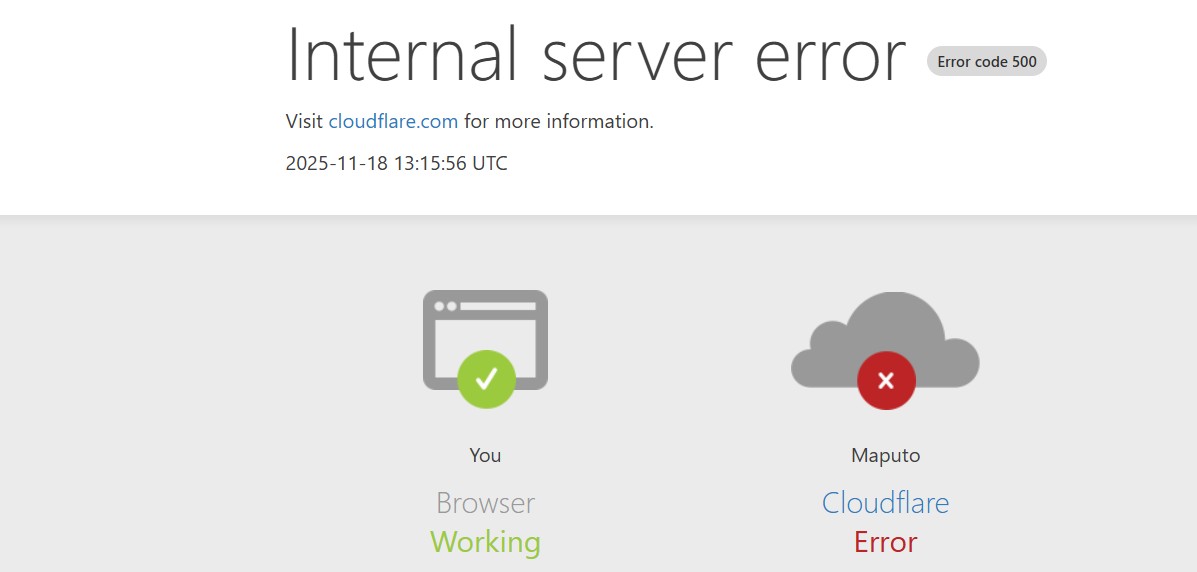
The Cloudflare outage began around 11:20 UTC, when the company detected a “spike in unusual traffic” affecting one of its core services. Shortly after, websites that rely on Cloudflare began to throw 500 error codes, signaling that the server had encountered an unexpected condition it couldn’t process.
Internal server error message. | Credit: Cloudfare
Affected services included:
ChatGPT, which displayed error messages instructing users to “unblock challenges cloudflare.com.”
X (formerly Twitter), where visitors were greeted with internal server errors linked to Cloudflare traffic.
Meta (Facebook), experiencing intermittent failures for some regions.
Downdetector, the outage monitoring website, which itself went down during the spike.
Crypto platforms such as Coinbase, Kraken, Aave, DeFiLlama, and blockchain explorer Etherscan.
Cloudflare later clarified the issue involved “widespread 500 errors, Dashboard and API also failing.”
Because the failure affected the core routing infrastructure, it created cascading problems across web applications worldwide.
Part of the remediation process involved temporarily disabling certain services for UK-based users, including Cloudflare Access and WARP. These were later restored, with the company confirming that error levels had returned to pre-incident rates in London.
Cloudflare Outages Highlight the Internet’s Overreliance on Single Points of Failure
Experts say the outages underscore a troubling reality: the modern internet relies on just a handful of infrastructure providers, meaning a single failure can disable a significant portion of global online activity.
Graeme Stewart, head of public sector operations at cybersecurity firm Check Point, noted that during the outage, “news sites, payments, public information pages and community services all froze, not because each organisation failed individually, but because a single layer they rely on stopped responding.”
This layer is Cloudflare.
Others described the event as “a catastrophic disruption,” emphasizing that Cloudflare’s popularity as a defense against DDoS attacks has unintentionally positioned the company as “one of the internet’s largest single points of failure.”
A 2022 Cloudflare outage disrupted crypto exchanges, and a 2019 Cloudflare failure similarly took down Coinbase, CoinMarketCap, and other significant sites.
Did Cloudflare Outage Impact Crypto and Blockchain Platforms?
The latest Cloudflare failure caused significant disruption in the crypto industry, with front-end interfaces failing across several major platforms. While underlying blockchains such as Bitcoin and Ethereum remained unaffected, the websites users rely on to interact with them were hit.
Impacted crypto platforms included:
Coinbase: Site access issues.
Kraken: Intermittent errors.
Etherscan: 500 Internal Server Error pages.
Aave: Front-end failures.
DeFiLlama: Dashboard failures.
Arbiscan: Abritrum block explorer also facing issues.
BitMEX and lending platform Aave are also among the impacted platforms because of Cloudflare’s “internal service degradation” affecting parts of its global network.
The outage also aligns with growing anxiety in the crypto sector, as more than $1 trillion in market value has been wiped out over the past six weeks due to fears of an AI-driven tech bubble and uncertainty about the U.S. Federal Reserve interest rates.
With Bitcoin falling 27% in the same period and global stock markets showing sharp declines, additional infrastructure instability only adds to investor unease.
Can Blockchain Fix the Growing Infrastructure Fragility?
The Cloudflare outage raises a critical question: can blockchain technology reduce the frequency and impact of these massive, centralized failures?
Increasingly, academic research suggests the answer is yes, partially. Blockchain’s core traits, decentralization, redundancy, immutability, and distributed trust, directly address the systemic weaknesses exposed whenever a major cloud or routing provider goes down.
Scientific studies examining blockchain’s role in critical-infrastructure resilience consistently point to three advantages:
Removal of single points of failure: Blockchain distributes data and transaction validation across many independent nodes. This means the collapse of one service provider cannot instantly cascade across dependent applications, as happens in today’s cloud-centric architectures.
Stronger integrity and auditability: Research shows that blockchain’s immutable, shared ledger significantly enhances the integrity of data and system states. During an outage or cyber-incident, organizations can recover faster because they can verify which data is accurate and tamper-free.
However, academic work is equally clear that blockchain is not a silver bullet. Major challenges remain: performance limitations, difficulty integrating with legacy systems, fragmented governance, and regulatory uncertainty. Fully replacing cloud infrastructures with blockchain-native systems is unrealistic for most businesses today.
The most promising path is a hybrid model, one that combines the redundancy and trust benefits of blockchain with the scalability and maturity of modern cloud platforms. For payments, this means designing transaction flows where no single cloud provider, authentication service, or routing vendor becomes a critical point of collapse.
In other words, blockchain can’t prevent outages on its own, but it can make them less catastrophic, more contained, and faster to recover from, helping build a digital ecosystem where one provider’s failure no longer brings half the internet to a standstill.
Why the Cloudflare Outage Matters: Security, Stability and the Future of Internet Infrastructure
This outage is more than a temporary inconvenience-it is a critical reminder that the global internet relies on extremely centralized systems. Cloudflare’s services include:
DDoS protection
Traffic routing
Edge computing
Human-vs-bot verification
Global content delivery networks (CDNs)
When Cloudflare breaks, enormous pieces of the internet break with it.
The situation also raises questions about cybersecurity. As a Check Point’s manager pointed out, platforms that handle huge portions of global traffic become lucrative targets, whether attackers cause outages intentionally or exploit the confusion afterward.
With no confirmed cause for the spike in unusual traffic, concerns remain about whether the event was:
A misconfiguration.
A software bug.
A cyberattack.
A failure triggered by simultaneous maintenance.
A targeted attempt to exploit Cloudflare’s network.
Cloudflare has not yet provided details.
How the Cloudflare Outage Exposed Systemic Weaknesses in the Digital Economy
Fadl Mantash, Chief Information Security Officer, Tribe Payments: “Today’s Cloudflare outage shows how vulnerable the digital economy has become. When a single upstream provider experiences issues, the impact doesn’t stay contained; it cascades across industries, touching everything from social media platforms to e-commerce checkouts and backend payment services.”
For Mantash, payments are particularly exposed. The infrastructure behind a single transaction relies on a chain of cloud platforms, processors, third-party APIs, authentication tools, and card schemes.
“When any link in that chain fails, the entire journey can break. It’s the same pattern we saw during last year’s CrowdStrike incident: the initial issue wasn’t in payments, yet payments were among the most visible casualties,” the expert said.
This is exactly why resilience can’t start at the moment of crisis. The payments industry needs to adopt the ‘prepper’ mindset, building modular systems that isolate faults, rehearsing failure scenarios, and ensuring teams know precisely how to respond when something goes down.
“This also reflects the importance of adhering to robust frameworks in our day-to-day activities. As a highly regulated industry, the many compliance frameworks provide critical guarantees that cover not just security, but also resilience against incidents.”
“Resilience is one side of the foundational information security triad: confidentiality, integrity, and availability. Companies need to make all three principles their ‘bread and butter’. By ensuring the confidentiality of sensitive data, the integrity of transactions, and the availability of services even during disruptions, we can build a more secure and trustworthy financial ecosystem.”
A Reminder of How Fragile the Internet’s Backbone Has Become
The Cloudflare outage joins a troubling pattern of failures involving the world’s biggest infrastructure providers. As cloud, security, and routing services consolidate into fewer hands, disruptions grow more powerful and more frequent.
For businesses, the message is clear: distributed systems must become truly distributed, not merely outsourced to the same set of global vendors.
For consumers, the outage is a reminder of how interconnected their online tools are, and how easily those tools can break.
And for Cloudflare, the incident underscores the responsibility of operating a platform that much of the internet depends on.
The company says complete restoration is underway. But the broader questions raised by the outage will linger long after the servers come back online.
Cloudflare reported a sudden spike in unusual traffic hitting one of its core services around 11:20 UTC, which triggered widespread 500 Internal Server Errors. While the exact cause is still under investigation, Cloudflare has not ruled out possibilities such as a misconfiguration, software bug, cyberattack, or issues linked to ongoing maintenance.
What is a “500 Internal Server Error”?
A 500 Internal Server Error is a generic message indicating that a server encountered an unexpected condition and cannot fulfill the request. It does not specify the exact problem, but it signals a server-side failure rather than an issue with a user’s device or connection.
How widespread was the Cloudflare outage?
The outage affected thousands of websites worldwide, spanning social media, payment platforms, news outlets, crypto exchanges, analytics dashboards, and even outage-monitoring services. Because Cloudflare powers nearly 20% of all websites globally, the disruption had broad and cascading effects across the internet.
Did the Cloudflare outage affect cryptocurrency networks like Bitcoin or Ethereum?
No. Core blockchain networks remained fully operational. The outage impacted only the front-end websites and dashboards used to access crypto platforms. This meant users could not interact with exchanges or block explorers, but the underlying chains were unaffected.
Disclaimer:
The information provided in this article is for informational purposes only. It is not intended to be, nor should it be construed as, financial advice. We do not make any warranties regarding the completeness, reliability, or accuracy of this information. All investments involve risk, and past performance does not guarantee future results. We recommend consulting a financial advisor before making any investment decisions.
Giuseppe Ciccomascolo began his career as an investigative journalist in Italy, where he contributed to both local and national newspapers, focusing on various financial sectors.
Upon relocating to London, he worked as an analyst for Fitch's CapitalStructure and later as a Senior Reporter for Alliance News. In 2017, Giuseppe transitioned to covering cryptocurrency-related news, producing documentaries and articles on Bitcoin and other emerging digital currencies. He also played a pivotal role in establishing the academy for a cryptocurrency exchange website. Crypto remained his primary area of interest throughout his tenure as a writer for ThirdFloor.


 Easy
Easy