As blockchain ecosystems mature, the focus is shifting from basic network functionality to advanced real-world applications capable of supporting large-scale automation, intelligent agents, and robust security.
The rapid advancement of AI and the approaching era of quantum computing are pushing blockchain developers to re-evaluate assumptions about speed, interoperability, and cryptographic resilience.
Within this landscape, Sei has emerged as a high-performance layer-1 network designed to meet the demands of modern decentralized applications, particularly those requiring instant execution and scalable infrastructure.
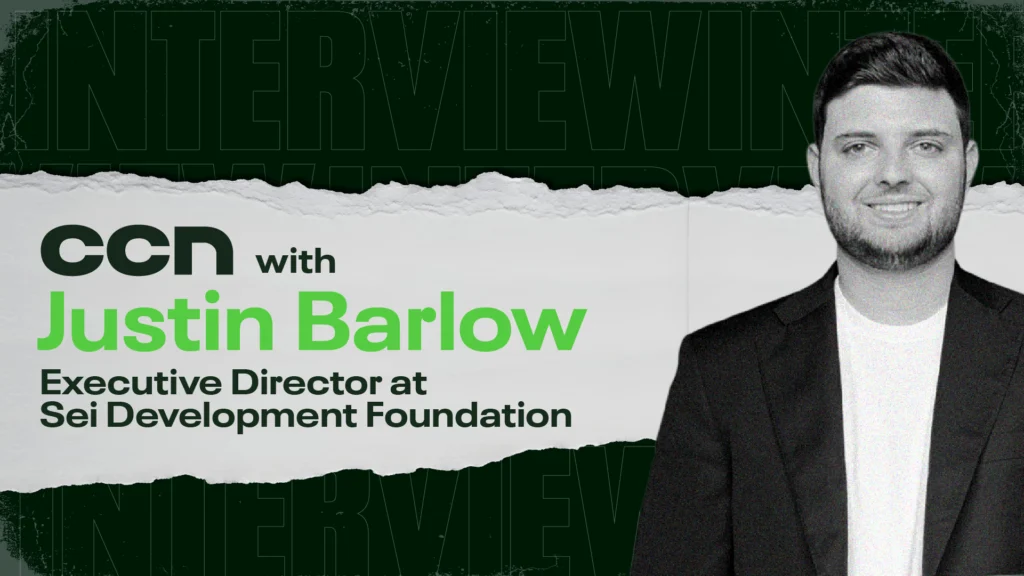
At the Blockchain Futurist Conference 2025, Dr. Guneet Kaur, Senior Editor at CCN, spoke with Justin Barlow, Executive Director of the Sei Development Foundation.
The conversation focused on Sei’s scalability, its approach to AI-driven automation, and the potential impact of quantum computing on blockchain security.
Amid rising interest in AI agents, on-chain automation, and quantum-resilient cryptography, Barlow outlined how Sei delivers high-speed performance today while preparing for a future where intelligent systems and blockchain technology operate side by side.
Sei’s High-Speed Performance and Scalable Infrastructure for Developers
Dr. Guneet Kaur began by addressing Sei’s reputation for speed and performance at the protocol level. When asked what that means for developers building on Sei, Barlow said:
“When you make a transaction using the Sei network, it’s fast and it’s cheap, which means for the user, it’s a very smooth experience that feels just as easy as using something like Venmo, but has the benefits of blockchain on the back end.”
Venmo is a U.S.-based mobile payment app owned by PayPal. The comparison underscores how Sei aims to deliver the speed and convenience of Web2 apps while operating on-chain.
Barlow also emphasized that Sei’s architecture is built to handle usage spikes without losing reliability.
“Sei is an extremely scalable, high-throughput chain. You can see upwards of 12,000 transactions per second without having the performance bottlenecks that you have on other chains,” Barlow said.
AI Agent Adoption and Sei’s Early Integration of the X402 Protocol
In July 2025, Sei announced its integration with MCP (Model Context Protocol), enabling AI agents to read blockchain data and execute transactions. Dr. Kaur asked how Sei envisions agentic systems evolving over the next 12 to 18 months.
“I think it’s likely that not just on Sei but on the internet in general, we’ll see a significant portion of transactions being done by AI agents,” Barlow said.
“This is the flow of AI being adopted more widely, the tooling becoming better, and Sei is just one part of that.”
Discussing how Sei is preparing its infrastructure for autonomous AI agents, Barlow explained that Sei’s early adoption of the X402 protocol allows for seamless agentic payments.
“Sei, like a number of other technologically advanced chains, is making a really big effort to adopt protocols that can help enhance the experience for AI agents. An example is the X402 protocol, which was adopted by Sei very early on and has since been adopted by a number of other chains as well.”
When asked about the proliferation of ‘X402 tokens’ following Coinbase’s announcement of the X402 protocol, Barlow said:
“The vast majority of these tokens have no underlying connection to X402 other than in name. I think we’ll likely see more projects inherently linked to the protocol by default, and that’s where real utility will emerge.”
He compared the phenomenon to the memecoin craze:
“During the memecoin craze, tokens like SPX 6900 served as memes of the SPX in traditional finance, but now we are seeing the actual launch of tokenized equities on blockchain rails. Similarly, with X402, we have the memes first and later we’ll have the real integrations.”
Sei’s Quantum Resilience and Future Security
With discussions around Bitcoin’s future under quantum computing gaining momentum, Dr. Kaur asked how Sei is approaching cryptographic migration and the long-term quantum-safe roadmap.
“Many people are talking about quantum resistance, but what’s important to remember is how far off we are from these things actually being used in production,” Barlow said.
“One year in crypto is like seven years in the real world. For most teams, focusing too hard on quantum before it’s commercially viable is probably a distraction for now.”
He added that in the meantime, the focus should be on optimizing the technology available today.
“Teams like Sei Labs and others in the ecosystem can build a lot in the time between now and when quantum becomes a real threat.”
Discussing tokenized institutional funds launched via KAIO on Sei, Barlow noted the balance between performance and long-term security.
“Agents are natively going to be part of the blockchain world, whether through payment protocols like X402 or data integrations like MCP. From the agent perspective, all assets should be compatible with agentic flow,” he emphasized.
The Convergence of AI, Machine Learning and Blockchain on Agentic Rails
Dr. Kaur asked about the next wave of innovation, how Sei views the convergence of AI, machine learning, and blockchain compared with a focus on simply improving transaction throughput.
Barlow said, “I think a lot of on-chain finance and real-world finance will move to agentic rails. And so what that means is that agents will be paying for everyday things like API calls, managing your data, etc.”
He continued, “Sei is really gearing towards this place where you can have a fast, cheap experience, not just for real-world users but also for agents as well.”
Trust, Transparency and Security in an AI-Driven Blockchain Environment
Dr. Kaur then turned to the question of trust, auditability, and finality in a world where AI automation and quantum threats are rising.
Barlow explained, “Sei is an open source, fully permissionless blockchain. And what that means is that anyone can verify transactions on the chain. The chain has been extremely well battle-tested over the last few years, processing over 4 billion transactions, and we will continue to see more and more teams building applications that take advantage of this inherent performance as well as the battle-tested nature of the chain.”
When asked about the risks of AI agents, including smart contract bugs, misbehavior, or hallucination, Barlow said,
“There are risks across the spectrum when you talk about crypto or even when you talk about Web2 as well. I think the important thing is leaving a lot of the flexibility and decision-making in the hands of users and developers.”
Barlow emphasized that developers have the tools they need to have safe transactions and interactions on-chain.
“They also have the flexibility where they aren’t heavily restricted by the types of transactions they can do or the people they choose to engage with”, he said.
As the discussion concluded, Barlow emphasized Sei’s commitment to building technology that serves both present and future needs.
By combining high-speed infrastructure with readiness for AI integration and quantum security, he said Sei aims to provide a foundation where humans and intelligent agents can interact transparently, securely, and at scale.
For Barlow, the mission is clear: to make blockchain performance indistinguishable from traditional systems while keeping it open, verifiable, and built for the innovations ahead.
The information provided in this article is for informational purposes only. It is not intended to be, nor should it be construed as, financial advice. We do not make any warranties regarding the completeness, reliability, or accuracy of this information. All investments involve risk, and past performance does not guarantee future results. We recommend consulting a financial advisor before making any investment decisions.

Dr. Lorena Nessi is an award-winning journalist and media technology expert with 15 years of experience in digital culture and communication. Based in Oxfordshire, UK, she combines academic insight with hands-on media practice.
She holds a PhD in Communication, Sociology, and Digital Cultures, and an MA in Globalization, Identity, and Technology.
Lorena has taught at Fairleigh Dickinson University, Nottingham Trent University, and the University of Oxford. She is a former producer for the BBC in London, with additional experience creating television content in Mexico and Japan.
Her research focuses on digital cultures, social media, technology, capitalism, and the societal impact of blockchain innovation.
She has written extensively on digital media and emerging technologies, with her work featured in both academic and media platforms. Her Web3 expertise explores how blockchain technologies shape culture, economics, and decentralized systems.
Outside of work, Lorena enjoys reading science fiction, playing strategic board games, traveling, and chasing adventures that get her heart racing. A perfect day ends with a relaxing spa and a good family meal.

Dr. Guneet Kaur is a senior editor at CCN.com and a Science Fellow at Exponential Science. She is a fintech and blockchain expert with extensive experience in digital finance education, blockchain ecosystems, and cryptocurrency markets. She has worked with global media such as Cointelegraph, as well as education and blockchain platforms, to design and lead strategic content and learning initiatives. As an educator and assessor for top-tier executive programs, she bridges real-world fintech trends with academic insight.
Dr. Kaur is also a published researcher and peer reviewer across fintech and data science journals, including Financial Innovation Journal and International Journal of Big Data Intelligence and Applications. Her work spans data-driven analysis, Web3 innovation, and technical content development. With a strong foundation in both industry and academia, she translates complex financial technologies into practical applications, empowering learners, professionals, and institutions across the rapidly evolving digital finance landscape.


 Easy
Easy