Home / Education / Crypto / Investing / Tether Is Quietly Becoming One of the World’s Largest Private Gold Holders — Here’s Why It Matters for USDT Stability and Bitcoin
But what’s wild about this is who’s buying: Tether (USDT stablecoin issuer).
The stablecoin issuer’s September 2025 reserve reports $12,921,449,635 under the precious metals category, which it then clarifies as LBMA-standard physical gold bars, not exchange-traded funds or futures. That’s right, the digital asset company is holding physical gold.
Tether has quietly accumulated around 140 metric tons of gold worth roughly $24 billion (at the time of writing), making it one of the largest known private holders of bullion outside banks and governments, according to company executives.
TETHER HAS QUIETLY AMASSED AROUND 140 TONS OF GOLD
Tether has quietly amassed around 140 tons of gold—worth about $24 billion—making it the largest known private holder outside banks and governments. The crypto giant is buying 1–2 tons per week, storing bullion in a former Swiss…
The firm is reportedly buying 1–2 tons per week, storing the metal in high-security Swiss vault facilities often described as former nuclear bunkers, and plans to expand into gold trading alongside backing its gold-linked token XAUT, which it expects could reach up to $10 billion in circulation.
These purchases have positioned Tether among the world’s largest new gold buyers and coincided with gold prices pushing to record highs above $5,200 per ounce, as the company says it increasingly views gold as a central-bank-style reserve asset amid weakening confidence in fiat currencies.
This matters because USDT comprises a significant portion of the cryptocurrency market infrastructure, and when people trust it, Bitcoin liquidity tends to stay strong. When that trust breaks, however, traders rush to dump their holdings, and Bitcoin can get hit as a byproduct.
This article discusses how Tether’s “central-bank-like“ behavior may affect the wider crypto market, and the potential risks or benefits that may come alongside the issuer’s ever-increasing holdings.
What Is Tether (USDT) and How Is It Backed?
USDT is a stablecoin, or a cryptocurrency pegged to the US dollar. Tether claims that it holds reserves that match its number of tokens, so coin redemptions won’t alter its stability.
In practice, those reserves are a mix of assets. Tether releases regular reports about what it holds, but it refuses to publish a full public audit like many skeptics call for. The entity has discussed an audit with a Big Four firm, but the long-standing report has been a long-running issue for the company’s credibility.
Breakdown of Tether’s Reserve Assets (Cash, Treasuries, Bitcoin, Gold)
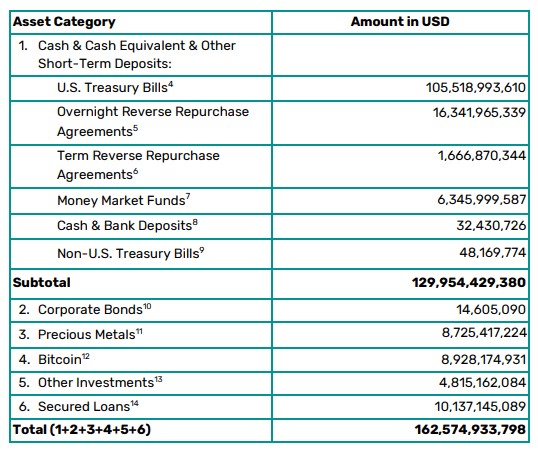
In Tether International’s existing reports, its biggest reserve holdings are typically in US Treasury bills, as well as cash-like tools such as repo or money market funds.
That said, Tether also holds Bitcoin and gold in its reserve mix. For instance, its June 2025 report lists about $8.9 billion in Bitcoin and $8.7 billion in precious metals.
Source: Tether International
Why Reserve Transparency Matters for Stablecoin Trust
This level of reserve transparency is a must, as stablecoin value can fluctuate from its $1 peg should trust begin to break. If traders think an issuer’s reserves are suspect or hard to redeem, they may dump the token.
How Much Gold Does Tether Actually Own?
If you’re looking for how much gold Tether owns in tons, you have to do some math, as Tether reports its gold in dollars. Here are its three most recent reports and their gold value:
So if gold is around $5,090 per troy ounce and Tether has $12,921,449,635 in gold value, that’s about 2.54 million troy ounces. The National Institute of Standards and Technology lists one troy ounce as 31.1 kilograms, and 1 ton (2,000 pounds) is about 9.2 kilograms, the math works out to roughly 87 tons of gold.
Tether also purchased 27 metric tons of gold in Q4 2025 as part of an investment fund for its reserves, bringing its total gold holdings to about 116.8 metric tons (roughly 128.7 U.S. tons).
Why Is Tether Accumulating Gold Instead of Only US Treasuries?
Tether’s gold accumulation is similar to central bank activity, focusing on diversification over keeping all of its eggs in one basket. There are multiple reasons for this.
Gold as a Hedge Against Inflation and Currency Risk
Gold may hold its value when people worry about inflation or currency issues. The former issue is especially important, considering the company’s stablecoin is tied to the dollar. If Tether thinks these risks are at play, gold acts as a sort of hedge against them.
Geopolitical Risk and De-Dollarization Trends
Gold is also a global asset with a value that doesn’t depend on any other country. For instance, Tether’s US Treasuries are technically an IOU from the US government, while corporate bonds are a promise that a company will pay you back. Nobody has to pay Tether for a gold bar to have value.
Why Gold Fits a Global Stablecoin Business Model
Much like gold, Tether is an international company offering an international product in USDT. Both USDT and gold are globally recognized and are still valuable even in places where people don’t trust banks.
Tether is also combining its gold holdings and stablecoin offerings, with its gold-backed stablecoin XAU₮ making up about 60% of the $4 billion market.
What Tether’s Gold Strategy Means for USDT Stability
Gold is just one factor in the USDT stability story, but it’s an important one.
How Gold Improves Long-Term Reserve Diversification
As mentioned, gold protects against inflation or the devaluation of other assets in Tether’s reserves, but it’s important to note that the metal is far from “backup collateral” for USDT. It also promotes the value of XAU₮, building a wider reserve strategy over time.
Liquidity vs. Stability: Gold Compared to Treasuries
US Treasuries make for speedy trades. Tether can trade them en masse at almost any time for fast redemption. Physical gold is liquid as well, but requires additional redemption steps.
That said, gold will hold its value longer term while other assets crash, while Tether can sell US Treasuries in anticipation of a short-term issue. Think of gold as long-term protection, and Treasuries as an immediate sell-off when needed.
Could Gold Reduce the Risk of a USDT Depeg?
A USDT depeg typically occurs when traders sell more than buyers can keep up, which can happen during a panic.
Gold might help prevent panic, as if Tether’s reserves are appropriately diverse, traders might see the entity as more reliable during a crisis.
That said, gold redemptions take time, and if the market thinks Tether will struggle to make redemptions fast, USDT might still depeg due to a lack of trust.
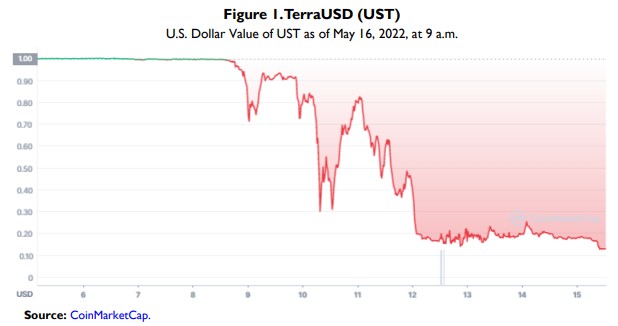
This is what happened during the May 2022 panic after Terra’s collapse. USDT fell to about $0.95 on May 12, 2022, due to billions in redemptions, with Tether’s reserves dropping by about $16 billion in total.
Source: CoinMarketCap via Congress.gov
TerraUSD (UST) was an algorithmic stablecoin that tried to hold $1 using a mint-and-burn tie with its LUNA token rather than real cash reserves. UST collapsed when a ton of holders tried to sell or redeem UST at the same time. It plunged well below the peg (down to roughly $0.67 on May 10 and near $0.31 on May 11). The crash dissolved trust in the stablecoin market, and USDT briefly traded below $1 during the same panic before recovering.
The FTX scandal in November 2022 caused depegging as well, as customers rushed to liquidate their exchange holdings. The panic had USDT drop to $0.97 before recovering.
All this to say that diversified assets such as gold might prevent a USDT depeg, as its value is backed by more than just one kind of asset.
Do Strong USDT Reserves Support Bitcoin Trading Volume?
Most Bitcoin trades worldwide are executed against USDT rather than fiat currencies. When confidence in USDT is high, traders are more willing to hold large stablecoin balances on exchanges, which supports:
Higher spot trading volume
Faster capital rotation between assets
Easier entry and exit during volatility
Stronger reserves, especially diversified ones, help reinforce trust that USDT can maintain its dollar peg even during market stress, which in turn supports continuous trading activity.
How Gold Fits Into Tether’s Reserve Strategy
Gold does not directly back day-to-day redemptions the same way cash and short-term government bonds do, but it plays a role as a long-term value stabilizer within Tether’s overall reserve structure.
Gold-backed assets can help by:
Reducing exposure to single-asset risk
Providing protection during currency or bond market stress
Strengthening balance-sheet resilience over long periods
For traders, this diversification can improve confidence that Tether remains solvent even if traditional markets face shocks, which supports ongoing use of USDT in large Bitcoin markets.
Does Gold Backing Increase Bitcoin Trading Volume Directly?
Not directly. Bitcoin trading volume depends primarily on:
Market volatility
Investor sentiment
Macro liquidity conditions
Exchange activity
However, reserve strength affects market plumbing, not price direction. When traders trust stablecoin backing, they are more willing to keep capital inside the crypto ecosystem rather than moving back to banks, which can indirectly support higher and more stable trading volumes.
In other words, gold in reserves does not cause Bitcoin rallies, but it can help keep liquidity channels open when markets are uncertain.
Where Is Tether’s Gold Stored?
Tether has stated that its physical gold holdings are stored in secure vault facilities in Switzerland, a country known for its long-standing role in global bullion custody and private asset storage. While the company does not disclose the exact locations for security reasons, the gold is held in high-security, professionally managed vaults that meet international bullion standards, similar to those used by banks and commodity institutions.
In public statements related to its gold-backed token (XAUT) and reserve disclosures, Tether has indicated that its bullion is kept in Swiss vaults compliant with London Good Delivery standards, which means the gold bars meet strict requirements for purity, weight, and chain-of-custody documentation. These standards are widely accepted in global gold markets and are required for large-scale institutional trading and settlement.
These facilities as fortified, bunker-style vaults, reflecting the type of infrastructure commonly used in Switzerland for precious metals storage. However, Tether has not confirmed whether the gold is held in former military bunkers or private vault operators, only that it is secured in professional, insured storage facilities designed specifically for high-value bullion custody.
From a reserve-management perspective, storing gold in Switzerland provides several advantages: strong property rights, political neutrality, mature custody infrastructure, and easier access to global bullion markets if assets need to be mobilized or reallocated. While gold is not used for day-to-day stablecoin redemptions, its role in Tether’s reserves is to strengthen long-term balance-sheet resilience rather than provide immediate liquidity.
Is Tether Becoming a Private Central Bank?
Tether is replicating central bank activity, such as building a large reserve portfolio, holding gold, and protecting itself from future liquidity issues, but it doesn’t abide by the same rules or have the same oversight as a central bank.
However, Tether launched USA₮, a US-regulated stablecoin, in January 2026. The asset operates only in the United States and aims to provide a compliant digital dollar for the US financial system. With its launch, US fintech companies can use USA₮ for payroll, corporate treasurers could treat USA₮ similar to a Treasury bill, and banks or exchanges could offer USA₮ custody.
In a recent interview with Bloomberg, Tether CEO Paolo Ardoino said the company has become one of the largest private holders of gold in the world, holding around 140 metric tons of physical bullion valued at roughly $23–24 billion as part of its reserve strategy, a hoard that rivals the holdings of many sovereign states and puts Tether among the top global gold players outside central banks and major ETFs.
He described Tether’s approach as similar to a “gold central bank,” noting that the firm is buying gold at a rate of about 1–2 tons per week and intends to continue doing so in the near term, using the metal not only to strengthen its balance sheet and back products like its gold-linked stablecoin XAUT but also to build a competitive gold trading operation in the bullion market.
Ardoino said these moves help diversify away from traditional assets such as U.S. government debt and reflect a long-term strategy tied to broader market and geopolitical trends.
How Tether’s Balance Sheet Compares to Sovereign Reserves
That said, Tether’s reserves are large enough to overlap with smaller countries’ reserves. Australia, for instance, only reports around 80 tonnes of gold, and Tether’s own XAU₮ report claims it has surpassed other countries like Greece and Qatar.
Risks and Criticisms of Tether’s Gold Accumulation Strategy
Of course, Tether’s gold accumulation is not without its critics.
Despite Tether’s claims, there’s the ever-present problem of independently verifying all of the entity’s reserves, be it gold or USD. Consultant John Reed Stark argues that Tether relies heavily on attestations, not a full audit, which he believes is cause for speculation.
Source: @JohnReedStark on X
Web3 security firm Three Sigma also highlights the operational friction that comes with redeeming gold-backed tokens. Tether gold redemption takes time and additional fees, which get in the way if traders are trying to withdraw fast.
And none of this is to mention the fact that the S&P rated Tether as weak in its November 2025 stability assessment due to “an increase in higher-risk assets backing USDT’s reserve” since its last review.
What Crypto Investors and Traders Should Watch Next
From here onward, keep an eye on the following regarding Tether’s gold movements:
Pay attention to Tether’s next reserve report to see if gold keeps rising as part of its holdings.
Watch whether or not Tether ever closes its “full audit” gap. Reserve reports are different than full audits, which critics have been vocal about for years.
Track how Tether’s USA₮ develops in the US. If Tether launches a strict, US-compliant stablecoin, it could change how the company positions USDT around the world as well.
How much gold does Tether currently hold to back USDT reserves?
Tether reports gold as a dollar value inside its reserve snapshots. As of Sept. 30, 2025, it listed $12.9 billion in precious metals and described it as LBMA-standard physical gold bars.
Does Tether’s gold reserve improve the stability and safety of USDT?
It can help with long-term diversification, but it does not solve the core “speed” problem in a redemption rush. In a panic, markets want assets that can turn into dollars fast.
Why is Tether investing in physical gold instead of only US Treasuries?
Gold can hedge inflation and currency stress, and it is “no one else’s liability,” which can matter in geopolitical tension. It also supports Tether’s gold token (XAUT) business.
Could Tether’s gold strategy impact Bitcoin and the broader crypto market?
Yes. Because USDT is a major trading and liquidity rail for crypto, trust in its reserves can affect market liquidity and risk mood, which can spill into Bitcoin volume and pricing.
Max Moeller is a Chicago‑based writer and video editor passionate about games, tech, and crypto. Whether it’s crafting clear, insightful articles or piecing together engaging video retrospectives, he’s driven by curiosity and takes pride in keeping things human. Since 2017, Max has been published in a variety of notable crypto magazines.


 Easy
Easy