How Perpetual DEXs Differ From Centralized Exchanges — and What Traders Should Know
Share
Key Takeaways
$ASTER surged 2,800% in its first week, pushing market cap above $3 billion and briefly eclipsing Hyperliquid in daily perp trading volume.
CZ’s endorsement and exchange listings fueled FOMO, amplified by whales and a massive airdrop campaign.
Aster offers 1001x leverage, hidden orders, multichain access, and stock perps — features designed to stand out in the crowded DEX space.
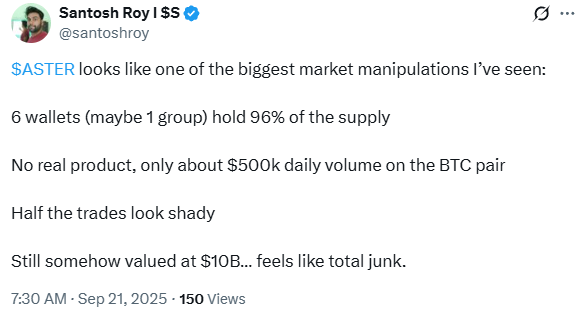
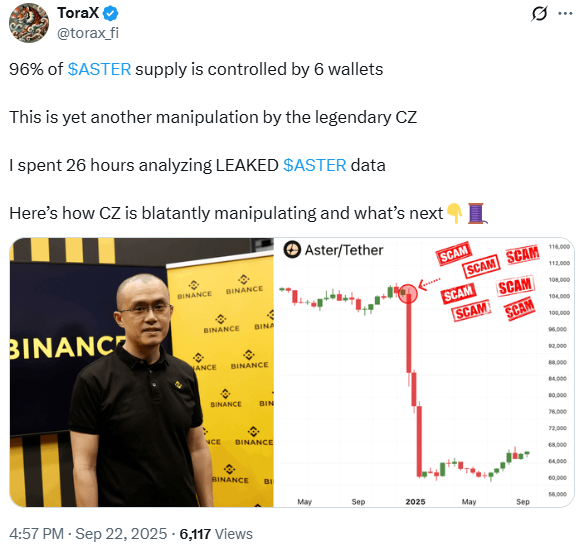
Six wallets control 96% of supply, raising risks of whale manipulation and sudden sell-offs.
In the fast-paced world of decentralized finance (DeFi), Aster has ignited a firestorm. Launched on Sept. 17, 2025, via CoinMarketCap’s first-ever pre-TGE launchpad, its native token, $ASTER surged approximately 2,800% from a TGE price of $0.08439 to an all-time high of $2.42 by Sept. 24, pushing its market cap to $3.7 billion and ranking it among the top 50 cryptocurrencies.
More impressively, Aster’s perpetual futures trading volume hit $24.7 billion on Sept. 24, outpacing rival Hyperliquid’s $10 billion, with daily revenue peaking at $7.2 million.
With over 2 million users and $2 billion in total value locked (TVL), Aster’s meteoric rise, fueled by CZ’s hype and a massive airdrop, has DeFi buzzing.
But whispers of whale control cast shadows.
Here’s how Aster pulled it off and what’s driving the frenzy.
We sometimes use affiliate links in our content, when clicking on those we might receive a commission at no extra cost to you. By using this website you agree to our terms and conditions and privacy policy.
Born from the 2025 merger of Astherus (yield protocols) and APX Finance (perp trading), it runs on BNB Chain, Solana, Ethereum, and more, blending spot trading, perps, and even tokenized U.S. stocks in “Pro Mode.”
The rocket fuel? CZ’s endorsement.
On Sept. 18, he tweeted about Aster’s “Binance-like” liquidity and dark-pool privacy features, sparking FOMO that sent $ASTER vertical from $0.17. Listings on KuCoin, Gate.io, MEXC, and whispers of a full Binance spot/perp debut by Oct. 1 followed.
CZ: Aster becomes the biggest BSC-USDT holder apart from Binance Hot Wallet. | Source: @cz_binance on X.
Whale action piled on: Wallets linked to MrBeast deposited $114K USDT, and three whales scooped $61 million in $ASTER in 24 hours on Sept. 24.
Cumulative volume? Over $514 billion since March, with $7.2 million in fees on September 23 alone, topping Hyperliquid.
The 2,800% Surge: Breaking Down the Numbers
TGE (Sep 17, 2025): $ASTER launched at $0.08439 on Aster DEX, with spot trading kicking off on KuCoin and others by Sept. 18.
All-time high:Reached $2.42 on Sept. 24, a 2,768% increase ([($2.42 – $0.08439) / $0.08439] × 100%). CoinGecko notes a similar $2.41 peak (2,757%).
Current price (Sept. 26, 2025, 13:01 PM CET): $1.80-$1.88, down 21% from ATH but still up 2,033% from launch.
Market cap: $3.0 billion (1.66 billion circulating supply out of 8 billion total).
The catalyst? A 53.5% airdrop (4.28 billion tokens), with 704 million (8.8%) unlocked at TGE, and Season 2 (ending Oct. 5) offering 4% more ($800M at peak) via Rh points for trading/holding.
CZ’s Sept. 18 tweet, “Aster is the perp DEX we’ve been waiting for, liquidity like Binance, but decentralized,” lit the fuse, with whale buys (e.g., $61M in 24 hours) and listings on Gate.io, MEXC, and LBank amplifying FOMO.
What Is Aster, Anyway?
Aster isn’t your grandma’s spot trader. It’s a decentralized exchange (DEX) laser-focused on perpetual futures, those never-expiring contracts where you bet big on crypto (or even U.S. stocks) price swings without owning the underlying asset.
Think of it as Robinhood meets Wall Street on steroids, but fully on-chain, non-custodial, and with zero KYC drama. No banks, no brokers, just you, your wallet, and up to 1001x leverage that can turn $100 into a yacht… or a liquidation nightmare.
It runs across heavy-hitters like BNB Chain, Solana, Ethereum, and Arbitrum, aggregating liquidity without clunky bridges.
Key perks?
Hidden orders for stealth trading (no front-running frontrunners).
Multi-asset collateral (e.g., USDC, Pendle PT-USDF) to juice your capital efficiency.
Pro Mode for stock perps—trade Tesla or Apple settled in crypto, no fiat fuss.
Backed by YZi Labs (the rebranded Binance Labs, tied to CZ himself) and other deep-pocketed VCs, Aster’s roadmap screams ambition: from mobile app upgrades to its own privacy-obsessed layer-1 chain (Aster Chain) launching in testnet soon.
DEX Wars: Aster vs. Hyperliquid — Who Wins?
Hyperliquid has ruled perp DEXes like a benevolent dictator, clocking $300 billion monthly volume and $12.8 billion daily averages with its slick HyperEVM layer and 97% fee buybacks for $HYPE. But Aster’s crashing the party, flipping the script in this “Perp DEX Meta.”
Perps, spot, plus “stock perps” (U.S. equities exposure)
Perps, spot, margin for crypto assets
Leverage & collateral
Up to 1000×, supports yield-bearing collateral
Up to 50×, stablecoin collateral (e.g. USDC)
Order book / execution
Hybrid with order book + hidden orders (dark/iceberg)
Fully on-chain order book, low latency
Cross-chain / accessibility
Strong multichain interoperability, less bridge reliance
Primarily native to Hyperliquid chain, bridges for others
Speed & finality
Host chain–dependent, variable latency
Sub-second execution & finality
Native token
ASTER (governance, incentives, participation)
HYPE (governance, staking, fees)
Fees
Trading fees + gas (depends on chain)
No gas fees; maker/taker fees only
Market position
New entrant, fast traction & narrative momentum
Established leader in on-chain perps, deeper liquidity
Aster‘s multi-chain vibe and CZ shoutout (he called it “Binance-like” with better liquidity) sparked FOMO, eroding Hyperliquid’s market share from 71% in May to 38% now.
BNB Chain even flexed by surpassing Hyperliquid’s 24-hour perps volume overall. But Hyperliquid’s no slouch, its user base grew 78% in the first half of 2025 to 518,000, and it’s listing $ASTER for 3x leveraged trades. The war’s just heating up.
In just seven days, Aster’s trading volume hit $228 billion, almost triple Hyperliquid’s $80.5 billion, while generating $93.5 million in fees, surpassing Circle and even topping Tether in daily earnings.
Aster’s token has soared over 2,800% since launch, pushing its market cap near $4 billion. While Hyperliquid’s HYPE token still sits at $16 billion, Aster’s rapid growth calls its dominance into question.
96% Controlled by 6 Wallets? The Shocking Truth Behind ASTER’s Token
Here’s where it gets juicy and terrifying. On-chain sleuths from Arkham, Bubblemaps, and Lookonchain reveal a nightmare distribution: six wallets control over 96% of the total $ASTER supply.
That’s 7.68 billion tokens at current prices, worth over $11.5 billion FDV, locked in what analysts call “likely one entity” via SafeProxy multisigs.
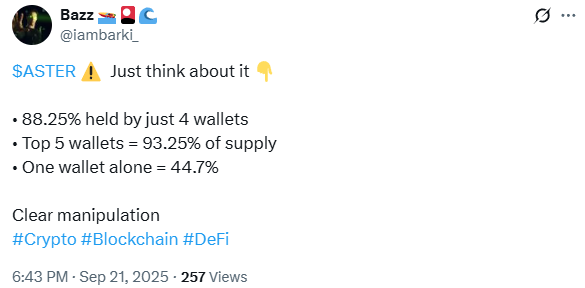
Next four: 48.5% combined, pushing the top five to 93%+.
Exchanges? A measly 3.29% across Binance and others, 25x less than the top holders.
These aren’t random degens; they’re tied to team vaults, ecosystem pools, and migration from APX (1:1 swap, giving early holders 18x gains at zero cost).
One vault (0x128463a60784c4d3f46c23af3f65ed859ba87974) alone moved 168 million tokens in 24 hours. Vesting? The remaining airdrop (3.6 billion) unlocks over 80 months, ecosystem tokens over 20, delaying dumps but not erasing control.
Risks Surrounding Aster: Whale Control, Volatility and Regulatory Shadows
While Aster’s 2,800% surge and $24.7 billion daily trading volume paint a picture of DeFi dominance, the platform’s meteoric rise comes with serious risks that could derail investors and traders.
From extreme token concentration to regulatory red flags, here’s a breakdown of the key dangers surrounding Aster as of Sept. 26, 2025.
Extreme token concentration:Six wallets hold 96% of $ASTER’s 8 billion supply (7.68 billion tokens), with one controlling 44.7%, risking price crashes from whale dumps like the 168 million tokens moved in 24 hours.
High volatility and leverage:1001x leverage can wipe out positions with a 0.1% price move, and $ASTER’s 2,800% surge to $2.42, then 21% drop to $1.80, shows unstable price action.
Regulatory risks: Aster’s no-KYC model invites potential SEC/FBI scrutiny, which could disrupt operations or force compliance shifts.
Competitive pressure: Despite outtrading Hyperliquid ($24.7 billion vs. $10 billion daily volume), Aster’s $2 billion TVL trails Hyperliquid’s $3.5 billion, risking loss of its 38% market share gain.
Airdrop liquidity flood: The Oct. 1 unlock of 4% of supply ($800 million at peak) could flood liquidity, potentially crashing $ASTER’s price if traders sell off.
The truth? Aster’s a double-edged sword: Killer tech (hidden orders, stock perps) meets cartel-level control. 96% in six wallets isn’t a bug; it’s the feature enabling this pump, but it risks a brutal rug if whales exit. Track vaults like 0xe8c3… and 0x1284… on Arkham.
Crypto’s casino rules: High risk, high reward. Aster proves whales win first. Trade smart, or watch from the sidelines. What’s your play?
Conclusion
Aster’s breakneck rise underscores both the opportunity and the peril at the heart of DeFi. Its multi-chain design, hidden-order features, and eye-watering leverage have propelled it to the forefront of perpetual DEX trading, even eclipsing Hyperliquid in daily volumes.
Yet its concentration of token supply in a handful of wallets, volatile trading swings, and looming regulatory risks cast long shadows.
For now, Aster embodies the paradox of DeFi’s frontier: innovation that excites traders and whales alike, but with fragilities that could unravel just as quickly.
Whether it cements a place among the dominant exchanges or fades as a cautionary tale will depend on how it manages adoption, governance, and scrutiny in the months ahead.
The surge was driven by CZ’s endorsement, a massive 53.5% airdrop, and $24.7 billion in daily trading volume, peaking at $2.42 from $0.08439 in a week.
Is Aster’s 96% token concentration a red flag?
Yes, six wallets holding 7.68 billion of 8 billion tokens (44.7% in one) risks price manipulation, as whale dumps could crash the market.
How risky is trading on Aster with 1001x leverage?
Extremely risky, a 0.1% price move can liquidate positions, and $ASTER’s 21% drop from $2.42 shows high volatility.
Could regulators target Aster’s no-KYC model?
Potentially, as its anonymity and CZ’s 2023 legal issues raise SEC/FBI scrutiny risks, which could disrupt operations.
Disclaimer:
The information provided in this article is for informational purposes only. It is not intended to be, nor should it be construed as, financial advice. We do not make any warranties regarding the completeness, reliability, or accuracy of this information. All investments involve risk, and past performance does not guarantee future results. We recommend consulting a financial advisor before making any investment decisions.
Giuseppe Ciccomascolo began his career as an investigative journalist in Italy, where he contributed to both local and national newspapers, focusing on various financial sectors.
Upon relocating to London, he worked as an analyst for Fitch's CapitalStructure and later as a Senior Reporter for Alliance News. In 2017, Giuseppe transitioned to covering cryptocurrency-related news, producing documentaries and articles on Bitcoin and other emerging digital currencies. He also played a pivotal role in establishing the academy for a cryptocurrency exchange website. Crypto remained his primary area of interest throughout his tenure as a writer for ThirdFloor.


 Easy
Easy