Even as Aster's token rockets and users pile in, the individual at the helm remains a complete enigma, a CEO known only as Leonard.| Credit: Roni Bintang/Anadolu via Getty Images.
Share
Key Takeaways
Aster’s CEO, Leonard, operates entirely behind a veil of anonymity.
The project has seen its token skyrocket shortly after launch.
Leonard stresses audits, community feedback, and long-term commitment as substitutes for transparency
Aster, a newly rebranded decentralized finance protocol, has surged into the spotlight in extremely quick fashion.
Yet even as its token rockets and users pile in, the individual at the helm remains a complete enigma, a CEO known only as Leonard.
Try Our Recommended Crypto Exchanges
Sponsored
Disclosure
We sometimes use affiliate links in our content, when clicking on those we might receive a commission at no extra cost to you. By using this website you agree to our terms and conditions and privacy policy.
Aster is the result of a merger between yield-protocol Astherus and a perpetual DEX known as APX.
The rebrand, formally announced in April, was intended to unify the strengths of both platforms and sharpen its identity in the increasingly crowded perp-DEX field.
Within days of token launch on Sept. 17, Aster’s native token witnessed dramatic upside.
In 24 hours, its value surged by hundreds of percent, fueled in part by public support from CZ, the founder of Binance.
The Man Behind the Curtain
From public records and interviews, Leonard’s presence is felt almost entirely through the protocol’s press materials and Ask Me Anything sessions (AMAs).
He is quoted discussing the branding, roadmap and security of the project, but has given no details of his identity or credentials.
Known only as Leonard, this degree of anonymity is not unusual in crypto, but it leaves open questions about the mysterious leader’s track record in the industry.
Leonard’s X profile is equally mysterious | Source: X
Leonard’s X profile is equally mysterious, sporting a profile picture of a hooded figure with no real details provided on his identity.
“CEO @Aster_DEX. Reimagining the future of Decentralized trading,” the bio reads.
The profile was also made in March this year, shortly before Aster’s rebrand was announced.
Promises and Potential Pitfalls
In the AMA, which was recorded in April, Leonard describes Aster as aiming to dominate two key revenue verticals in crypto: exchanges and lending.
The platform is divided into Simple mode, fully on-chain with no deposits, and Pro mode, built around an order book for professional traders.
The merger’s logic, Leonard explains, is that combining yield expertise and a perp-DEX gives Aster multiple levers for growth.
In order to control risk, Aster claims a multi-oracle architecture with internal risk monitoring will be implemented.
But making it work won’t be easy.
Leonard himself admits Aster is still behind on things like mobile usability and trading depth.
“We are also lacking behind on the mobile experience, which is a general issue in Web3,” he said in response to a user’s question.
“The nature of dApps makes the mobile experience less smooth,” he added. “We want to tackle this in the long-term by working with different wallets to develop a more native experience.”
The CZ Effect
No small part of Aster’s early success is tied to the visibility lent by CZ.
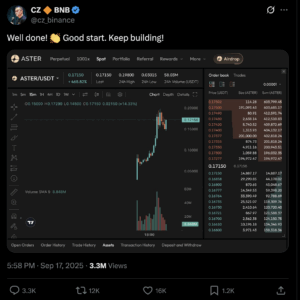
When the Binance founder publicly endorsed the token swap, it served as a signal to speculators:
“Well done! Good start. Keep building!”
On X, his post sharing an ASTER price chart helped amplify the hype and push momentum even further.
CZ gave a shout-out to Aster | Source: X
That momentum showed up quickly on-chain.
Aster’s trading volume spiked to more than $324 million, a level that suggests the rally was not just the result of thin liquidity or a small group of traders, but broad market participation.
“When volume rises alongside price, it indicates that the uptrend has genuine backing rather than being a short-lived spike,” CCN analyst Victor Olanrewaju said.
The Trust Paradox
In transparent projects where the founder is known, there is a sense of accountability because people know who to question if the protocol is flawed.
In anonymous projects, participants are forced to rely on code audits and community oversight.
Leonard’s responses in the AMA and on social media have attempted to bridge this gap, emphasizing a culture of community feedback, audits conducted by Peckshield, and a commitment to long-term goals.
Also, transparency does not always guarantee truth.
High-profile downfalls of figures like Sam Bankman-Fried have shown that even when leaders are visible and celebrated, they can still mislead their communities.
Kurt Robson is a London-based reporter at CCN, specialising in the fast-moving worlds of crypto and emerging technology. He began his career covering local news in Cornwall after graduating from Falmouth University with First Class Honours in Journalism. There, he cut his teeth on everything from council meetings to missing swans.
He quickly rose through the ranks to become a frontline journalist at several of the UK’s leading national newspapers. Over the years, he has interviewed musicians and celebrities, reported from courtrooms and crime scenes, and secured multiple front-page exclusives.
Following the upheaval of the COVID-19 pandemic, Kurt shifted his focus to technology journalism—just ahead of the AI boom. With a natural curiosity and a trained eye for emerging trends, he has found a new rhythm in reporting on innovation.
At CCN, Kurt's work focuses on the cutting edge of crypto, blockchain, AI, and the evolving digital world. Drawing on his background in people-first reporting and his deep interest in disruptive tech, Kurt delivers stories that are insightful, entertaining, and human-centric.