Ethereum enters 2026 with rising on-chain activity, shrinking liquid supply, growing institutional use, and macro tailwinds that could fuel a major breakout. | Credit: Veronica Cestari/CCN.com
Share
Key Takeaways
Ethereum’s on-chain fundamentals are strengthening despite price weakness, with record-high active addresses, transactions, stablecoin supply, and staked ETH.
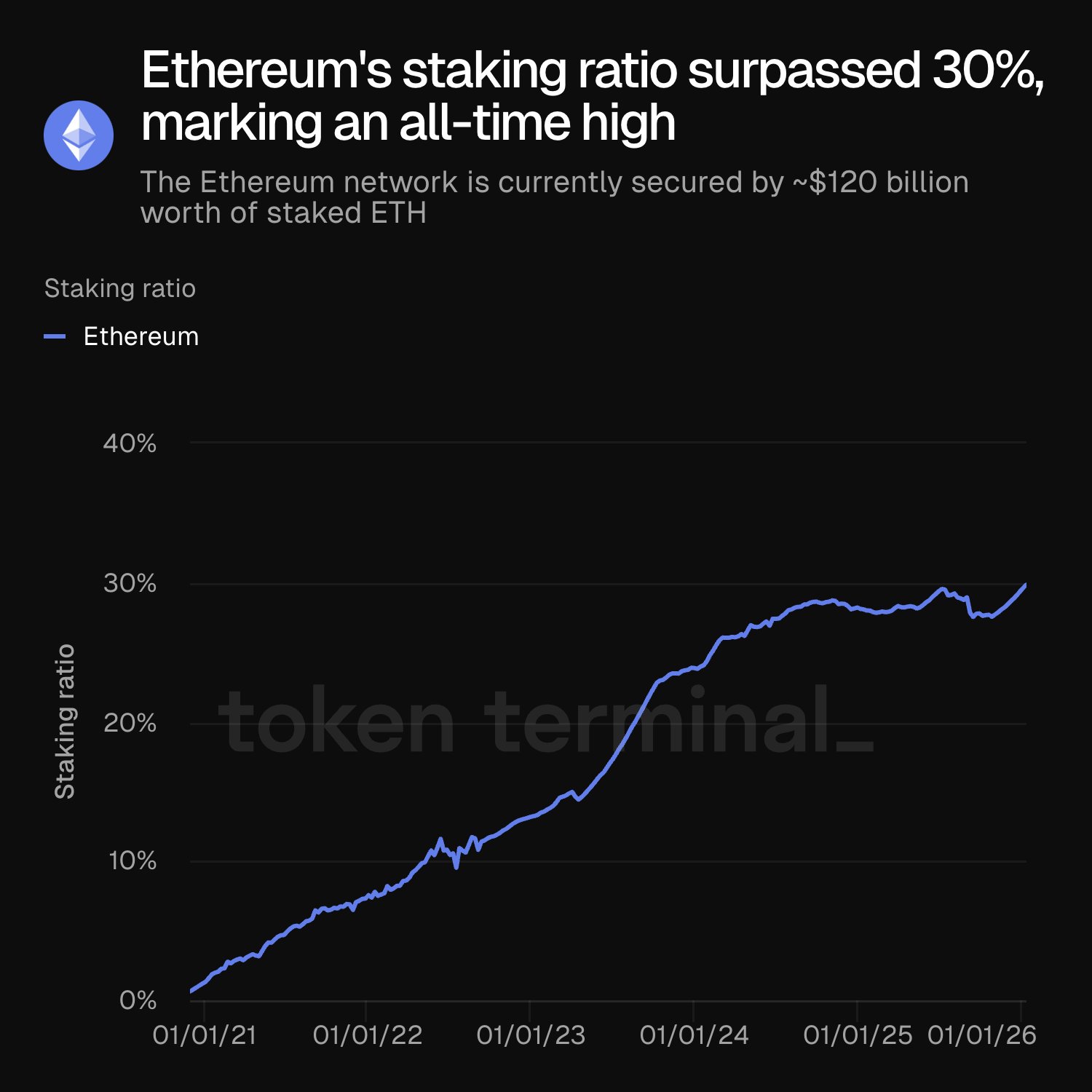
Over 30% of ETH supply is now staked, removing significant liquidity from circulation and creating structural supply constraints.
Gas fees have fallen to 2020 levels while activity rises, indicating that Ethereum’s scaling roadmap is working.
Risk-on market signals, including Russell 2000 strength, historically precede renewed capital flows into Ethereum.
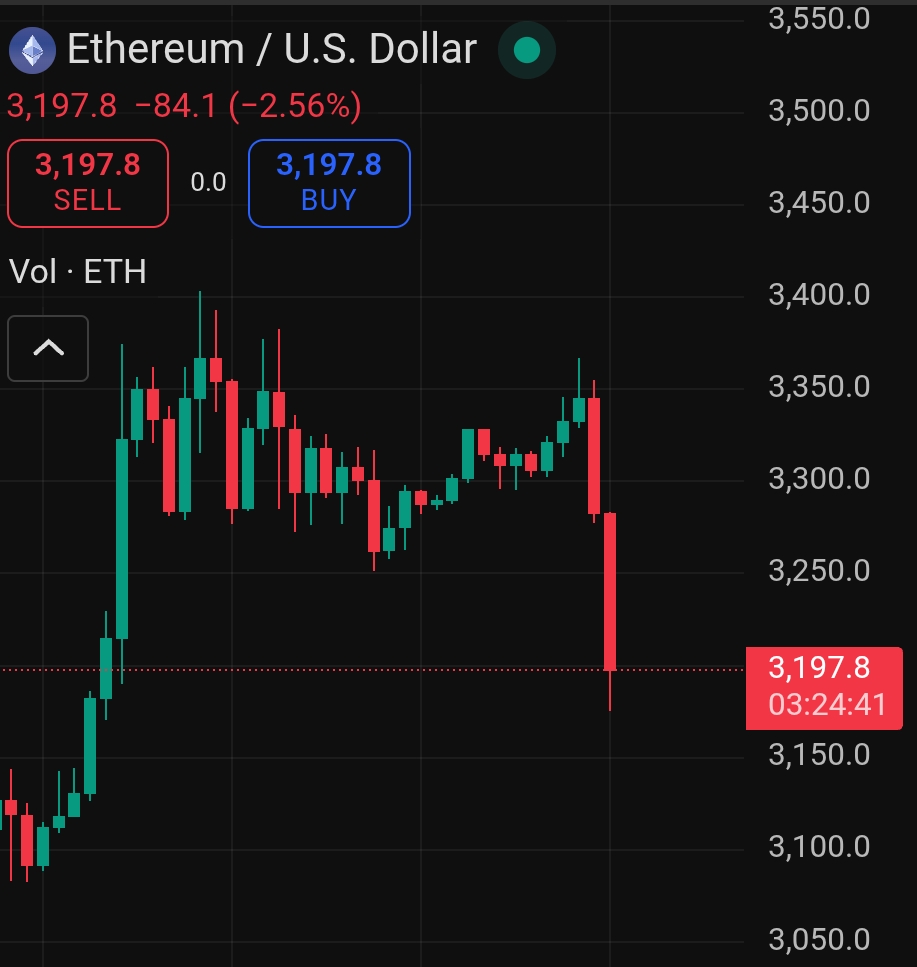
Ethereum enters 2026 in an unusual position. While Bitcoin surged to new highs earlier in the cycle, Ethereum largely lagged, barely exceeding its 2021 peak before pulling back sharply.
At first glance, that underperformance is a weakness. But under the surface, Ethereum’s fundamentals are arguably stronger than at any point in its history.
Network usage is climbing even as prices remain subdued. Institutional participation is accelerating. Regulatory clarity is coming into focus. And macroeconomic conditions may soon shift in ways that favor yield-bearing, productive assets over passive capital storage.
Together, these forces suggest that 2026 could be Ethereum’s most bullish year yet, not because of hype but because of structure.
1. Network Activity Is Rising While Prices Fall — A Rare Bullish Signal
In crypto markets, network activity typically tracks price action. During bull markets, usage explodes; during bear markets, activity dries up. Ethereum is currently breaking that pattern.
2026 COULD BE THE MOST BULLISH YEAR FOR ETHEREUM 🚨
And here's why:
1) Network activity
During a bull market, network activity goes up. During a bear market, network activity goes down.
In the past 3 months, the crypto market has been in a downtrend, but Ethereum network… pic.twitter.com/1OGjJDZRmg
Gas fees: back to Q2 2020 levels despite rising usage.
This combination is critical. It signals that Ethereum’s scaling roadmap, particularly rollups and layer-2 networks, is working. More people are using Ethereum, but they are paying less to do so.
Historically, sustained increases in activity during price drawdowns have often preceded major repricing events. Usage is demand. And demand rising quietly during pessimistic market conditions is usually the foundation of future upside.
This matters because the price is set at the margin. As the liquid supply shrinks, even moderate increases in demand can have an outsized effect on price. Unlike Bitcoin, where issuance is fixed but liquidity remains relatively accessible, Ethereum is increasingly locked into long-term security and yield strategies.
Institutional momentum is visible across several fronts:
ETH ETFs recorded their most significant weekly inflows since the October market crash.
Treasury-focused firms are accumulating ETH as a reserve asset.
JPMorgan launched its first tokenized money-market fund on the Ethereum network.
Stablecoin activity remains concentrated on Ethereum and its rollups.
This is no longer about experimentation. Ethereum is increasingly treated as neutral, programmable financial infrastructure, closer to plumbing than a speculative asset.
4. Regulatory Clarity Could Unlock Ethereum’s Biggest Growth Phase
Ethereum’s adoption curve has long been constrained by regulatory uncertainty, particularly in the United States. While Bitcoin has largely achieved commodity-like clarity, smart contract platforms have remained in limbo.
Clear rules don’t just validate ETH, they legitimize the economic activity happening on top of it. Reduced legal uncertainty lowers friction for banks, asset managers, fintech firms, and enterprises that are already building but hesitant to scale.
More clarity leads to more usage and more transactions, which bring more value into circulation on Ethereum.
5. Falling Interest Rates Could Shift Capital Toward ETH
Macro conditions are another underappreciated catalyst. As interest rates decline:
Ethereum staking ratio surpassed 30%, marking an all-time high. | Credit: Token Terminal
Even small reallocations matter. A $5-10 billion institutional rotation into ETH staking, minor by global capital standards, would be significant relative to Ethereum’s liquid supply and could materially impact price dynamics.
6. Risk-On Markets Are Flashing Green
Traditional markets are also sending signals. The Russell 2000 Index, a proxy for risk-on small-cap equities, has been hitting new all-time highs.
Historically:
Risk-on equities lead.
Crypto follows.
Ethereum benefits disproportionately.
With the Fed already engaging in Treasury bill purchases and expectations of a more liquidity-friendly environment by mid-2026, risk appetite may persist longer than many expect.
Ethereum’s Price Lag Masks Strong On-Chain and Institutional Momentum
Ethereum did not have the explosive rally many expected this cycle. Bitcoin nearly doubled its 2021 highs. ETH barely exceeded them before pulling back.
ETH/USD daily chart. | Credit: TradingView
That divergence raises a different question: Was Ethereum weak or simply early?
Ethereum is increasingly embedded in global financial infrastructure, often invisibly. If the next cycle is driven less by speculation and more by usage, Ethereum’s positioning looks uniquely potent.
Ethereum may have missed the spotlight this cycle. But the groundwork for 2026 is already in place.
Ethereum’s Utility Extends Far Beyond ETH Price
Much of the market still frames Ether (ETH) primarily as a tradeable token, but its real value increasingly comes from what is being built and settled on top of the network rather than short-term movements in ETH’s price.
Ethereum now serves as the base layer for several critical financial and digital functions, including stablecoin settlement, tokenized assets, decentralized exchanges, lending protocols, NFT infrastructure, and enterprise blockchain pilots. Billions of dollars in value move across Ethereum and its layer-2 networks daily, often without users directly interacting with ETH beyond gas fees in the background.
Stablecoins alone represent one of Ethereum’s strongest real-world use cases. Most on-chain dollar transactions, including remittances, cross-border settlements, and merchant payments, continue to flow through Ethereum-based infrastructure, making the network a core settlement layer for digital dollars. This activity is driven by utility rather than speculation.
Institutional adoption further reinforces this shift. Banks, asset managers, and fintech firms are increasingly using Ethereum for tokenized funds, on-chain collateral management, and settlement experiments, treating the blockchain more like neutral financial plumbing than a speculative platform. In many cases, end users may never realize they are interacting with Ethereum at all.
This growing layer of invisible usage matters because it anchors demand in functionality rather than hype. Even when market sentiment weakens, applications continue to process transactions, settle trades, and issue tokens. Over time, sustained utility tends to be more durable than speculative cycles, positioning Ethereum as infrastructure that can compound in relevance even when prices move sideways.
In that sense, ETH functions less like a standalone asset and more like a productive stake in a global transaction network — one whose value is increasingly linked to how much economic activity flows through it, not just how traders feel about it on any given day.
Ethereum is showing strong fundamentals despite recent price weakness. Network activity is reaching all-time highs, institutional adoption is accelerating, ETH supply is becoming increasingly locked through staking, and macroeconomic conditions, such as potential interest rate cuts, could favor yield-bearing assets like ETH.
How is Ethereum network activity performing compared to price?
Ethereum’s on-chain activity is rising even while prices remain well below all-time highs. Metrics such as daily active addresses, transaction counts, stablecoin supply, and staked ETH have all reached or approached record levels, a divergence that historically has preceded periods of price appreciation.
Why does staking matter for Ethereum’s price outlook?
Staking removes ETH from active circulation while providing yield to holders. With more than 30% of ETH now staked, the liquid supply available on exchanges is shrinking. This can amplify price movements if demand increases, especially from institutions.
What role do institutions play in Ethereum’s growth?
Ethereum has become the leading blockchain for institutional finance experiments, including tokenized funds, stablecoins, and settlement infrastructure. More than 35 major financial institutions have deployed or expanded products on Ethereum, signaling long-term confidence in the network.
Disclaimer:
The information provided in this article is for informational purposes only. It is not intended to be, nor should it be construed as, financial advice. We do not make any warranties regarding the completeness, reliability, or accuracy of this information. All investments involve risk, and past performance does not guarantee future results. We recommend consulting a financial advisor before making any investment decisions.
Giuseppe Ciccomascolo began his career as an investigative journalist in Italy, where he contributed to both local and national newspapers, focusing on various financial sectors.
Upon relocating to London, he worked as an analyst for Fitch's CapitalStructure and later as a Senior Reporter for Alliance News. In 2017, Giuseppe transitioned to covering cryptocurrency-related news, producing documentaries and articles on Bitcoin and other emerging digital currencies. He also played a pivotal role in establishing the academy for a cryptocurrency exchange website. Crypto remained his primary area of interest throughout his tenure as a writer for ThirdFloor.


 Easy
Easy