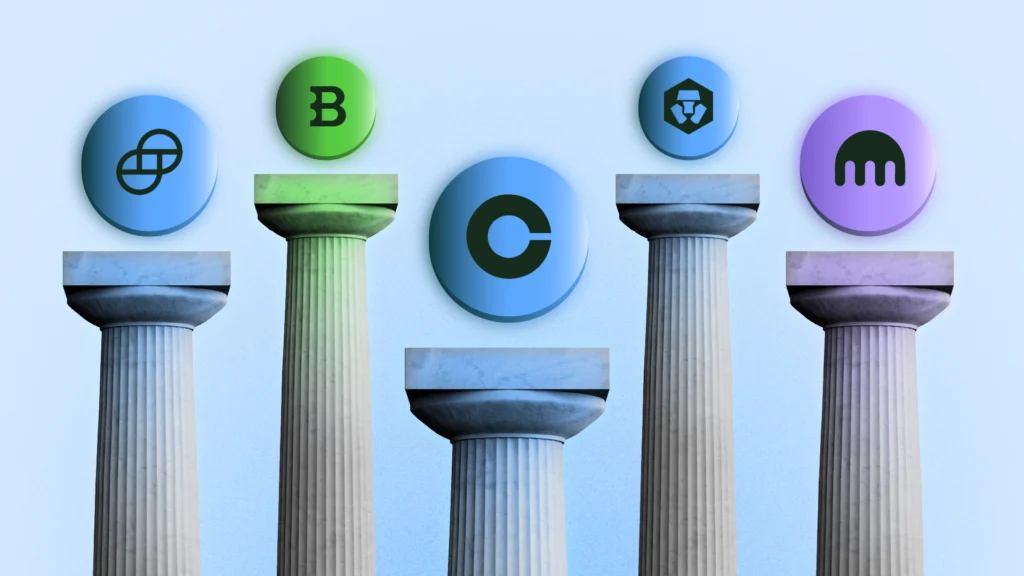
Discover which crypto exchanges outperformed Binance in 2025 and why governance, security, and transparency now matter more than volume. | Credt: Hameem Sarwar/CCN.com
Share
Key Takeaways
Kaiko’s latest Exchange Score crowned Kraken as the #1 centralized spot exchange.
Despite an identical 79 score, Bitstamp’s stronger governance and data metrics placed it ahead of Binance.
The methodology rewards regulatory compliance, transparency, and operational resilience.
As crypto markets mature, large investors are increasingly concerned with governance, security, and verifiable data, rather than raw volume.
In the competitive world of centralized cryptocurrency exchanges, ranking and trustworthiness are crucial.
That’s why the latest quarterly review from Kaiko, a crypto-market data specialist, carries weight: their Kaiko Exchange Score aggregates six performance dimensions across governance, business, technology, data quality, liquidity, and security.
In the third-quarter ranking of centralized spot exchanges, five platforms stood out above the rest, and remarkably, the industry juggernaut Binance was pushed down to sixth place.
According to Kaiko’s data, top 6 crypto exchanges of Q3 2025 are:
Rank
Exchange
Kaiko Exchange Score
Kaiko Exchange Rating
1
Kraken
82
AA
2
Crypto.com
81
AA
3
Coinbase
80
AA
4
Gemini
80
AA
5
Bitstamp
79
AA
6
Binance
79
AA
While Bitstamp and Binance both scored 79 overall, Bitstamp took the fifth spot thanks to a more potent mix of scores across sub-criteria.
Kaiko ranked the best crypto exchanges. | Credit: Kaiko
Binance’s Ranking Performance: Strength in Volume, Weakness in Governance?
Binance, despite its global volume dominance, was hampered in this ranking by several weaker sub-scores:
Governance score: 57, far below the top five.
Data quality score: 65, which is lower than our peers.
In contrast, the top five all scored Governance in the 70s to 80s and Data Quality in the 70s to 90s. Remember: governance carries a 30% weight in the overall Score.
While Binance leads in sheer volume and liquidity, for Kaiko’s ranking, governance, transparency, and data integrity weighed heavily, and that’s where the top five edged ahead.
Inside Kaiko’s Exchange Ranking: How Kraken, Crypto.com and Others Took the Lead
As you have seen why Binance didn’t rank among the top five. But what did the others do to get better positions?
1. Kraken
Kraken topped the list with a Score of 82. With strong marks in Governance (70), Business (84), Technology (88), Data Quality (83), and Security (84), it clearly offered a balanced profile.
2. Crypto.com
Scored 81 overall. Its Governance score was 74, Technology 91, Data Quality 81, indicating a platform that invested heavily in infrastructure, transparency, and data.
3. Coinbase
The U.S.-dominated exchange scored 80, with Governance at 73, Technology at 91, and Data Quality at 73. Its established regulatory footprint and audited practices likely boosted its governance and business criteria.
4. Gemini
Also at 80, Gemini scored Governance at 80, the highest among peers, Security at 91, and Technology at 82, signaling a strong compliance-first stance.
5. Bitstamp
At a Score of 79, Bitstamp earned its position with Security at 94, the highest, Technology at 92, and Data Quality at 76, showing that its long-standing reputation has translated into strong infrastructure metrics.
X users praised Kraken efficiency after Kaiko’s ranking put it at the first spot among crypto exchanges. | Credit: @ch3nweii X profile
What the Ranking Measures
Kaiko’s methodology is worth understanding because it shows what “scoring high” means. Here are the six criteria, with approximate weights:
Data Quality (10%): Public verifiable data, trade-feed reliability.
Thus, exchanges that show strength across multiple categories, rather than relying solely on volume, gain higher scores.
Why an Exchange’s Governance, Transparency and Trust Now Outweigh Trading Volume
Crypto exchanges are no longer judged solely by how much they trade; they’re judged by how well they operate. In 2025, institutional adoption and regulatory scrutiny make governance, transparency, and operational security critical benchmarks for credibility.
Kaiko’s scoring framework captures this shift, showing which exchanges are safest for large investors and which still rely on sheer trading volume to remain competitive.
Trust and transparency: For institutional participants, governance and data quality matter almost as much as volume. High-scoring exchanges signal lower counterparty risk.
Competition heating: The top five show that smaller, or more regulated, exchanges can compete not just on fees, but on structure and compliance.
Use case fit: If you are a retail trader focused solely on volume and cost, Binance may still be your go-to choice. But if you’re an institution or asset manager evaluating custody, risk, and data, these rankings matter.
Limitations of Kaiko’s Exchange Score
While Kaiko’s Exchange Score provides a valuable snapshot of exchange health and trustworthiness, it’s not a crystal ball.
Rankings are based on measurable factors at a given moment in time; they don’t capture every operational nuance, nor can they predict future shocks. Market conditions, regulatory shifts, or security incidents can rapidly change the picture.
Scores don’t guarantee performance: An exchange might score well but still face operational or regulatory issues.
Rankings are quarterly: Next quarter could bring changes; e.g., hacking incident, regulatory blowback, or liquidity drop could shift standings.
Methodology bias: Since governance carries the most significant weight, an exchange with high volume but weaker governance may score below one, whereas one with moderate volume and stronger compliance may score above one.
Not full coverage: The data covers centralized spot exchanges and may not include all global venues or derivatives platforms.
Q4 2025 Outlook: Governance, Security & Transparency Will Shape the Next Crypto Exchange Rankings
The leaderboard is tighter than ever, with just a few points separating the top exchanges. Even minor improvements in governance, security, or data quality could reshuffle the rankings next quarter.
As competition intensifies and regulators apply more pressure worldwide, Q4 2025 may reveal whether top performers can maintain their position and whether Binance can stage a comeback.
Will Binance act to improve its governance & data-transparency to reclaim the top spot?
Will any other exchange break into the Top 5? With margins this tight, even minor improvements matter.
Will regime shifts (e.g., regulatory crackdowns, security incidents) significantly alter the hierarchy of power?
Will institutions shift more trades toward higher-scored platforms rather than purely volume-dominated ones?
The Q3 2025 ranking from Kaiko reveals a nuanced story: volume and liquidity are essential, but in a maturing crypto market, governance, security, technology, and data quality are now critical differentiators.
The fact that Kraken snagged the top spot, ahead of giants like Binance and Coinbase, underscores how the crypto-exchange landscape is evolving: trust, transparency, and infrastructure matter as much as size.
For users, investors, and institutions alike, this ranking offers more than a leaderboard; it provides a risk-adjusted lens through which to assess which exchanges to use and why.
As crypto continues to integrate with mainstream finance, those with stronger foundations will likely attract the next wave of volume.
The Kaiko Exchange Score is a composite rating system that evaluates centralized cryptocurrency exchanges across six key categories: governance, business, liquidity, security, technology, and data quality. Each category carries a different weight, with governance contributing the most (30%) to the final score.
How are exchanges ranked?
Kaiko aggregates quantitative and qualitative data from verified sources, combining market metrics (like trading depth and uptime) with compliance and transparency assessments. Each exchange receives a numerical score (0-100) and a letter grade (A-AAA).
Why did Binance fall behind Kraken and others?
Despite leading global trading volumes, Binance scored poorly in governance (57) and data quality (65). These lower sub-scores weighed down its overall ranking, reflecting ongoing regulatory scrutiny and concerns over transparency rather than trading performance.
Does a higher score mean an exchange is completely safe?
Not necessarily. The Kaiko Score is a comparative indicator, not a guarantee. Even highly rated exchanges can face cyber incidents, liquidity crunches, or compliance challenges.
Disclaimer:
The information provided in this article is for informational purposes only. It is not intended to be, nor should it be construed as, financial advice. We do not make any warranties regarding the completeness, reliability, or accuracy of this information. All investments involve risk, and past performance does not guarantee future results. We recommend consulting a financial advisor before making any investment decisions.
Giuseppe Ciccomascolo began his career as an investigative journalist in Italy, where he contributed to both local and national newspapers, focusing on various financial sectors.
Upon relocating to London, he worked as an analyst for Fitch's CapitalStructure and later as a Senior Reporter for Alliance News. In 2017, Giuseppe transitioned to covering cryptocurrency-related news, producing documentaries and articles on Bitcoin and other emerging digital currencies. He also played a pivotal role in establishing the academy for a cryptocurrency exchange website. Crypto remained his primary area of interest throughout his tenure as a writer for ThirdFloor.


 Easy
Easy