Two solo Bitcoin miners stunned the market by earning full block rewards worth over $200,000 but the math shows such wins are extremely rare. | Credit: CCN.com
Share
Key Takeaways
In January and February, individual miners successfully mined full Bitcoin blocks worth over $200,000-$300,000 each, without sharing rewards with a pool.
Over the past year, only about 22 blocks out of over 52,000 were mined solo, representing roughly 0.04% of total blocks.
With a hashrate of around 1 ZH/s and difficulty above 125 trillion, small miners face astronomical odds.
Solo mining remains technically possible, but economically it is rare, unpredictable, and accounts for less than 1% of total network output.
In January and February 2026, two solo Bitcoin miners stunned the crypto world.
On Jan. 13, a single address mined a full Bitcoin block and earned 3.125 BTC plus fees, nearly $300,000 at the time. There was no mining pool. No shared payout. One miner received everything.
Then, on Feb. 11, another solo participant mined Block #936100, earning 3.153 BTC, including 0.028 BTC in fees, worth roughly $213,000. According to AtlasPool, the miner temporarily rented 450 petahashes per second (PH/s) for about 90 minutes.
The odds of success? Just 0.4485%.
A few days later, another operator reportedly rented 1 PH/s for around $75 and landed a block worth about $200,000.
Stories like these spread quickly because they reinforce a powerful idea: that anyone can still strike digital gold.
Technically, that’s true. Statistically? It’s a very different story.
Is Solo Bitcoin Mining Still Worth It in 2026?
To answer that, we need to zoom out.
Bitcoin produces about 144 blocks per day, or more than 52,000 blocks per year. According to solo mining tracker data, individual miners collectively found just 22 blocks over the past 12 months.
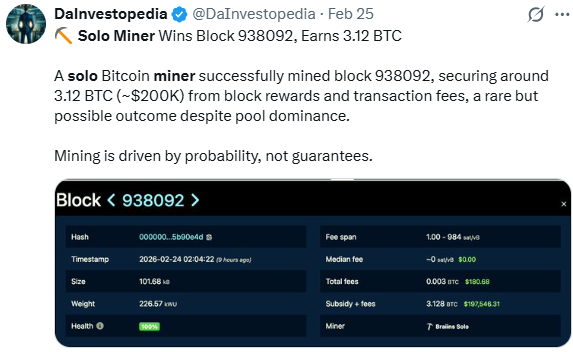
A solo miner wins block 938092. | Credit: DaInvestopedia X profile
Roughly 1 out of every 2,400 blocks was solo mined.
In other words, solo wins are real, but they are statistical outliers. They make headlines precisely because they are rare.
The core reason comes down to math.
Inside the Math: Real Chances of Mining a Bitcoin Block
Bitcoin mining is a probability game.
Miners compete to solve cryptographic puzzles. The more computing power (hashrate) a miner controls relative to the total network, the higher their chances of winning the next block.
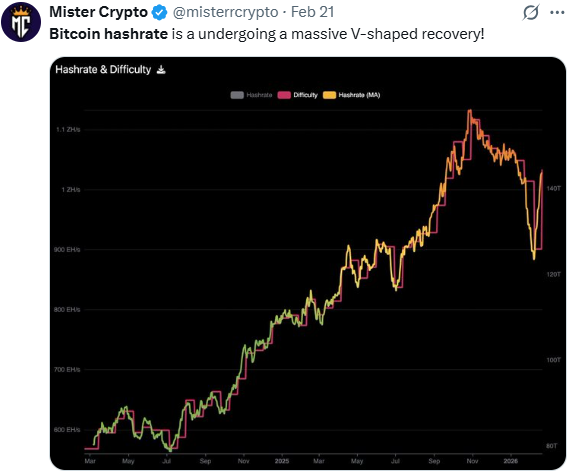
As of 2026, Bitcoin’s network hashrate is hovering near 1 zetahash per second (1 ZH/s), which is 1,000 exahashes, or 1,000,000 terahashes.
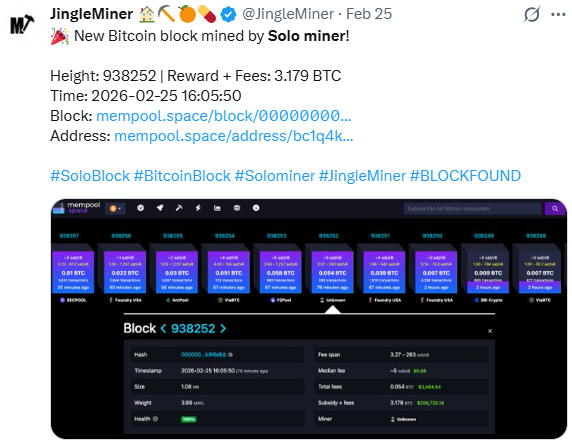
Another miner gained block 938252. | Credit: JingleMiner X profile
Bitcoin mining follows what’s called a Poisson process, meaning wins are random and unpredictable. Someone eventually gets lucky. But the system doesn’t guarantee fairness or timing.
Probability doesn’t care how long you’ve been trying.
Bitcoin Hashrate Near 1 ZH/s: Why Solo Wins Were So Unlikely
The difficulty of mining adjusts automatically to keep blocks coming every 10 minutes.
The 450 PH/s rented miner on Feb. 11 had a 0.4485% chance, still less than half of 1%. Even that “high” probability required enormous temporary computing power.
Solo Mining vs Mining Pools: Risk, Rewards, and Reality
Most miners join pools instead of mining solo. Here’s why.
Think of it like this: solo mining is buying one giant lottery ticket. Pool mining is earning small, steady payments based on the miner’s contribution.
Over time, pools dominate because they reduce financial risk. That’s why pooled operations mine more than 99% of blocks.
What Transaction Count and Probability Really Show
Examining solo wins, transaction counts, and probabilities reveals how rare each event truly was.
A block with over 4,000 transactions suggests heavy network usage and higher fee income. A block with fewer than 2,000 transactions indicates lighter activity.
Probability shows how unlikely each win was based on the miner’s hashrate versus the global network.
In 2025, solo miners’ daily win probabilities ranged from:
1 in 800
To 1 in 6,875,000
In some cases, equivalent to once every 10,000-18,000 years statistically
Not all solo wins are equal. Some had stronger setups. Others were near-impossible flukes.
But collectively, they remain rare.
Why Some Bitcoin Miners Are Pivoting to AI
Meanwhile, some large mining firms are shifting toward AI infrastructure.
This shift highlights an important truth: mining economics are tight, even at scale. If industrial players are diversifying, that says something about long-term margins.
Solo mining remains under 1% of total blocks historically
Most participants rely on pooled or cloud-based infrastructure
Solo mining in 2026 is best understood as:
Ideological participation
Entertainment
A high-variance gamble
It is not a reliable income strategy.
Bitcoin Mining Is No Longer A Small-Town Gold Rush
It is a capital-intensive global industry competing at nearly 1 zetahash per second.
Yes, lightning still strikes.
But history shows solo wins remain below 1% of total blocks, often closer to 0.04%. The headlines celebrate the miracle. The math explains the reality.
And in 2026, that reality is clear: solo mining is possible. Profitable, sustainable solo mining is extraordinarily rare.
Solo mining means trying to mine a Bitcoin block independently, without joining a mining pool. If you successfully mine a block, you keep the entire reward (currently 3.125 BTC plus transaction fees). However, your chances of winning are extremely low unless you control a large amount of computing power.
How rare are solo mining wins in 2026?
Very rare. Over the past year, solo miners found only about 22 blocks out of more than 52,000 total blocks mined. That’s roughly 0.04% of all blocks, meaning more than 99.9% are mined by pools or large-scale operations.
Why are the odds so low?
Bitcoin’s network hashrate is close to 1 zetahash per second (1 ZH/s) in 2026. That means trillions of trillions of calculations are happening every second. A small home miner controls only a tiny fraction of that power, making the probability of finding a block extremely small.
Why are some Bitcoin miners moving into AI?
Large mining companies are pivoting toward AI and high-performance computing because mining margins have tightened. AI data centers can offer more stable and predictable revenue compared to Bitcoin mining, which is affected by halvings, price volatility, and rising difficulty.
Disclaimer:
The information provided in this article is for informational purposes only. It is not intended to be, nor should it be construed as, financial advice. We do not make any warranties regarding the completeness, reliability, or accuracy of this information. All investments involve risk, and past performance does not guarantee future results. We recommend consulting a financial advisor before making any investment decisions.
Giuseppe Ciccomascolo began his career as an investigative journalist in Italy, where he contributed to both local and national newspapers, focusing on various financial sectors.
Upon relocating to London, he worked as an analyst for Fitch's CapitalStructure and later as a Senior Reporter for Alliance News. In 2017, Giuseppe transitioned to covering cryptocurrency-related news, producing documentaries and articles on Bitcoin and other emerging digital currencies. He also played a pivotal role in establishing the academy for a cryptocurrency exchange website. Crypto remained his primary area of interest throughout his tenure as a writer for ThirdFloor.


 Easy
Easy