Bitcoin hashrate derivatives allow exposure to mining profitability without operating physical mining hardware.
Specialized platforms and OTC venues are the primary markets, with some centralized exchanges experimenting with standardized products.
Miners use hashrate derivative contracts to hedge block rewards, electricity costs, and hardware depreciation to stabilize cash flows.
Growing adoption of hedging tools is reshaping mining economics, allowing operators to stabilize revenue amid volatile market cycles.
Bitcoin hashrate derivatives are specialized financial contracts tied to the computational power securing the Bitcoin network. These instruments have become an essential part of crypto mining risk management and profit strategies by enabling exposure to mining performance without operating hardware.
From mining basics to market structure, this guide explains how hashrate derivatives work, where hashrate derivatives trade and why hashrate derivatives are becoming a key factor in mining profitability and network stability.
Understanding Bitcoin Mining and the Role of Hashrate
Bitcoin mining involves validating transactions and adding blocks to the blockchain using specialized ASIC hardware. This process relies on hashrate, a measure of how many cryptographic calculations can be performed per second.
Try Our Recommended Crypto Exchanges
Sponsored
Disclosure
We sometimes use affiliate links in our content, when clicking on those we might receive a commission at no extra cost to you. By using this website you agree to our terms and conditions and privacy policy.
Higher hashrate: Strengthens network security and increases the difficulty of carrying out malicious attacks.
Mining profitability factors: Influenced by Bitcoin’s market price, network difficulty, hardware efficiency and electricity costs.
Machines like the Bitmain Antminer S19 can perform trillions of calculations every second to mine Bitcoin, but use a lot of electricity. As a result, the high energy demand makes careful management of power costs crucial for miners to remain profitable. A direct link between hashrate and revenue has created the foundation for financial products tied to mining power.
How Financial Derivatives Apply to Bitcoin Hashrate
Financial derivatives, such as futures, options and swaps, derive value from an underlying benchmark. In traditional markets, these benchmarks could be commodities, currencies or interest rates. In crypto, that benchmark can be a hashrate-related index, often using network difficulty or mining pool output as a proxy.
Hashrate derivatives allow contracts to settle based on actual or forecasted mining power. Whilst actual network hashrate isn’t directly observable, it’s an estimate derived from block production and difficulty over time. Some contracts use difficulty as a proxy, others use mining pool-reported performance.
For miners, this can lock in revenue and offset the risk of fluctuating difficulty or Bitcoin prices.
For investors, financial derivatives set on the Bitcoin hashrate open a path to mining-linked returns without physical mining operations.
Bitcoin hashrate derivatives come in several forms, each designed to help miners, investors, and traders manage risk or speculate on network performance. These instruments vary in structure, flexibility and purpose, offering tools for both revenue stability and market positioning.
Futures contracts: Agreements to buy or sell a defined quantity of hashrate at a set price on a future date.
Options contracts: Rights to buy or sell hashrate exposure at a strike price, offering flexibility in volatile markets.
Swaps: Cash flow exchanges based on differences between fixed and variable hashrate-related prices.
Contracts for difference (CFDs): OTC agreements to exchange the value difference in hashrate exposure over a contract period.
Each contract type serves different strategic needs, from stabilizing miner revenue to enabling speculative positioning on network growth trends.
A Brief History of Bitcoin Hashrate Derivatives
Bitcoin hashrate derivatives emerged as the mining industry matured and sought tools to manage operational risk. Early experiments appeared around 2020 on specialized platforms like FTX (before its collapse) and Luxor, offering futures contracts tied to network hashrate.
These instruments allowed miners to hedge against difficulty changes and Bitcoin price volatility.
Over time, the market evolved with standardized contracts, greater OTC participation and improved settlement mechanisms, paving the way for broader institutional interest.
Who Trades Hashrate Derivatives
Participants include a mix of:
Bitcoin miners: Both industrial-scale and mid-size operators using derivatives to stabilize revenue and lock in profitability.
Institutional investors: Hedge funds, proprietary trading firms and asset managers seeking exposure to Bitcoin’s infrastructure layer.
Energy companies: Integrating hashrate risk management into broader commodity and power trading strategies.
OTC desks and brokers: Facilitating bespoke contracts for large clients with specific hashrate, duration, or settlement needs.
How Bitcoin Hashrate Derivatives’ Settlement Works in Practice
When you hear “settlement” in finance, it simply means the point at which a contract is finalized and money changes hands based on the agreed terms.
For Bitcoin hashrate derivatives, settlement isn’t based on a physical delivery of mining machines, it’s based on data that represents mining power.
Step 1 – Measuring the Benchmark
Nobody can directly “see” the actual Bitcoin network hashrate in real time. It’s always an estimate, calculated from:
How many blocks are mined over a set period.
The network difficulty (how hard it is to find a block).
As a result contracts use one of the following benchmarks:
Difficulty-based index: Converts network difficulty into an estimated hashrate.
Mining pool data: Average performance from a specific pool.
Hybrid index: Blends multiple data sources for accuracy.
Step 2 – The Players (Alice and Bob)
Alice: Miner who wants to make sure her revenue doesn’t drop if Bitcoin difficulty goes up.
Bob: Investor who believes the hashrate will rise and wants to profit from that trend.
Step 3 – The Deal
Alice and Bob agree to a 3-month hashrate futures contract:
Size: 100 PH/s (petahashes per second) of exposure.
Price: $0.08 per TH/day (terahash per day).
Settlement: Based on the average network difficulty over the contract period, converted to TH/day.
Step 4 – Two Possible Outcomes
Case A – Network difficulty rises:
Average hashrate index shows 105 PH/s.
This means mining became harder — Alice’s real mining rewards would have dropped.
But because she locked in the contract, Bob pays her the difference, offsetting her loss.
Case B – Network difficulty falls:
Average hashrate index shows 95 PH/s.
Mining became easier — Alice’s real rewards are higher.
In this case, Alice pays Bob, because she earned more from mining than expected.
Scenario (hypothetical)
Avg. Hashrate Index (PH/s)
Mining Condition
Payout Direction
Who Pays Whom?
Reason
A. Difficulty rises
105
Harder to mine
Contract favors miner
Bob → Alice
Alice earns less from actual mining, so Bob’s payment offsets her loss
B. Difficulty falls
95
Easier to mine
Contract favors investor
Alice → Bob
Alice earns more from actual mining, so she pays Bob under the contract
Baseline
100
Expected difficulty
No payout
No one
The hashrate matched the agreed contract level exactly
Why This Matters
Alice gets stability in her mining income.
Bob gets a chance to profit from correctly predicting network trends.
Neither of them needed to physically ship or run any mining hardware, just agree on the data and cash-settle at the end.
Bitcoin mining profitability is influenced by several interconnected factors, creating a need for tools that stabilize returns and reduce uncertainty.
Key drivers include:
Block rewards: The primary source of miner income, gradually reduced through Bitcoin’s programmed halving events.
Transaction fees: Additional earnings that fluctuate with network usage and transaction demand.
Price volatility: Bitcoin’s market price swings directly affect the fiat value of mining rewards.
Difficulty adjustments: Network recalibrations that influence the share of rewards miners can capture.
Operational costs: Expenses such as electricity, maintenance and facility overheads that impact net profitability.
Hardware Depreciation: Loss of efficiency and value in mining equipment over time.
Regulatory Shifts: Policy changes that can alter mining economics through restrictions or compliance requirements.
Hashrate derivatives allow mining operators to hedge against these pressures by locking in revenue or controlling operational costs, allowing more predictable capital planning.
Understanding where Bitcoin hashrate derivatives are traded reveals how different venues cater to standardized risk management and customized strategies.
Where Bitcoin Hashrate Derivatives Are Traded
Trading takes place in two main settings:
Specialized platforms & OTC markets: The primary venues today, with tailored contract sizes, terms, and settlement methods.
Select centralized exchanges: Some have trialed standardized hashrate products, though most focus on BTC price derivatives.
Specialized platforms offer flexibility for large operations, while standardized exchange products aim for greater transparency and liquidity.
Pricing Models and Risk Management Strategies
Valuing a hashrate derivative involves assessing network difficulty, Bitcoin market trends, electricity prices and hardware efficiency. Some contracts use settlement indices based on actual hashrate, others rely on proxies such as difficulty adjustments or mining pool data.
Risk management strategies range from locking in future cash flows with futures to using options for asymmetric protection. For miners, this means less revenue volatility, for traders, it offers targeted exposure to network fundamentals.
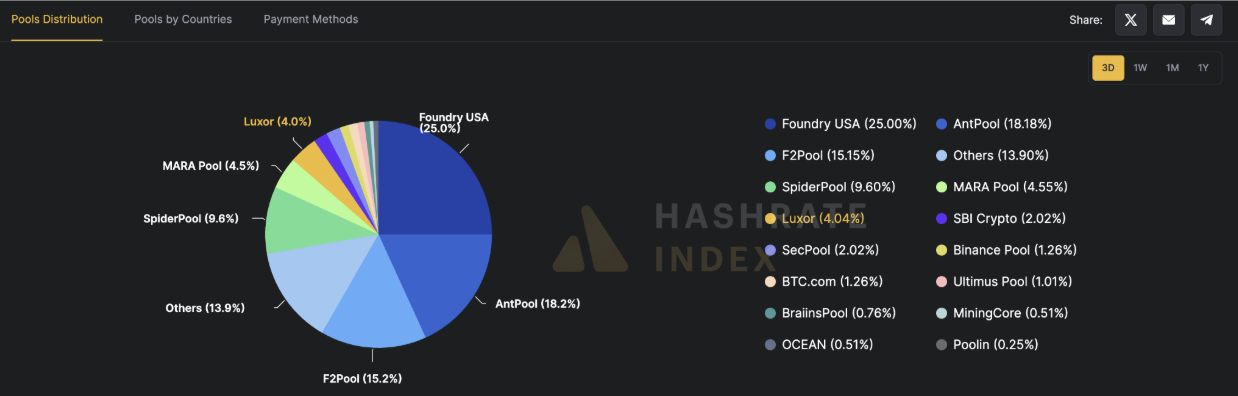
Bitcoin Mining Pools Comparison | Source: Hashrate Index
Pricing and managing Bitcoin hashrate derivatives comes down to understanding the mining environment and using the right tools to handle uncertainty.
How pricing works: The value of these contracts depends on how hard it is to mine Bitcoin (network difficulty), where the Bitcoin price is headed, how much power costs, and how efficient the mining machines are.
Different pricing methods: Some deals settle based on the hashrate measured, while others use stand-ins like difficulty changes or mining pool statistics.
Managing risk: Miners might lock in future income with futures contracts, while options only protect them if the market moves against them.
Why it matters: Miners get steadier income, and traders can bet directly on the health of the Bitcoin network without running mining rigs themselves.
Risks and Challenges in the Hashrate Derivatives Market
Despite their benefits, hashrate derivatives face hurdles:
Liquidity limitations: Niche participation can widen bid-ask spreads and increase execution costs.
Counterparty risk: Especially prevalent in OTC contracts without centralized clearing.
Regulatory uncertainty: Classification under securities or commodities law remains inconsistent across jurisdictions.
Technology vulnerabilities: Smart contract bugs or oracle failures can disrupt settlements.
Mitigating these risks requires transparent data, robust legal agreements, and secure execution platforms.
Real-World Applications of Hashrate Derivatives in Bitcoin Mining
Large mining companies have used hashrate futures to protect against revenue drops during periods of high difficulty and falling Bitcoin prices.
Mining pools have adopted swap agreements to stabilize payouts for participants, reducing the financial impact of market downturns.
Case studies from 2021–2023 show that miners with active hedging positions were able to maintain profitability during extended bear markets, while unhedged operators faced equipment liquidations and shutdowns.
In December 2022, U.S. Bitcoin miner Core Scientific filed for Chapter 11 bankruptcy after slumping BTC prices, soaring energy costs and a $7M unpaid Celsius debt. Shares fell 98% in 2022. The restructuring highlighted the risks for unhedged miners during market downturns compared to hedged competitors.
Moreover, the causes were more multifaceted, including hosting agreement disputes, machine impairment losses and debt restructuring pressures.
Integration with the Broader Crypto and Energy Markets
Hashrate derivatives intersect with Bitcoin spot and futures markets, influencing miner incentives and network stability.
Hashrate derivatives also connect to energy markets, as mining is energy-intensive and electricity costs directly impact profitability. Some products now integrate carbon credit considerations, aligning mining profitability with environmental objectives.
Real-World Energy Impact: Loka Mining’s Approach
A prime example of this energy–hashrate connection comes from Andy Fajar Handika, CEO of Loka Mining. In an interview with CCN, he explained how miners in energy-rich emerging markets like Ethiopia, Kazakhstan, and Bhutan use hashrate futures to sell future mining output for upfront capital.
This model lets miners absorb excess electricity from new renewable plants, offsetting infrastructure costs and accelerating energy growth in regions with low initial demand.
“If you’re a corn farmer, you sell your harvest before it’s ready. We’re doing the same for Bitcoin miners,” Handika said.
By turning projected hashrate into immediate funds, miners can reinvest in new machines, scale faster, and strengthen the Bitcoin network while driving local economic growth.
Future Trends Shaping the Hashrate Derivatives Market
Emerging trends include:
Smart contract automation: Enabling real-time, trustless settlement of hashrate-linked contracts.
DeFi integration: Allow tokenized hashrate exposure to be tradable on decentralized platforms.
AI-powered forecasting: Enhancing pricing models through predictive analytics.
Global standardization: Harmonizing contract terms and settlement methods for cross-border adoption.
As the market matures, increased participation, innovation and AI-driven analytics are shaping its growth.
These analytics use artificial intelligence to process vast mining and market data, such as network difficulty, Bitcoin price trends and electricity usage, to identify patterns, forecast changes and optimize trading or hedging strategies.
Together, these factors could position hashrate derivatives as a core component of the crypto mining economy.
Conclusion
Bitcoin hashrate derivatives transform mining power into a tradable financial asset, offering new tools for risk management, investment diversification, and operational stability.
While regulatory clarity, liquidity growth, and technical safeguards remain priorities, innovations in smart contracts, decentralized trading, and AI-driven analytics could point toward a more robust and integrated future for this market segment.
Miners use them to hedge against difficulty changes, Bitcoin price swings, and rising operational costs.
Can you trade Bitcoin hashrate derivatives without owning mining equipment?
Yes. Many hashrate derivative contracts are cash-settled, meaning you can speculate or hedge based on mining power indexes without operating ASICs.
Do hashrate derivatives impact the Bitcoin network’s security?
Indirectly. By stabilizing miner revenue, they can reduce the chance of mass miner shutdowns during downturns, which supports network hashrate and security.
Who sets the hashrate index used in these derivative contracts?
It’s typically created by exchanges or data providers, often using difficulty adjustments, mining pool stats, or blended averages as the benchmark.
Disclaimer:
The information provided in this article is for informational purposes only. It is not intended to be, nor should it be construed as, financial advice. We do not make any warranties regarding the completeness, reliability, or accuracy of this information. All investments involve risk, and past performance does not guarantee future results. We recommend consulting a financial advisor before making any investment decisions.
Andrew Kamsky is a chart analyst and writer with a background in economics and ACCA certification. He has held roles at a Big Four firm, a fintech bank, and a listed bank specializing in currency hedging. His work explores Bitcoin, macro trends, and market structure. Outside finance, he's passionate about music, travel, and neon design.


 Easy
Easy