Key Takeaways
- Home mining only works with cheap or renewable energy sources.
- ASICs are mandatory—GPUs are obsolete for Bitcoin.
- Joining a mining pool is an ideal option for home mining to win steady and consistent rewards.
- Hosted mining offers better long-term value as cloud mining is riskier—always research providers thoroughly.
In 2025, as mining difficulty increases and competition intensifies, solo miners must evaluate whether investing in a home setup still makes sense.
The dramatic shift from hobbyist setups to industrial-scale mining operations has changed the landscape since Bitcoin’s early days, when earning 50 BTC per block was possible using just a personal laptop. Today, higher electricity prices, tightening regulations, and growing environmental concerns have made solo mining far more complex.
Still, mining enthusiasts with access to affordable or free electricity and renewable energy options may find niche opportunities.
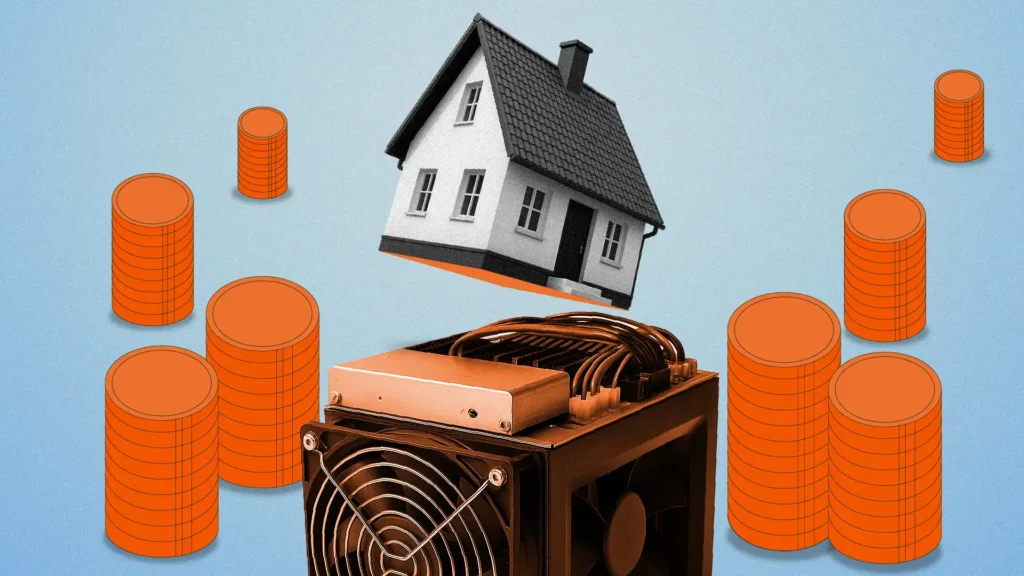
This article discusses the profitability of home mining in 2025, how to set up a rig, associated costs, energy consumption and viable alternatives like cloud mining or joining mining pools.
Is Home Bitcoin Mining Profitable in 2025?
Mining profitability in 2025 is closely tied to Bitcoin’s price, the total network hash rate, and local electricity costs. Industrial miners benefit from economies of scale, bulk ASIC purchases, and often subsidized power. In contrast, home miners face higher per-unit costs and increased difficulty in earning profits.
Profit Thresholds Are Getting Tighter
Recent estimates using the CoinWarz Bitcoin mining calculator suggest that for a modern ASIC miner running at 390 TH/s and consuming 7,215 watts, profitability begins to meaningfully appear only at electricity rates around $0.05/kWh or lower.
- Miner earns: At $0.05/kWh, the miner earns about $10.79 per day after electricity costs.
- Profits shrink: At $0.06/kWh, that profit shrinks considerably.
- Breakeven/loss: Above $0.07–$0.08/kWh, most home miners are either breakeven or losing money.
This implies that the once-commonly cited break-even rate of $0.08/kWh is now optimistic, especially given rising global hash rate and difficulty adjustments.
How to Set Up a Bitcoin Mining Rig at Home
Setting up a Bitcoin mining rig at home in 2025 requires planning, technical know-how, and a realistic understanding of power and cost limitations.
Here’s a step-by-step breakdown tailored for today’s conditions (as of May 2025):
1. Choose ASIC Hardware
To mine Bitcoin in 2025, you’ll need a modern ASIC miner (application-specific integrated circuit). Devices from leading brands like Bitmain—such as the Antminer S21 or models in the Whatsminer M60 series—offer solid performance and efficiency, often in the 17 to 22 joules per terahash (J/TH) range.
Avoid older models, even if cheaper, as they typically consume more electricity than they earn you rewards. The gap in performance between older and newer ASICs continues to widen as network difficulty grows.
2. Prepare Your Environment
ASICs generate intense heat and operate at high noise levels, often between 75–90 decibels (comparable to a vacuum cleaner or louder). These machines are not suited for shared living spaces.
A suitable environment might include:
- A garage, basement, or detached shed
- Active ventilation or ducting
- Possible sound insulation if near neighbors or living areas
Maintaining stable temperatures and airflow is essential to prevent thermal throttling or hardware damage.
3. Power and Connectivity
Most current ASICs draw 2,800 to 3,800 watts each, continuously. Before running a unit, ensure:
- Electricity: The home’s electrical system can handle high, continuous loads
- 240V outlet: The mining space must have access to a 240V outlet—while 230V–240V is standard in some countries, miners may still require electrical upgrades.
- Power strips: Avoid daisy-chaining power strips or overloading circuits. Daisy-chaining refers to plugging one power strip into another, creating a chain of strips connected to a single wall outlet.
Use a wired Ethernet connection to reduce downtime and prevent lost work due to unstable internet connectivity. Mining doesn’t require high speed, but it does demand stability.
4. Select Mining Software and Join a Pool
Many ASICs have built-in firmware, but upgrading to custom firmware like Braiins OS+ can unlock better performance, efficiency tuning, and detailed monitoring. It also enables advanced features such as auto-tuning, custom fan control, and profit-optimized modes that adjust power usage based on market conditions.
However, custom firmware may void your manufacturer’s warranty and typically requires some technical skill to install and configure safely—missteps can lead to hardware inefficiency, instability, or even damage.
It’s often used to underclock the machine, reducing power draw while keeping most of the hashrate. Braiins OS+ is a custom firmware for Bitcoin ASIC miners that improves efficiency, allowing for power tuning, and provides advanced performance monitoring tools.
Individuals may opt to join a mining pool to avoid the unpredictability of solo mining. These platforms combine one miner’s machine’s hashpower with thousands of others, offering smaller, consistent payouts.
Popular, reputable mining pools in 2025 include:
- Foundry USA
- F2Pool
- ViaBTC
Each has slightly different payout models and fees (typically around 1–2%), so research before choosing.
5. Track and Optimize Performance
Effective mining is all about monitoring and efficiency. Use dashboards—either built-in, from your firmware, or third-party platforms like Hive OS—to track key metrics and keep your operation running smoothly.
Track the following:
- Hashrate consistency: Monitor performance stability to detect issues early.
- Temperature and fan speeds: Keep the machine cool and within safe operating ranges.
- Uptime and rejected shares: Ensure the miner stays connected and work isn’t wasted.
Power consumption metrics: Compare energy usage against output to assess profitability.
Optimize with these tools:
- Underclock or overclock based on your goals: Adjust performance to balance efficiency and revenue.
- Adjust fan curves for noise vs. cooling balance: Reduce sound output while maintaining thermal safety.
- Respond to hardware warnings before failure occurs: Use alerts to catch overheating or part wear early.
- Proactive monitoring: Helps extend hardware life and avoid wasted electricity or downtime.
The Real Costs of Bitcoin Mining in 2025
Beyond just the hardware, crypto mining costs in 2025 include:
- ASIC Units: $2,000–$4,500 depending on model and availability.
- Electricity: The biggest recurring cost, highly variable by region.
- Cooling Infrastructure: Fans, ducting, or immersion systems can be essential.
- Maintenance: Dust buildup, heat stress, and part replacement (fans, PSUs) can lead to downtime or damage if neglected.
Mining at home exposes one to volatility in Bitcoin’s price and difficulty adjustments, which can rapidly shift ROI projections.
Home Mining vs. Pool Mining: Which Is Better?
Solo mining is nearly impossible for most home users due to the low probability of finding a block alone. That’s why most people join mining pools, where rewards are shared based on contributed hashrate.
However, hobbyist miners sometimes experiment with devices like the “Bitaxe” a tiny, open-source ASIC miner that consumes as little as 5 to 15 watts, similar to an LED light bulb.
While its hashrate is minuscule, it technically allows solo mining and keeps the user eligible for the full block reward. Though the odds are vanishingly small, BitAxe remains a fun, low-cost way to participate in the network.
Advantages of pool mining:
- Consistent payouts
- Lower variance risk
- More accessible for small-scale miners
Disadvantages of pool mining:
- Pool fees (typically 1–2.5%)
- Reliance on centralized platforms
Ultimately, pool mining is the better option for those seeking stability and predictability in home operations.
Bitcoin Mining Energy Consumption in 2025
In 2025, modern ASICs like the Antminer S21 (~3,150 W) or Whatsminer M60S (~3,400 W) consume approximately 75–82 kWh per day when running 24/7.
Account for an additional 5–10% energy loss from power supply unit (PSU) inefficiencies, which can increase total consumption. Use a high-quality, 80+ Gold or Platinum PSU to minimize losses and improve profitability.
High energy usage has increased environmental scrutiny, and several jurisdictions have introduced mining-specific regulations or outright bans.
Renewable energy sources like solar and wind offer compelling alternatives for miners looking to reduce their carbon footprint. While the upfront installation costs can be significant, the long-term savings and environmental benefits often make the investment worthwhile.
Many mining operations have already adopted renewable energy sources in regions like Canada and the Netherlands. By tapping into abundant hydropower, wind farms, or solar installations to power their rigs sustainably and reduce dependence on fossil fuels.
Alternatives to Home Bitcoin Mining: Cloud and ASIC Solutions
Given the barriers to solo mining Bitcoin from home, many enthusiasts turn to alternatives:
1. Cloud Mining
Cloud mining involves paying a provider to rent hashrate, eliminating the need for personal hardware. However, the industry is rife with scams, and even legitimate providers often charge fees that make contracts unprofitable.
In 2025, cloud mining is rarely viable due to high costs and counterparty risks. Thoroughly research providers, read user reviews, and avoid services promising guaranteed returns, as these are often fraudulent.
2. Hosted Mining
Hosted mining means placing your ASIC miner in a professional facility with low-cost electricity, industrial cooling, and 24/7 maintenance. One still owns the hardware but pays monthly fees for power and hosting.
This is ideal to mine without dealing with heat, noise, or setup at home, especially in regions where residential mining isn’t practical.
3. Indirect Participation
Invest in mining-related stocks or ETFs, or purchase Bitcoin outright via exchanges to benefit from price exposure without operational headaches.
Conclusion
In 2025, Bitcoin mining at home is no longer the plug-and-play hobby it once was. While it remains possible with the right conditions, especially access to cheap, renewable power, it is no longer broadly profitable for the average user.
That said, for technically inclined individuals willing to invest time, money, and effort, home mining can still be rewarding, especially when part of a mining pool or supplemented by sustainable energy solutions. Strategic thinking, diligent cost management, and staying informed about the latest hardware and regulation trends will be essential for any home miner navigating the future of Bitcoin.
FAQs
It typically ranges from 8 to 18 months, depending on the ASIC used, electricity rate, and BTC price fluctuations.
No. Bitcoin mining now requires ASICs. GPUs are obsolete for Bitcoin but are still used for altcoins like Kaspa or Ethereum Classic.
There’s no truly “quiet” full-performance ASIC, but the Bitaxe—an open-source, low-power miner—runs silently and uses as little energy as a light bulb. It’s ideal for educational or hobbyist solo mining, though its hashrate is extremely low and not intended for profit.
Yes. In most countries, mined Bitcoin is considered taxable income. Track your earnings and consult a tax professional to stay compliant.
The information provided in this article is for informational purposes only. It is not intended to be, nor should it be construed as, financial advice. We do not make any warranties regarding the completeness, reliability, or accuracy of this information. All investments involve risk, and past performance does not guarantee future results. We recommend consulting a financial advisor before making any investment decisions.

Andrew Kamsky is a chart analyst and writer with a background in economics and ACCA certification. He has held roles at a Big Four firm, a fintech bank, and a listed bank specializing in currency hedging. His work explores Bitcoin, macro trends, and market structure. Outside finance, he's passionate about music, travel, and neon design.


 Easy
Easy