Solana's Alpenglow upgrade ships Q3 2026 with 150ms finality — but it arrives as users, fees, TVL, and SOL price all slide, with the token pinned between $80 and $92. | Credit: CCN
Share
Key Takeaways
Solana co-founder Anatoly Yakovenko confirmed at Consensus Miami 2026 that the Alpenglow upgrade — designed to slash finality from 12.8 seconds to roughly 150 milliseconds — will ship as early as Q3 2026.
Solana’s on-chain fundamentals have weakened sharply in 2026: monthly active users have fallen to a two-year low of 34.1 million, fees are down 50% since January, and TVL has collapsed 56% from its August 2025 peak to $5.5 billion.
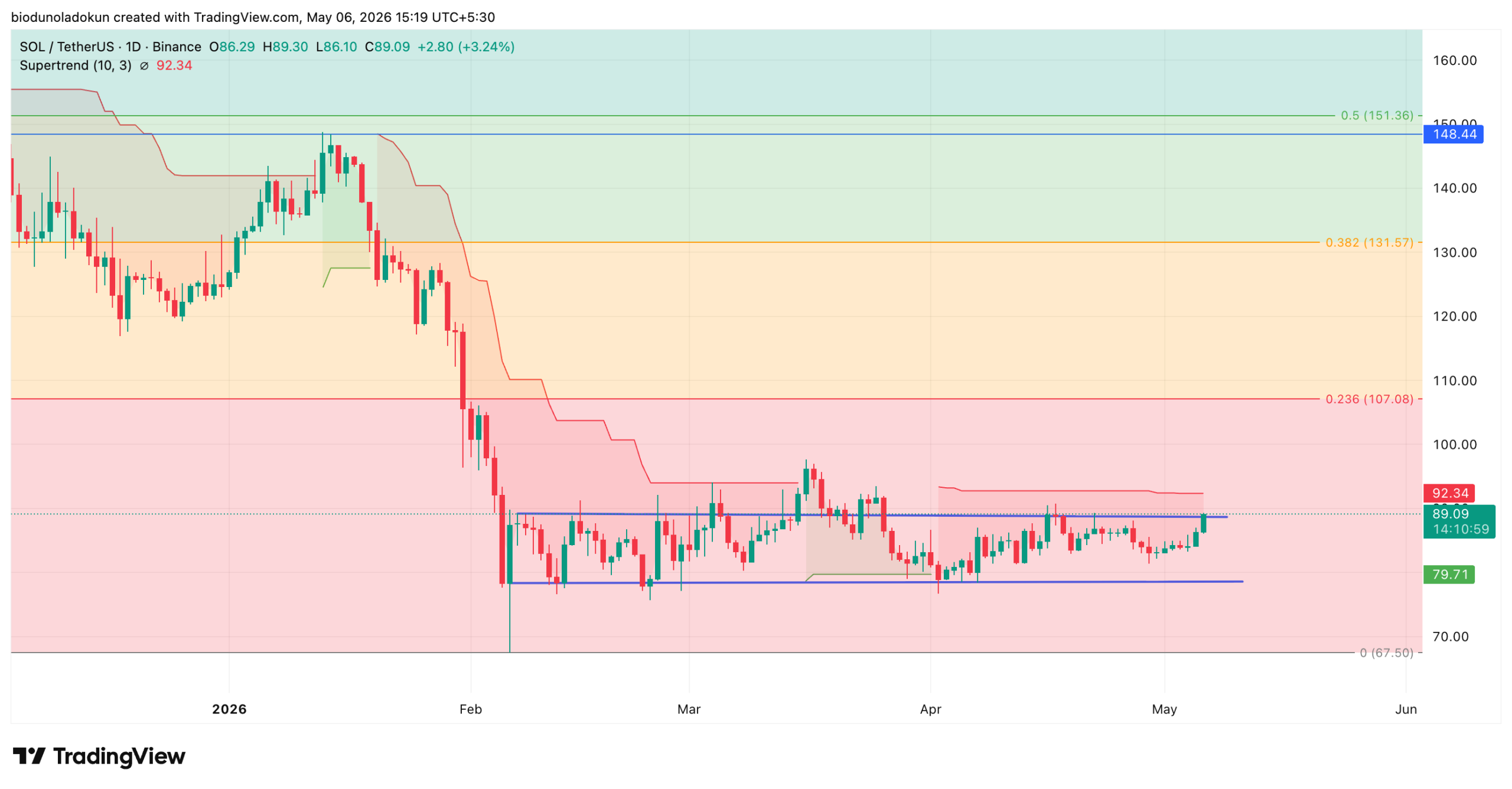
SOL is trapped in a tight $78.54–$89.20 range; a breakdown below $79.71 opens a path to $67.50, while a flip above $92.34 targets $107 and $131.
Speaking on a fireside panel at Consensus Miami 2026, Solana co-founder Anatoly Yakovenko revealed that the Alpenglow release is due sometime this year, putting a timeline on what is shaping up to be the network’s most significant technical overhaul.
The upgrade is designed to push transaction confirmation toward what Yakovenko described as the “speed of light,” bringing finality near the physical limits of how fast information can travel around the globe.
As the market awaits this upgrade, here’s a look at how the Solana ecosystem has fared so far this year.
Solana’s Alpenglow Upgrade Set for Q3 2026
In September 2025, the Solana community approved the Alpenglow proposal, with 98.27% of participating SOL stakers voting in favor, 1.05% against, and 0.36% abstaining.
The upgrade has been designed to make the network confirm transactions almost instantly, dropping finality from around 12.8 seconds to roughly 150 milliseconds.
It does this by replacing parts of Solana’s current consensus system with two new components, Votor and Rotor, and by moving validator voting off-chain to ease congestion.
Try Our Recommended Crypto Exchanges
Sponsored
Disclosure
We sometimes use affiliate links in our content, when clicking on those we might receive a commission at no extra cost to you. By using this website you agree to our terms and conditions and privacy policy.
Yakovenko, at the conference, described the upgrade as a defining moment for the protocol.
“So the Alpenglow release is basically due sometime this year, I think next quarter,” he said. “That, to me, is this exciting step in the evolution of the protocol.”
Solana Active Users Have Tumbled To Multi-Year Lows
Ahead of the network upgrade, a look at how Solana has fared so far this year shows that activity has cooled hard on the Layer 1 (L1) blockchain since January.
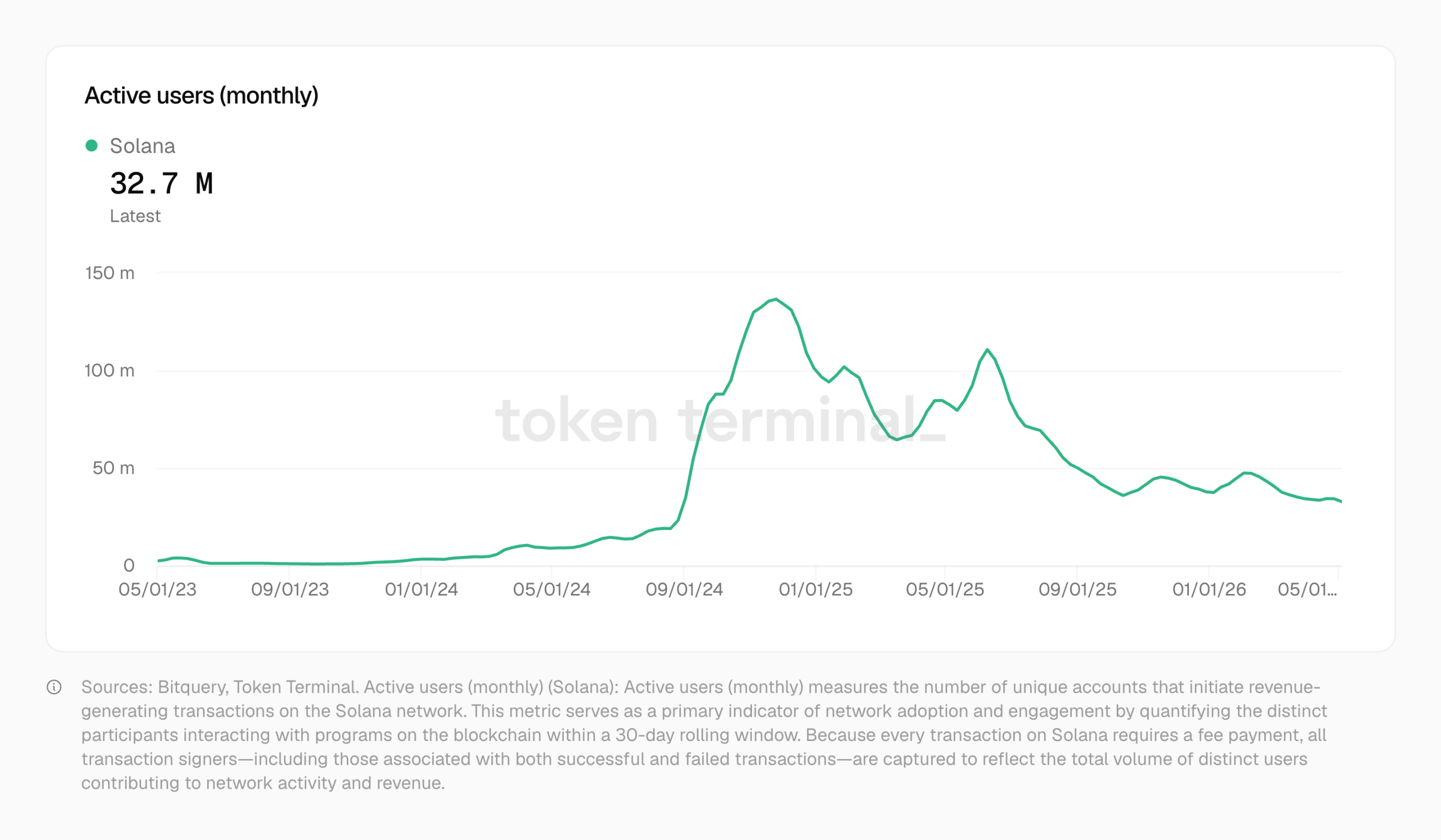
First, user activity on the network has tumbled. Since clinching a year-to-date high of 46 million monthly active addresses in February, the count has fallen almost in a straight line.
Solana Monthly Active Addresses | Credit: Token Terminal
Per Token Terminal, Solana closed April with a monthly active user count of 34.1 million, its lowest reading since May 2024.
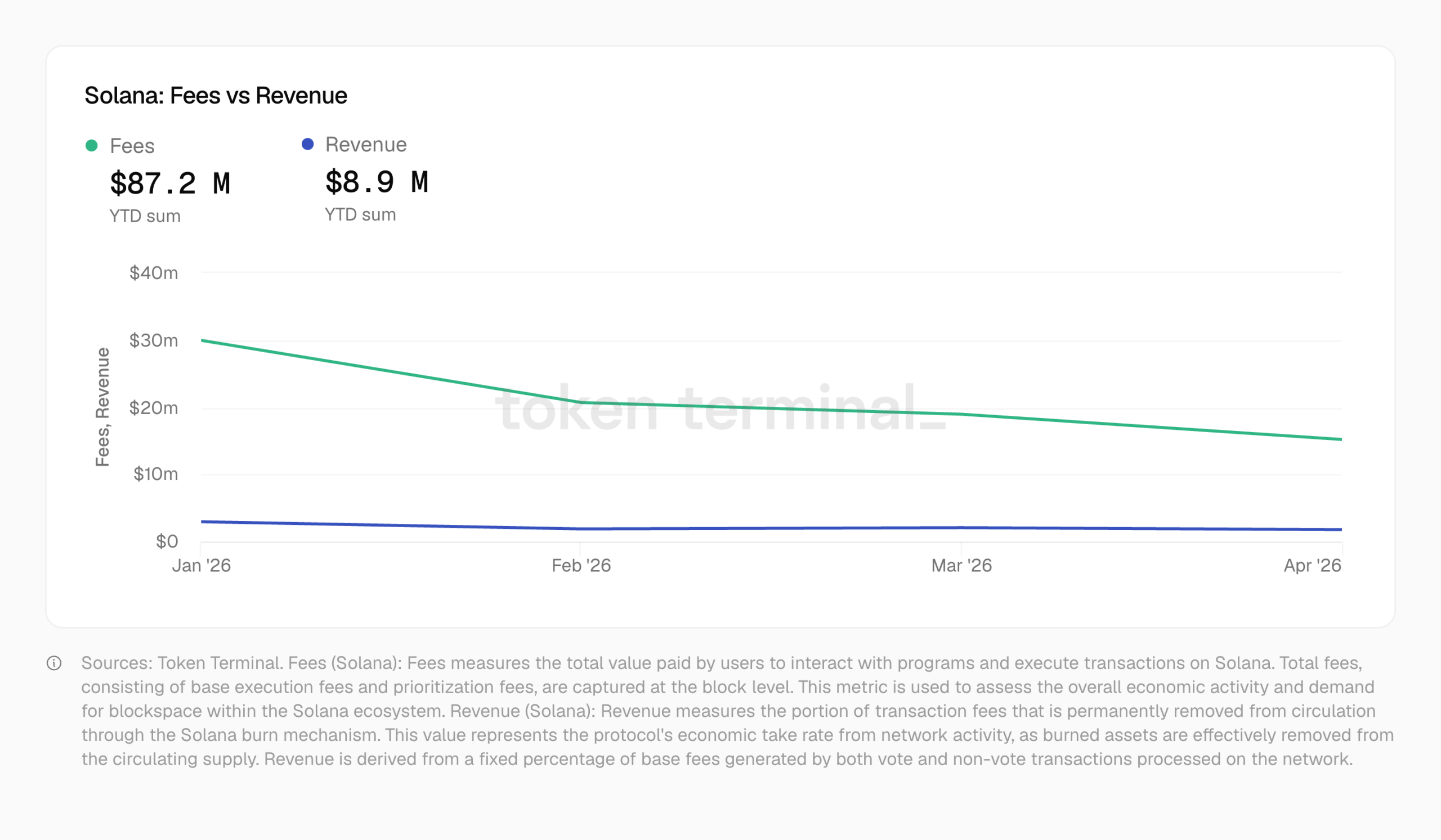
As network usage has fallen, Solana’s monthly fees and revenue have also declined.
Token Terminal data shows Solana’s monthly fees collapsing from $30 million in January to $15.20 million at the end of April—a 50% drop in just four months.
At press time, year-to-date fees stand at $87.2 million.
As for the network’s monthly revenue, the slide has been even sharper.
Per Token Terminal, Solana’s monthly revenue has fallen from roughly $2.95 million in January to $1.75 million by the end of April, a drop of more than 40% in four months.
These metrics show that active Solana users have nearly halved since February.
Because every transaction on the network requires a fee, the collapse in fees and burn-driven revenue is tied to that user exodus.
Capital Exits Solana DeFi Ecosystem
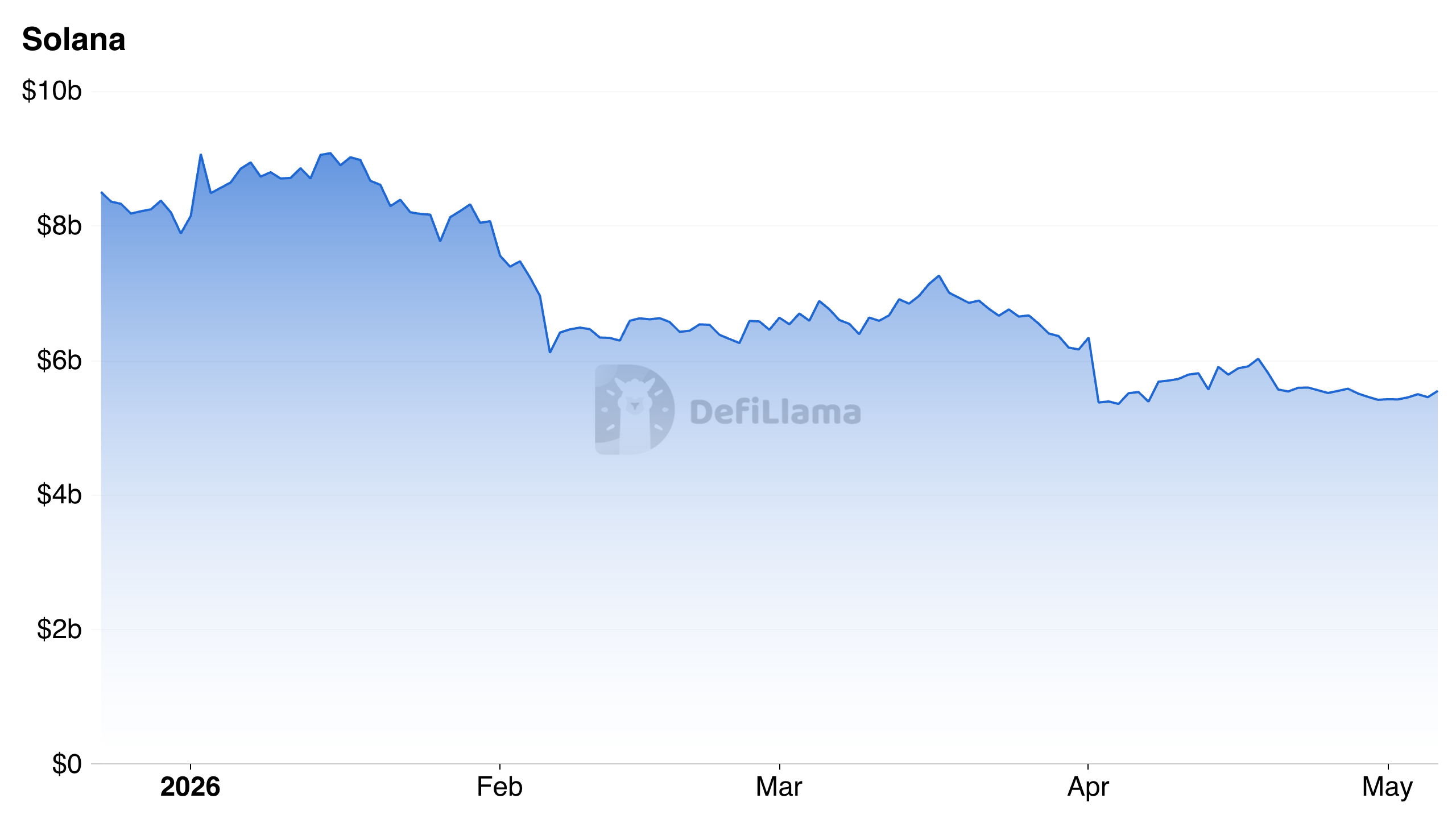
On the decentralized finance (DeFi) side of things on Solana, its total value locked (TVL) and decentralized exchange (DEX) trading volume have also suffered.
According to DefiLlama, since reaching an all-time high of $11.40 billion in August 2025, the L1’s TVL has contracted.
Currently sitting at $5.5 billion, it has since dropped by 56%.
A network’s TVL measures the total value of assets (stablecoins, tokens, LP positions, lending collateral) that users have deposited into smart contracts on the chain.
It is one of the cleanest gauges of capital commitment to a network’s DeFi ecosystem.
When TVL falls this sharply, it signals that this capital is leaving the ecosystem.
It means Solana users have been pulling liquidity from the network and putting it elsewhere.
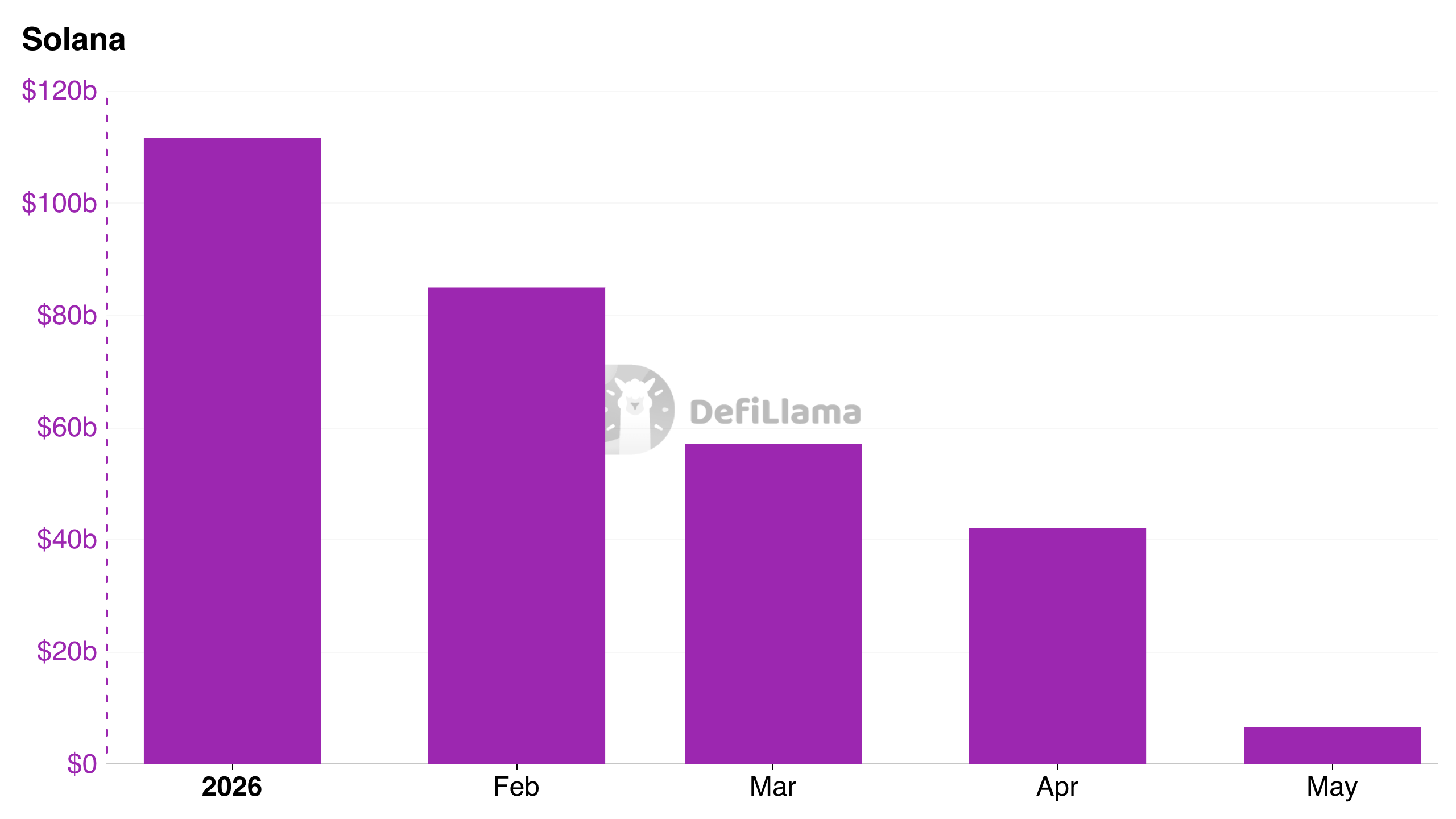
Moreover, trading activity on Solana-based DEXes has also dropped.
Per DefiLlama, monthly DEX volume has slid from the $145 billion peak in October 2025 to $42 billion as of the end of April 2026.
The result is a near-flat four months of price action, and a market tilted toward selling.
On the daily chart, the token’s supertrend indicator confirms a bearish lean.
At press time, it forms another resistance layer ($92.34) above the upper boundary of SOL’s current consolidation range.
For context, SOL has traded below this red line since April 2.
The Supertrend indicator helps traders identify the market’s direction by placing a line above or below the price chart based on the asset’s volatility.
As with SOL, when an asset’s price trades below the Supertrend line, it signals a bearish trend where selling activity is dominant.
If sell-side pressure mounts and the next retest of the $79.71 results in a breakdown of the support floor, SOL could decline to $67.50, a roughly 24% decline from current levels.
SOL/USD Daily Chart | Credit: TradingView
For the bulls, the immediate task is to close above the upper line resistance at $89.20 and reclaim the supertrend at $92.34.
This would flip the indicator green and open a path to $107.08, with $131.57 as the more ambitious medium-term target.
Until one side resolves, SOL is likely to remain pinned within the $80–92 range.
Disclaimer:
The information provided in this article is for informational purposes only. It is not intended to be, nor should it be construed as, financial advice. We do not make any warranties regarding the completeness, reliability, or accuracy of this information. All investments involve risk, and past performance does not guarantee future results. We recommend consulting a financial advisor before making any investment decisions.
Abiodun Oladokun is a Research Analyst at CCN, where he covers cryptocurrency markets with a focus on on-chain analysis, technical assessments, and emerging trends across decentralized finance (DeFi), real-world assets (RWA), artificial intelligence (AI), decentralized physical infrastructure networks (DePIN), Layer 2s, and meme coins.
Prior to CCN, he served as a Senior On-Chain Analyst at BeInCrypto, producing market reports spanning diverse crypto sectors.
Before that, he conducted technical analysis and market assessments of various altcoins at AMBCrypto, where he also contributed long-form quarterly research papers on DeFi, NFTs, DAOs, and scaling architectures, leveraging on-chain platforms including Messari, Santiment, DefiLlama, and Dune Analytics.
He began his crypto career as a research analyst at SixthSense DAO, developing blockchain forensic tools to trace the history of stolen assets.
Abiodun is a lawyer called to the Nigerian Bar and the founder of Ilé Ijó, a Lagos-based electronic dance music collective.