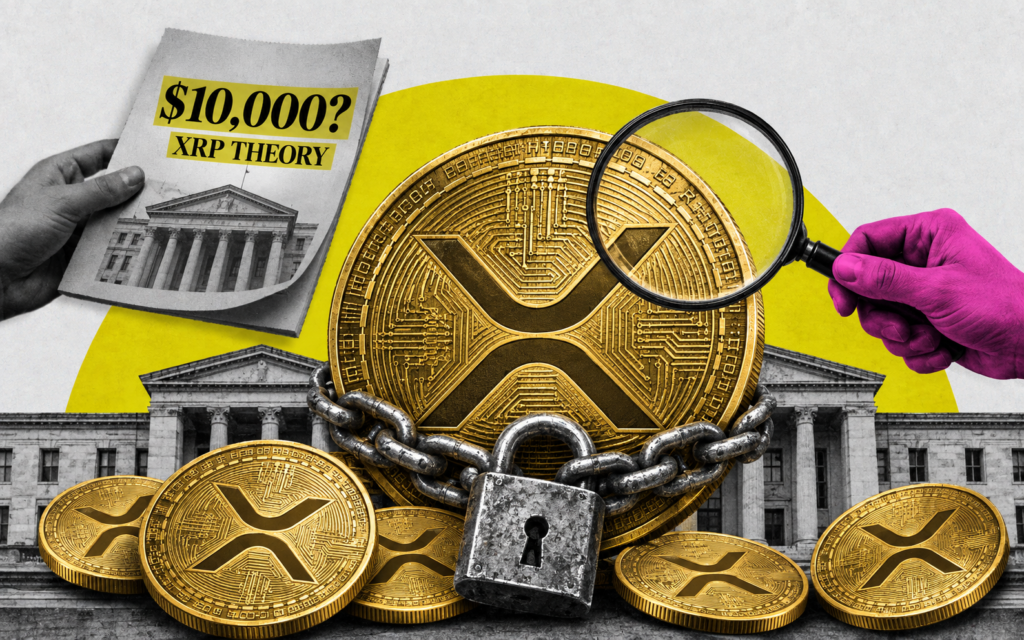
A viral XRP $10K price theory relies on extreme supply math and global liquidity assumptions, but market reality tells a very different story. | Credit: CCN.com
Share
Key Takeaways
Ripple Bull Winkle argues XRP could theoretically reach $10,000 if holders refuse to sell while institutional settlement demand competes for a much smaller pool of liquid tokens.
XRP has a fixed maximum supply of 100 billion, but CoinGecko counts roughly 63 billion as circulating.
The theory correctly distinguishes circulating supply from immediately available liquidity.
The $10,000 XRP theory is back, but its latest version isn’t being presented as a conventional price prediction.
Ripple Bull Winkle argues it is instead a liquidity problem.
“People are sleeping on this: the $10k $XRP theory isn’t a price prediction, it’s a supply math problem,” he wrote on X. “If you’re holding and not selling, you’re already reducing the available settlement supply. Your bag is part of the constraint the math is built on.”
The argument sounds simple: if XRP eventually handles enormous institutional payment flows while most holders refuse to sell, institutions would be forced to bid increasingly higher for a limited pool of available XRP.
But moving from that mechanism to $10,000 per XRP requires assumptions far more aggressive than simply having a fixed supply.
Try Our Recommended Crypto Exchanges
Sponsored
Disclosure
We sometimes use affiliate links in our content, when clicking on those we might receive a commission at no extra cost to you. By using this website you agree to our terms and conditions and privacy policy.
100 Billion XRP Doesn’t Mean 100 Billion Are for Sale
XRP’s maximum supply was fixed at 100 billion tokens when the ledger was created.
CoinGecko currently estimates approximately 63 billion XRP in circulation, with XRP priced at around $1.49 and a market capitalization of roughly $93 billion.
Even “circulating” does not mean available for immediate purchase.
Ripple reported that, as of June 30, it held 37.66 billion XRP, including 32.6 billion locked in escrow, while 62.33 billion had been distributed.
Ledger-level data illustrates the distinction further. Bithomp currently estimates that about 19.54 billion XRP has remained inactive for one to five years, with another 6.13 billion inactive for more than five years. That doesn’t prove those coins are permanently unavailable, but it demonstrates why tradable liquidity can be substantially smaller than headline supply.
September’s escrow cycle also complicates the idea that Ripple simply dumps one billion XRP into circulation every month.
One billion XRP was unlocked on Sept. 1, but 700 million was subsequently placed into new escrows. The remaining 300 million moved between Ripple-controlled wallets, which by itself does not establish that those tokens were sold into the market.
This is the strongest part of the $10,000 argument: market price is determined at the margin, not by simultaneously selling every XRP in existence.
If only a small percentage of XRP holders are willing to sell, increasingly aggressive buyers can push the quoted price substantially higher without purchasing the entire circulating supply.
But $10,000 Creates a $630 Trillion Problem
The counterargument becomes obvious when $10,000 is applied to today’s circulating supply.
Using CoinGecko’s roughly 63 billion circulating XRP, a $10,000 price implies a conventional market capitalization of approximately:
63 billion × $10,000 = $630 trillion.
That is not the same as saying $630 trillion of new money would need to enter XRP. Market capitalization does not measure cash invested dollar-for-dollar; the last traded price is simply applied across circulating units.
Still, a $630 trillion valuation would be extraordinary by almost any comparison.
The supply-squeeze thesis, therefore, needs more than holders refusing to sell. It requires buyers to continue supporting prices around $10,000 despite the enormous implied valuation and assumes higher prices would not entice previously dormant holders to sell.
That second assumption is particularly difficult. Supply is not static. A holder unwilling to sell XRP at $1.49 may behave very differently at $10, $100 or $1,000.
Settlement Volume Doesn’t Equal Required XRP Value
There is another problem with treating global payment volume as something XRP’s market capitalization must absorb.
The XRP Ledger (XRPL) can use XRP as an intermediary asset for cross-currency payments. For example, USD can be converted into XRP and then XRP into MXN when that route provides cheaper liquidity.
But the same XRP can subsequently be reused.
XRP payments typically settle in seconds; XRPL documentation says direct payments generally complete in eight seconds or less.
That creates velocity. A financial system processing trillions of dollars annually does not necessarily require trillions of dollars of XRP to sit idle simultaneously.
Nor is XRP mandatory for every XRPL transaction. Cross-currency payments can use direct liquidity between issued assets, with XRP used for auto-bridging when it offers the cheaper path.
So the viral theory contains a legitimate market mechanism wrapped around an extremely speculative endpoint.
Long-term holders can reduce the liquid XRP supply. Institutional adoption could increase demand for liquidity. And thin order books can magnify price movements.
But none of those facts mathematically produces $10,000 XRP.
The real variable isn’t XRP’s 100 billion maximum supply. It is how much XRP would actually be available for sale at progressively higher prices. How much real settlement demand requires XRP specifically? And how quickly the same tokens can be recycled.
Without credible assumptions for those three variables, $10,000 remains a scenario, not a supply-math inevitability.
Disclaimer:
The information provided in this article is for informational purposes only. It is not intended to be, nor should it be construed as, financial advice. We do not make any warranties regarding the completeness, reliability, or accuracy of this information. All investments involve risk, and past performance does not guarantee future results. We recommend consulting a financial advisor before making any investment decisions.
Giuseppe Ciccomascolo began his career as an investigative journalist in Italy, where he contributed to both local and national newspapers, focusing on various financial sectors.
Upon relocating to London, he worked as an analyst for Fitch's CapitalStructure and later as a Senior Reporter for Alliance News. In 2017, Giuseppe transitioned to covering cryptocurrency-related news, producing documentaries and articles on Bitcoin and other emerging digital currencies. He also played a pivotal role in establishing the academy for a cryptocurrency exchange website. Crypto remained his primary area of interest throughout his tenure as a writer for ThirdFloor.