Key Takeaways
- Ripple has secured permanent XRP branding on the University of Louisville’s home basketball court under a multi-year partnership.
- The agreement covers men’s and women’s basketball, TV-visible signage, radio broadcasts and the university’s digital platforms.
- Standard Chartered’s $19.60 XRP forecast for 2029 would require a roughly 1,374% rally from around $1.33.
XRP is about to receive one of its most visible sporting placements yet after Ripple secured permanent branding on the University of Louisville’s home basketball court.
Under a new multi-year partnership, the XRP logo will appear on Denny Crum Court during every Louisville men’s and women’s home game.
The expansion comes as Standard Chartered maintains a long-term XRP price forecast of $28 for 2030, although reaching it would require the token to rise nearly fifteenfold from its current price.
XRP Lands Permanent Louisville Court Branding
The University of Louisville announced the Ripple partnership on Monday, with XRP’s logo becoming a permanent fixture on the court at the KFC Yum! Center.
The branding will also appear on television-visible courtside signage, in-venue promotions, and radio broadcasts covering both basketball programs.
Ripple also announced that it will support financial and technology education for student-athletes and the wider campus community.
“Ripple was very intentional about aligning with premier basketball brands,” Louisville Athletic Director Josh Heird said.
The agreement gives XRP further exposure to sporting audiences.
Louisville competes in the Atlantic Coast Conference and says its athletics program supports more than 600 student-athletes across 23 varsity sports.
Louisville Is Ripple’s Second College Sports Deal This Month
The Louisville agreement is not Ripple’s first move into US college sports.
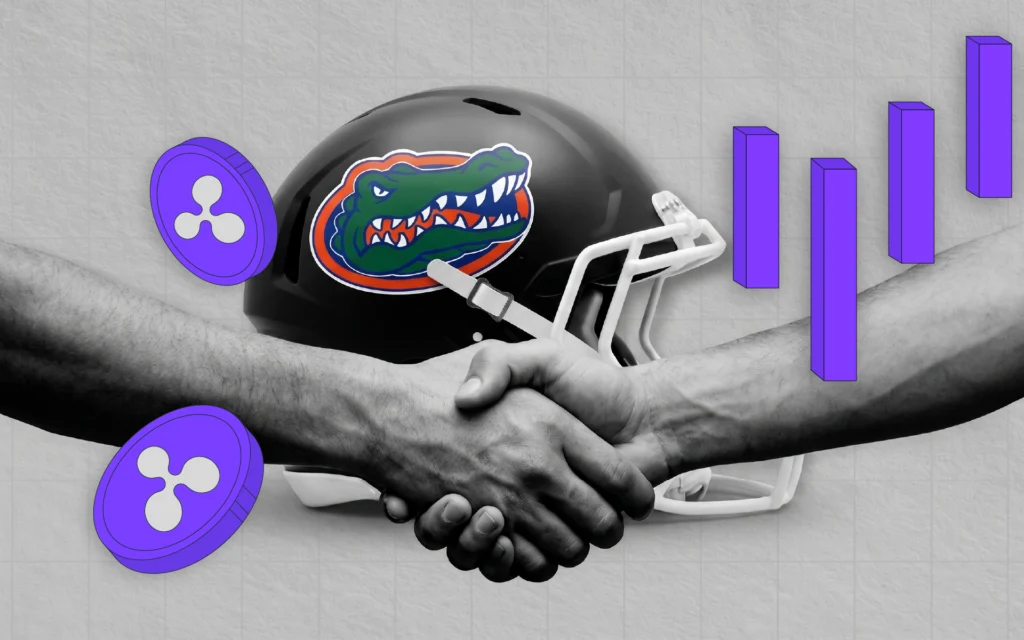
Less than two weeks earlier, the company signed a similar multi-year partnership with the University of Florida, placing the XRP logo on the field at Ben Hill Griffin Stadium for the 2026 football season.
As CCN previously reported, the Florida deal also includes event signage and financial and technology education for students and athletes.
The two agreements give XRP prominent placements in college football and basketball, suggesting Ripple is pursuing a broader sports marketing strategy rather than a one-off sponsorship.
However, neither university has announced plans to purchase XRP, accept it for payments, or build on the XRP Ledger. The deals expand the token’s public visibility but do not directly create additional demand or network activity.
Can XRP Price Reach $19.60?
The sporting partnership arrives as XRP trades near $1.33, after recently falling as low as $1.29.
At $1.33, XRP’s price would need to gain approximately 1,374% to reach Standard Chartered’s $19.60 target for 2029.
The bank’s current forecast is more complicated than the widely circulated $8 prediction for 2026.
Standard Chartered revised its XRP outlook in February, cutting its 2026 target from $8 to $2.80 and reducing its 2027 estimate from $10.40 to $7.
However, the bank became more optimistic further into the decade, setting out the following projected path:
- 2026: $2.80
- 2027: $7
- 2028: $12.60
- 2029: $19.60
- 2030: $28
Even the reduced $2.80 target would require XRP to rise approximately 111% from $1.33.
Reaching $19.60 would create a far greater valuation challenge.
Ripple’s Branding Push Meets Bigger XRP Ambitions
Ripple’s Louisville agreement places XRP itself, not just Ripple, in front of basketball audiences.
That may help Ripple reinforce the connection between its expanding financial infrastructure business and the token underpinning parts of its product ecosystem.
The branding push also follows increasingly ambitious public comments about XRP’s long-term position.
Former Ripple Chief Technology Officer David Schwartz recently said XRP could eventually overtake Bitcoin by growing faster and capturing a larger share of an expanding digital asset market.
Schwartz argued that the XRP Ledger’s speed and functionality could attract activity that Bitcoin’s base layer cannot support.
However, he has also downplayed predictions that XRP will reach between $50 and $100, describing such prices as possible but unlikely.
The information provided in this article is for informational purposes only. It is not intended to be, nor should it be construed as, financial advice. We do not make any warranties regarding the completeness, reliability, or accuracy of this information. All investments involve risk, and past performance does not guarantee future results. We recommend consulting a financial advisor before making any investment decisions.

Kurt Robson is a London-based reporter at CCN, specialising in the fast-moving worlds of crypto and emerging technology. He began his career covering local news in Cornwall after graduating from Falmouth University with First Class Honours in Journalism. There, he cut his teeth on everything from council meetings to missing swans.
He quickly rose through the ranks to become a frontline journalist at several of the UK’s leading national newspapers. Over the years, he has interviewed musicians and celebrities, reported from courtrooms and crime scenes, and secured multiple front-page exclusives.
Following the upheaval of the COVID-19 pandemic, Kurt shifted his focus to technology journalism—just ahead of the AI boom. With a natural curiosity and a trained eye for emerging trends, he has found a new rhythm in reporting on innovation.
At CCN, Kurt's work focuses on the cutting edge of crypto, blockchain, AI, and the evolving digital world. Drawing on his background in people-first reporting and his deep interest in disruptive tech, Kurt delivers stories that are insightful, entertaining, and human-centric.