Key Takeaways
- Treasury Secretary Scott Bessent will unveil sweeping new Iran sanctions at a 2 p.m. ET press conference.
- XRP has no known direct exposure to Iran’s sanctions-evasion networks, but oil shocks and risk-off selling could threaten its recent rally.
- Bitcoin faces greater scrutiny after an Iranian maritime platform offered to accept BTC to circumvent Western restrictions.
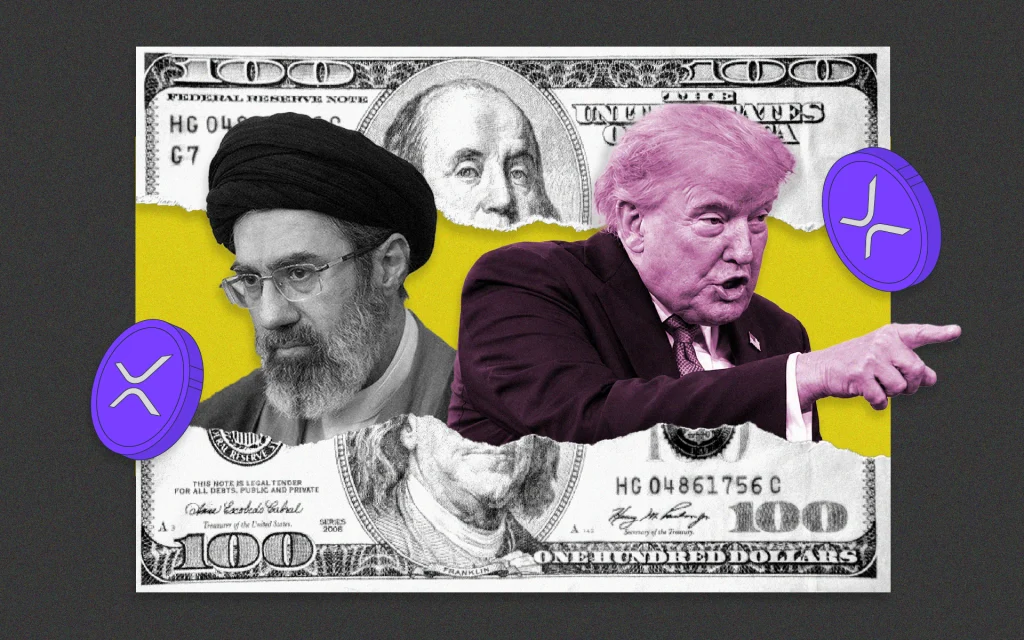
XRP’s explosive 47% weekly rally faces a major geopolitical test as the US prepares to unveil what Treasury Secretary Scott Bessent has called the “toughest sanctions in history” against Iran.
Bessent is expected to detail the measures at a high-stakes press conference on Monday, Aug. 24, at 2 p.m. ET.
Popular crypto YouTuber Crypto Rover, who has 1.6 million followers on X, warned traders to prepare for sharp price swings around the announcement.
“Be ready, markets could get volatile,” he wrote.
The comments have raised concerns that some of the most bearish XRP price predictions could be coming true.
Emergency Iran Sanctions Conference Set for 2 p.m. ET
Bessent will hold the press conference at 2 p.m. ET, or 7 p.m. BST, with markets waiting to learn how far Washington’s new restrictions will extend.
The Treasury secretary previously described the plan as a combination of financial sanctions and the existing US naval blockade.
“It is a one-two punch. We have the blockade, and we are going to have the toughest sanctions in history,” Bessent told CNBC.
The announcement could include secondary sanctions against foreign banks, companies and countries that continue trading with Iran.
These measures would not simply restrict Iranian businesses.
They could threaten third parties with exclusion from the US financial system if they continue purchasing Iranian oil or facilitating payments for Tehran.
China will be a crucial part of that strategy.
It purchased more than 80% of Iran’s seaborne crude exports in 2025, according to Kpler data cited by Reuters.
Markets are already showing signs of caution.
Iran’s rial fell to a record low of 2.02 million against the dollar on informal markets Monday, while world stocks weakened ahead of the announcement, according to the Associated Press.
Bessent Says Iran Has Entered the ‘Endgame’
Bessent dramatically escalated his rhetoric in an X post and Financial Times op-ed published Sunday.
The Treasury secretary claimed President Donald Trump had severely weakened Iran’s military and nuclear capabilities, describing the new economic campaign as the next phase of the conflict.
“At dawn begins an economic D-Day—the single greatest financial offensive ever marshalled against an adversary,” he wrote.
Bessent said Washington would target every remaining financial and commercial channel supporting Tehran.
The central message is that Iran’s trading partners may be forced to choose between maintaining economic ties with Tehran and preserving access to US markets and capital.
Bessent said the objective was to sever Iran’s remaining economic lifelines until the country stood alone.
He has also argued that maximum financial pressure could reduce the likelihood of renewed large-scale military action.
However, Iran has threatened retaliation if other countries help Washington isolate its economy, raising the danger that sanctions could intensify the conflict instead.
How Could the Iran Sanctions Impact XRP?
While the direct threat to XRP remains limited, the token is unlikely to be immune from impact.
Ripple states that its regulated businesses comply with anti-money laundering, counterterrorism financing and government sanctions requirements, according to the company’s compliance disclosures.
That makes it highly unlikely that a regulated Ripple payment corridor or licensed institutional partner would knowingly process Iran-linked transactions.
However, the token was trading near $1.47 on Monday after gaining approximately 47% over the previous seven days.
This was driven by Treasury bond buybacks and renewed inflows into US spot XRP ETFs.
That steep rally potentially leaves XRP vulnerable to profit-taking if Bessent’s announcement triggers a wider retreat from risk assets.
There are three main transmission risks.
First, restrictions on Iranian oil exports could send energy prices higher. That would increase inflation concerns and make it harder for the Federal Reserve to ease monetary policy.
Second, aggressive secondary sanctions against Chinese banks could deepen tensions between Washington and Beijing, weakening global investor confidence.
Third, XRP often moves more sharply than Bitcoin during periods of market stress because of its smaller market size.
Iran Fears Put XRP’s $0.18 Warning Back in Focus
The prospect of an Iran-driven crypto selloff has put one of XRP’s most bearish recent predictions back in the spotlight.
Motley Fool analyst Anthony Di Pizio raised the possibility of XRP eventually falling to $0.18 in an Aug. 13 analysis.
His warning followed a brutal reversal for the token. XRP reached $3.65 in 2025 before losing approximately 72% of its value and briefly falling below $1 on Aug. 11.
Di Pizio compared that decline with XRP’s previous boom-and-bust cycle.
After reaching its previous record high in 2018, XRP had lost approximately 95% of its peak value by mid-2020. It then remained below $1 until November 2024.
“I think history could repeat,” Di Pizio wrote.
If XRP experienced another 95% collapse from its $3.65 peak, its price would fall to approximately $0.18.
Di Pizio stressed that he was not predicting such a decline with certainty. However, he described XRP’s recent fall below $1 as “a clear warning” that further losses could follow.
Bessent’s sanctions announcement would not, by itself, be enough to drive XRP to $0.18.
However, a resulting oil shock and stronger dollar could increase selling pressure and revive concerns that XRP’s latest recovery will not hold.
What Could the Sanctions Mean for the Wider Crypto Industry?
The crypto industry could face a more direct challenge if Bessent expands the campaign against Iran’s digital asset infrastructure.
In June, the Treasury sanctioned Nobitex, Iran’s largest crypto exchange, alongside Wallex, Bitpin, and Ramzinex.
Nobitex processed more than half of Iran’s digital asset inflows during 2025 and allegedly helped the country’s central bank access hundreds of millions of dollars in stablecoins, according to the Treasury Department.
Treasury said its earlier actions had frozen nearly $500 million in regime-linked crypto.
Monday’s package could extend that crackdown through new sanctions against crypto exchanges and payment processors or secondary sanctions against foreign platforms serving Iranian users.
These measures could indirectly impact the demand for riskier assets such as Bitcoin, XRP and beyond.
Impact on Bitcoin?
Bitcoin could also face sharp volatility from the new Iran sanctions.
If the sanctions disrupt global oil supplies, energy prices could rise and fuel fresh inflation concerns.
This could strengthen the dollar, push bond yields higher and reduce expectations for interest-rate cuts — all generally negative developments for Bitcoin.
However, a less aggressive announcement could produce the opposite reaction.
If investors believe the sanctions reduce the likelihood of renewed military action, Bitcoin could hold its recent gains or move higher as geopolitical fears ease.
Crypto-specific measures will also be closely watched. The Treasury has already accused Iran of using Bitcoin to bypass Western restrictions.
On July 29, it sanctioned the HormuzSafe Marine Services Authority and Persian Gulf Marine Insurance Company over an alleged maritime extortion scheme.
According to the Treasury Department, HormuzSafe offered to accept Bitcoin from ships seeking passage through the Strait of Hormuz.
If Bessent announces additional sanctions against crypto platforms or payment networks, Bitcoin could face short-term selling pressure as exchanges tighten compliance checks.

Kurt Robson is a London-based reporter at CCN, specialising in the fast-moving worlds of crypto and emerging technology. He began his career covering local news in Cornwall after graduating from Falmouth University with First Class Honours in Journalism. There, he cut his teeth on everything from council meetings to missing swans.
He quickly rose through the ranks to become a frontline journalist at several of the UK’s leading national newspapers. Over the years, he has interviewed musicians and celebrities, reported from courtrooms and crime scenes, and secured multiple front-page exclusives.
Following the upheaval of the COVID-19 pandemic, Kurt shifted his focus to technology journalism—just ahead of the AI boom. With a natural curiosity and a trained eye for emerging trends, he has found a new rhythm in reporting on innovation.
At CCN, Kurt's work focuses on the cutting edge of crypto, blockchain, AI, and the evolving digital world. Drawing on his background in people-first reporting and his deep interest in disruptive tech, Kurt delivers stories that are insightful, entertaining, and human-centric.