Key Takeaways
- Tom Lee predicts AI-powered crypto payments will become mainstream within the next five years.
- He believes Ethereum will be the backbone of AI-driven payments, tokenization, and digital finance.
- Major firms, including MoonPay, Visa, Stripe, and Coinbase, are already building infrastructure for AI commerce.
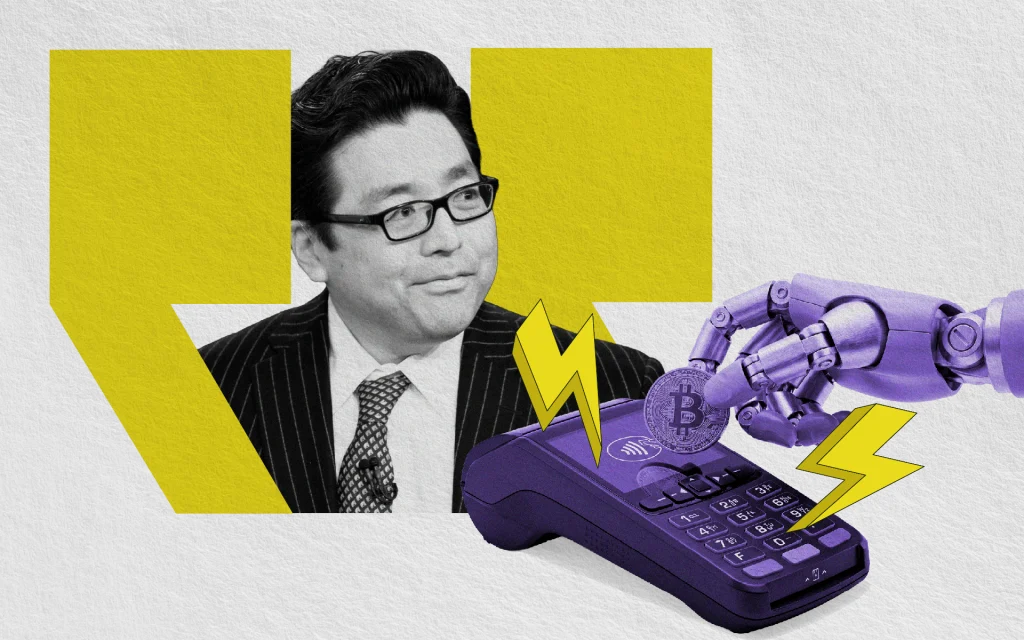
Tom Lee believes artificial intelligence will fundamentally reshape how money moves online, predicting that AI-powered crypto payments will become mainstream within the next five years.
Speaking about the convergence of blockchain and artificial intelligence, the Fundstrat co-founder and BitMine chairman argued that AI agents will increasingly transact with one another without human intervention, making blockchain-based payments a core part of the future digital economy.
His comments come as major technology and payments companies, including Coinbase, Stripe, Visa, Google, and MoonPay, race to build infrastructure that allows AI agents to autonomously pay for computing resources, data, software, and digital services using stablecoins.
AI Agents Could Transform Crypto Payments
Lee’s thesis centers on agentic AI, software capable of completing tasks and making purchasing decisions independently.
Unlike traditional payment systems that rely on cards or bank transfers, AI agents require infrastructure capable of handling millions of low-value, machine-to-machine transactions.
Lee argues that blockchain networks are better suited for that role because they provide programmable, always-available settlement without intermediaries.
The prediction aligns with recent industry data. A Keyrock report estimated AI agents settled more than $73 million through approximately 176 million blockchain transactions between May 2025 and April 2026.
While still small relative to traditional payments, researchers say the infrastructure is rapidly evolving as stablecoins become the preferred settlement layer for autonomous software.
Armstrong Says AI Makes Crypto More Important, Not Less
Coinbase CEO Brian Armstrong pushed back against the growing narrative that crypto should take a back seat to artificial intelligence, arguing that the two technologies are complementary rather than competitive.
In a post on X, Armstrong described crypto as foundational infrastructure, comparing it to electricity and the internet, and said AI’s rapid growth only increases the need for blockchain-based financial systems.
He argued that AI agents will require real-time programmable money because they cannot open bank accounts, wait for traditional wire transfers, or rely on country-specific financial infrastructure.
Armstrong said Coinbase is building for this future through technologies including the x402 protocol, Base, and USDC, which he said already power most agentic payments.
He added that AI agents will eventually manage financial tasks such as payments, trading, lending, fundraising, tax planning, portfolio rebalancing, and bill payments, describing the emerging model as “Agentic Finance,” or AiFi.
Ethereum Remains Central to Lee’s Vision
Lee’s optimism about AI payments also explains his increasingly bullish stance on Ethereum.
Over recent months, he has argued Ethereum should be viewed less as a cryptocurrency and more as the operating system for tokenized finance, artificial intelligence, and programmable payments. According to Lee, Wall Street adoption, rather than retail speculation, has become Ethereum’s primary long-term growth driver.
He has pointed to initiatives such as BlackRock’s tokenized funds, Robinhood Chain’s Ethereum compatibility, and growing institutional use of stablecoins as evidence that Ethereum is becoming critical infrastructure for digital finance.
Lee has also suggested ETH could eventually reach $250,000 if it becomes the dominant settlement asset for AI-driven commerce and tokenized financial markets, though that target remains highly debated among analysts.
BitMine, where Lee serves as chairman, has reinforced that conviction by accumulating more than 5 million ETH, making it one of the world’s largest corporate holders of Ethereum.
Infrastructure Race Is Already Underway
Whether Lee’s five-year timeline proves accurate will depend on more than just blockchain technology.
Developers still face challenges around regulation, digital identity, liability, and interoperability before AI agents can routinely conduct financial transactions on behalf of users. At the same time, competition is intensifying. Coinbase’s x402 protocol, Stripe’s Machine Payments Protocol, Google’s AP2 framework, Visa’s agentic commerce initiative, and MoonPay’s recently launched PayBox all aim to enable autonomous payments between AI systems.
If those efforts succeed, Lee believes crypto’s next adoption wave may not be driven by retail investors buying digital assets but by billions of AI-powered transactions occurring behind the scenes, making blockchain-based payments part of the internet’s everyday infrastructure
Top Trending Crypto Articles
The information provided in this article is for informational purposes only. It is not intended to be, nor should it be construed as, financial advice. We do not make any warranties regarding the completeness, reliability, or accuracy of this information. All investments involve risk, and past performance does not guarantee future results. We recommend consulting a financial advisor before making any investment decisions.

Dr. Guneet Kaur is a senior editor at CCN.com and a Science Fellow at Exponential Science. She is a fintech and blockchain expert with extensive experience in digital finance education, blockchain ecosystems, and cryptocurrency markets. She has worked with global media such as Cointelegraph, as well as education and blockchain platforms, to design and lead strategic content and learning initiatives. As an educator and assessor for top-tier executive programs, she bridges real-world fintech trends with academic insight.
Dr. Kaur is also a published researcher and peer reviewer across fintech and data science journals, including Financial Innovation Journal and International Journal of Big Data Intelligence and Applications. Her work spans data-driven analysis, Web3 innovation, and technical content development. With a strong foundation in both industry and academia, she translates complex financial technologies into practical applications, empowering learners, professionals, and institutions across the rapidly evolving digital finance landscape.