Tom Lee is bullish on the CLARITY Act as his price predictions are back in focus. | Source: CCN.
Share
Key Takeaways
Tom Lee said Polymarket and Kalshi may be underestimating the CLARITY Act’s chances of passing.
Fundstrat highlighted Ethereum’s growing strength as an “AI downstream” asset while memory-related investments declined.
Reaching Lee’s $22,000 target would require ETH to rise approximately 1,040% from its current price.
Ethereum’s prospects of reaching $22,000 have returned to focus after Fundstrat co-founder Tom Lee said prediction markets may be underestimating the likelihood of the CLARITY Act becoming law.
The BitMine chairman has also highlighted a separate bullish signal for Ethereum, arguing that ETH is strengthening as an “AI downstream” asset while investments tied directly to memory chips decline.
Try Our Recommended Crypto Exchanges
Sponsored
Disclosure
We sometimes use affiliate links in our content, when clicking on those we might receive a commission at no extra cost to you. By using this website you agree to our terms and conditions and privacy policy.
Tom Lee Says CLARITY Act Odds Are Being Underestimated
Lee endorsed analysis from Fundstrat Head of Digital Asset Strategy Sean Farrell on Monday, arguing that private conversations with policymakers painted a more optimistic picture than prediction markets.
According to Lee, Farrell’s conversations with policymakers indicated that the chances of the CLARITY Act passing were higher than the current probabilities displayed on Polymarket and Kalshi.
In a note to investors, Farrell wrote that he remained skeptical that “this market fully reflects informed expectations given its relatively limited liquidity and recent restrictions preventing Senators from trading on prediction markets.”
Love this take from @SeanMFarrell on Clarity Act odds of passage:
– his convos with policymakers show higher odds than seen in prediction markets – "recent restrictions" prevent insiders from trading on this outcome
— Thomas (Tom) Lee (not drummer) FundstratDirect.com (@fundstrat) July 21, 2026
“As a result, I still place less weight on the quoted probability than many market participants appear to,” he added.
Lee also argued that recent restrictions on political insiders trading on relevant outcomes could limit the extent to which informed activity reaches prediction markets.
“Hence, Polymarket and Kalshi markets likely underestimate odds of passage,” Lee said.
“PS: This is bullish.”
Why Are the CLARITY Act’s Polymarket Odds Still Below 50%?
Despite the reported progress in Washington, Polymarket traders remained unconvinced that the CLARITY Act would complete its journey through Congress this year.
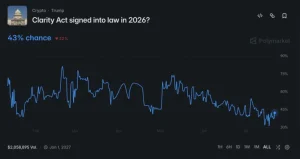
The prediction platform gave the legislation a 47% chance of becoming law at the time of writing, up from approximately 43% on Tuesday but still below 50%.
Polymarket odds are still low. | Source: Polymarket
More than $2.1 million had been traded on the market, according to Polymarket.
President Donald Trump has reportedly accepted proposed ethics restrictions intended to prevent senior government officials from financially benefiting from crypto.
“While we still do not know the substance of those discussions, it suggests negotiations are moving forward behind the scenes,” Farrell said in his investor note.
Tom Lee: Ethereum Flashes Bullish ‘AI Downstream’ Signal
Lee’s CLARITY Act comments came as the Fundstrat co-founder highlighted another potentially positive signal for Ethereum.
Lee described ETH as strengthening as an “AI downstream” asset, suggesting the crypto could benefit from the next stage of AI adoption rather than only the initial spending boom surrounding chips and data centers.
Fundstrat’s performance chart showed Ethereum rising approximately 24% over the comparison period while the Roundhill Memory ETF declined by around 38%.
That represented a 62-percentage-point difference in performance between the two assets.
A separate ETH-to-DRAM measure highlighted by Fundstrat strengthened by 72 points over the previous month.
The "AI downstream" relative performance continues to strengthen
— Thomas (Tom) Lee (not drummer) FundstratDirect.com (@fundstrat) July 21, 2026
A rising ETH-to-DRAM measure means Ethereum is outperforming the basket of memory-related companies.
Lee appears to view the divergence as evidence that the AI trade may be broadening beyond hardware.
Memory shortages and other infrastructure bottlenecks dominated the initial phase of the AI investment cycle as companies rushed to acquire chips, storage and computing capacity.
If those bottlenecks are beginning to ease, investors could increasingly turn to assets expected to benefit from applications built on that infrastructure.
Lee has repeatedly argued that Ethereum could become a financial settlement layer for AI agents.
Under that theory, Ethereum would benefit from AI adoption indirectly through stablecoin payments, tokenized assets, and machine-to-machine transactions.
How High Could Ethereum Go, According to Tom Lee?
Lee remains one of Ethereum’s most bullish supporters, linking its potential growth to Bitcoin’s performance and accelerating institutional adoption.
The bullish analyst has predicted that Ethereum could reach between $7,000 and $9,000 in the near term, though he acknowledged that further volatility could emerge before it reaches those levels.
His longer-term outlook depends partly on ETH recovering against Bitcoin.
If Bitcoin reaches $250,000, Lee believes historical ETH-to-BTC ratios could place Ethereum between $12,000 and $22,000.
The upper end of that range would require both cryptocurrencies to rally significantly, with Ethereum also reversing its prolonged underperformance against Bitcoin.
Lee has outlined an even more aggressive scenario in which Ethereum could reach $250,000 if Bitcoin eventually climbs to $1 million.
However, that outcome would require an unprecedented expansion in Ethereum’s value relative to Bitcoin and remains highly speculative.
What Would Ethereum Need to Do?
The Fundstrat co-founder has previously applied historical ETH-to-BTC ratios to his long-term Bitcoin valuation of $250,000.
If Ethereum returned to its longer-term average ratio of approximately 0.048 against a $250,000 Bitcoin price, ETH would trade near $12,000.
Ethereum traded close to $1,930 at the time of writing, having closed at approximately $1,928 on Tuesday, according to CoinMarketCap data.
From that level, reaching $22,000 would require ETH to add approximately $20,070 to its price.
That would represent a gain of around 1,040%, taking Ethereum to approximately 11.4 times its current value.
Ethereum would first need to reclaim $2,000 and $3,000 before returning to its August 2025 record of approximately $4,946.
Even after matching that peak, ETH would need to climb another 345% to reach $22,000.
Disclaimer:
The information provided in this article is for informational purposes only. It is not intended to be, nor should it be construed as, financial advice. We do not make any warranties regarding the completeness, reliability, or accuracy of this information. All investments involve risk, and past performance does not guarantee future results. We recommend consulting a financial advisor before making any investment decisions.
Kurt Robson is a London-based reporter at CCN, specialising in the fast-moving worlds of crypto and emerging technology. He began his career covering local news in Cornwall after graduating from Falmouth University with First Class Honours in Journalism. There, he cut his teeth on everything from council meetings to missing swans.
He quickly rose through the ranks to become a frontline journalist at several of the UK’s leading national newspapers. Over the years, he has interviewed musicians and celebrities, reported from courtrooms and crime scenes, and secured multiple front-page exclusives.
Following the upheaval of the COVID-19 pandemic, Kurt shifted his focus to technology journalism—just ahead of the AI boom. With a natural curiosity and a trained eye for emerging trends, he has found a new rhythm in reporting on innovation.
At CCN, Kurt's work focuses on the cutting edge of crypto, blockchain, AI, and the evolving digital world. Drawing on his background in people-first reporting and his deep interest in disruptive tech, Kurt delivers stories that are insightful, entertaining, and human-centric.