Franklin Templeton says agentic AI could drive blockchain adoption and boost altcoin demand as machine commerce grows toward $5 trillion. | Credit: CCN.com
Share
Key Takeaways
EigenCloud provides infrastructure that enables users to verify what autonomous AI agents actually did, rather than simply trusting the company that runs them.
AI agents are increasingly capable of performing real-world tasks such as managing finances, running businesses, or executing trades without human supervision.
According to Eigen Labs, the main challenge for autonomous agents is accountability, not computing power or technology.
Eigen Labs believes agents may eventually own assets, enter contracts, earn revenue, and operate businesses autonomously.
Artificial intelligence is entering a new phase. Instead of simply answering questions or generating text, AI agents are increasingly acting independently, trading assets, managing online services, writing code, and even running businesses.
This emerging shift is often called the “agentic era.” In this world, software doesn’t just assist humans; it acts on their behalf.
But there is a major problem: trust. If autonomous agents begin managing money, executing trades, or running digital services, how can users know the AI actually did what it claimed to do? That question sits at the center of EigenCloud, a new crypto-powered infrastructure designed to make AI agents verifiable, accountable, and economically responsible for their actions.
Built by Eigen Labs, the platform aims to combine blockchain technology with cloud computing and artificial intelligence to create a new trust layer for autonomous software.
What Are Autonomous Agents and Why They Matter
The idea behind autonomous agents is simple: software that can make decisions and perform tasks without constant human supervision.
AI agents can already perform a wide range of functions:
Some developers even envision agent-run companies, where AI systems manage operations, finances, and customer interactions with minimal human involvement.
But this vision comes with a challenge. As agents begin to control money, data, and infrastructure, users need to know that those agents are behaving correctly.
Sreeram Kannan, founder and CEO of Eigen Labs, told CCN that trust is the missing piece holding back the agentic economy.
“The bottleneck isn’t raw capability or compute, it’s accountability.”
Today’s AI systems often rely on trust in the companies that operate them, rather than verifiable proof of what they do.
That approach may work for low-risk tasks, but it becomes problematic when AI agents are handling financial transactions, sensitive data, or automated decision-making.
Why Trust Is the Biggest Problem for AI Agents
Most AI platforms today operate under a simple model: trust the provider.
If an AI agent executes a financial trade, allocates money, or processes sensitive data, users typically have no direct way to verify that the system followed the rules correctly.
According to Kannan, this trust model breaks down quickly when real value is involved. “Most AI systems today operate on a trust model that says, ‘Trust the company.’ That puts an unreasonable responsibility on the user to make those decisions. So the model breaks down in high-stakes scenarios.”
This issue becomes particularly dangerous in financial or enterprise environments. Imagine an AI system:
Misrouting funds in a financial portfolio.
Making biased or flawed decisions in automated trading.
Coordinating with other agents in unexpected ways.
If something goes wrong, it may be difficult or impossible to reconstruct what happened. Kannan describes this as one of the most concerning risks of the agentic future.
“The most concerning scenario is silent failure at scale.”
In other words, autonomous systems could make mistakes or behave unexpectedly, and no one would know exactly why.
That is the problem EigenCloud is designed to solve.
What EigenCloud Actually Does
EigenCloud is a crypto-powered cloud platform that enables AI systems to be verified.
Instead of simply trusting an AI system’s output, EigenCloud allows users to verify:
What the agent actually executed,
What data the agent used.
How the AI model made decisions.
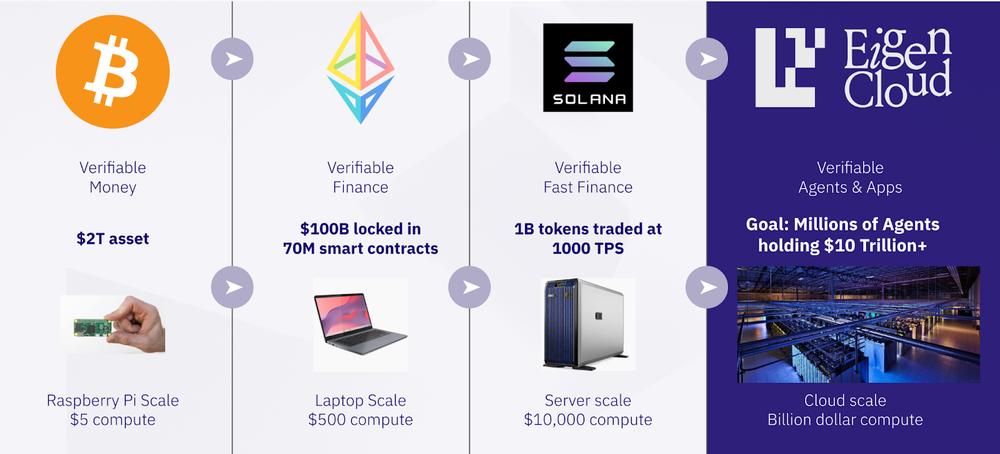
The platform accomplishes this through four core components working together.
What is EigenCloud? | Credit: Eigen Lab
EigenLayer – The Trust and Enforcement Layer
EigenLayer provides the system’s security backbone. It uses staking and slashing mechanisms, meaning participants who validate the system risk losing funds if they act incorrectly. This creates economic consequences for incorrect behavior.
EigenCompute – Verifiable Computing Power
EigenCompute enables developers to deploy applications and AI agents in a cloud-like environment similar to traditional platforms like AWS. The difference is that the system provides cryptographic proof of execution, allowing users to verify which computations were actually performed.
EigenDA – High-Speed Data Availability
AI systems rely heavily on large datasets. EigenDA ensures that the data used by agents is available and verifiable, preventing manipulation or hidden inputs.
EigenAI – Deterministic AI Models
One of the biggest challenges in AI verification is non-determinism, the fact that AI models may produce slightly different results even with the same input. EigenAI addresses this by enabling deterministic inference, meaning the same input produces the same result every time. Together, these components create what Eigen Labs calls “full-stack verifiability.”
How Crypto Makes AI Accountable
Blockchain technology introduces a new element into the AI ecosystem: economic enforcement.
In traditional software systems, accountability usually relies on contracts, reputation, or legal enforcement.
Crypto allows systems to enforce rules automatically through smart contracts and financial penalties.
EigenCloud uses this model to ensure agents follow their instructions.
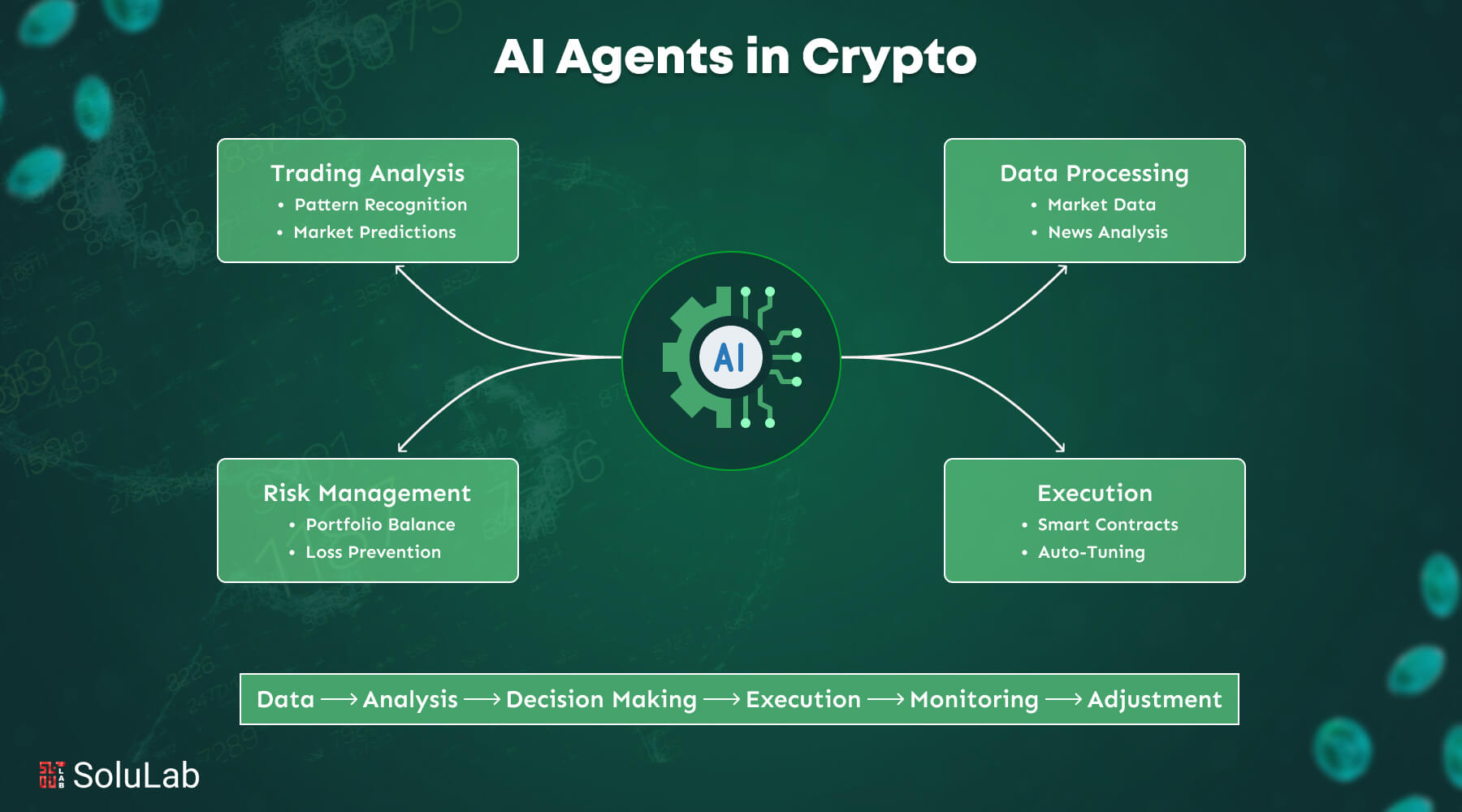
AI agents in crypto. | Credit: SoluLab
“EigenCloud introduces a trust model based on the ability to verify execution, verify data, ensure deterministic inference, and enforce commitments through slashing.”
If an agent or validator behaves incorrectly, their staked funds can be automatically reduced or redistributed.
This system turns trust into something measurable and enforceable. “Trust becomes a factor you can audit and not just interpret.”
That shift, from reputational trust to cryptoeconomic enforcement, is what Eigen Labs believes will enable large-scale adoption of autonomous agents.
How an AI Financial Agent Could Manage Your Money
To understand how this technology could affect everyday users, consider a simple scenario: an AI financial agent.
Sreeram Kannan explains it this way: “A simple example is an AI agent managing your money.”
In today’s systems, users must simply trust the company running the AI.
“You’d have to trust that the agent followed your instructions and didn’t cut corners, or even do something erratic or illicit.”
EigenCloud changes that relationship.
“What EigenCloud enables is verification of execution, verification of data, and deterministic AI inference, backed by economic consequences if something goes wrong.”
Instead of relying on corporate reputation, users can independently verify the system’s actions.
“So instead of asking ‘Do I trust this company?’ you can ask ‘Can this system prove what it did?’”
Role of the EIGEN Token in the EigenCloud Ecosystem
The EIGEN token plays a central role in securing the EigenCloud ecosystem. It is used within the platform’s staking and dispute resolution systems.
“EIGEN is embedded in the security and dispute-resolution layer of EigenCloud.”
As applications and AI agents rely on EigenCloud’s services, they effectively pay for programmable trust.
https://www.youtube.com/watch?v=7x1NNbbg2TM
“As more applications and agents rely on our services, they are effectively paying for programmable trust.”
That demand flows through the ecosystem via staking requirements, service fees, and slashing conditions tied to the token.
Early Use Cases for Autonomous AI Agents
While the technology behind EigenCloud is complex, the first real-world applications may focus on practical economic tasks.
Kannan says the company plans to build its own consumer-facing applications.
“We will ship products ourselves, including consumer-facing apps and agents that people can use today.”
One early example is Sovra, an AI cartoonist agent that generates content and earns money through product placements.
The agent can run auctions, collect payments, and manage its own treasury. This type of system hints at a future where AI agents act as independent economic participants.
AI Agents as Economic Actors
Eigen Labs believes autonomous agents will eventually become a new class of digital economic actors.
Without verifiability, those systems could become opaque and difficult to control.
Eigen Labs believes crypto infrastructure can provide the tools needed to keep autonomous software transparent, auditable, and economically accountable.
“No infrastructure can eliminate all risk. But we can dramatically reduce the risk of opacity.”
If successful, platforms like EigenCloud could become the foundation for a new digital economy where humans and autonomous agents interact through verifiable systems rather than blind trust.
In that world, AI agents may not just assist people; they could become partners, service providers, and even businesses in their own right.
And the trust that makes it possible could be powered by crypto.
EigenCloud is a crypto-based infrastructure platform designed to make AI agents verifiable and accountable. It combines blockchain security, cloud computing, and artificial intelligence to ensure autonomous systems can prove what actions they took, what data they used, and how they made decisions.
What are AI agents?
AI agents are autonomous software programs that can perform tasks and make decisions on behalf of users. Unlike traditional AI tools that only provide suggestions, agents can actively carry out actions such as managing finances, executing trades, running online services, or coordinating workflows.
Why is trust such a big issue with AI agents?
Most AI systems today rely on a “trust the company” model, meaning users must believe the system worked correctly without proof. When AI agents begin handling money, sensitive data, or automated decision-making, users need stronger guarantees that the system followed instructions properly.
What role does the EIGEN token play in EigenCloud?
The EIGEN token helps secure the network through staking and economic enforcement. Validators stake tokens to participate in the system, and if they behave incorrectly, their stake can be slashed (penalized). This creates financial incentives for honest behavior.
Disclaimer:
The information provided in this article is for informational purposes only. It is not intended to be, nor should it be construed as, financial advice. We do not make any warranties regarding the completeness, reliability, or accuracy of this information. All investments involve risk, and past performance does not guarantee future results. We recommend consulting a financial advisor before making any investment decisions.
Giuseppe Ciccomascolo began his career as an investigative journalist in Italy, where he contributed to both local and national newspapers, focusing on various financial sectors.
Upon relocating to London, he worked as an analyst for Fitch's CapitalStructure and later as a Senior Reporter for Alliance News. In 2017, Giuseppe transitioned to covering cryptocurrency-related news, producing documentaries and articles on Bitcoin and other emerging digital currencies. He also played a pivotal role in establishing the academy for a cryptocurrency exchange website. Crypto remained his primary area of interest throughout his tenure as a writer for ThirdFloor.


 Easy
Easy