Franklin Templeton says agentic AI could drive blockchain adoption and boost altcoin demand as machine commerce grows toward $5 trillion. | Credit: CCN.com
Share
Key Takeaways
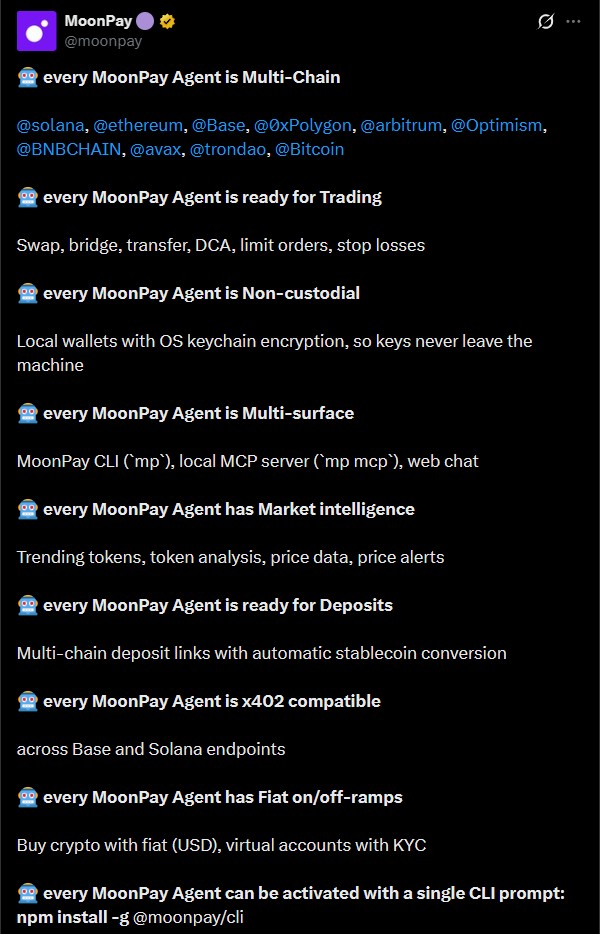
MoonPay Agents lets an AI agent use crypto tools like swaps, bridges, DCA, limit orders, and stop losses across 10 supported blockchains.
Agents is non-custodial. Your wallet keys stay on your device and use OS keychain encryption.
It can be used through MoonPay’s CLI, a local MCP server, or web chat, so agents can work in different setups.
It also connects to fiat rails, including virtual accounts and payment options like Apple Pay, Venmo, and PayPal (availability depends on the service).
MoonPay, the payments platform that allows for easy conversions between fiat and crypto, has introduced MoonPay Agents, a new product meant for AI agents. Launched on February 24, 2026, Agents is an automated tool that can plan actions and carry them out without human intervention.
MoonPay is a non-custodial software that gives an AI agent access to crypto wallets, funds, and onchain actions through MoonPay’s command-line interface (CLI).
The main feature, of course, is multi-chain support. In its announcement, MoonPay noted that each of its agents works across major networks like Solana and Ethereum.
Earn Crypto with These Top Mining Apps
Sponsored
Disclosure
We sometimes use affiliate links in our content, when clicking on those we might receive a commission at no extra cost to you. By using this website you agree to our terms and conditions and privacy policy.
MoonPay Agents aren’t just chatbots that buy crypto. They’re toolkits that let an AI agent execute on various pre-built crypto actions. The company’s Help Center notes that agents have 54 crypto-specific tools across 17 “skills.” These tools include wallet actions, trading actions, analyzing token information, and more.
Essentially, these agents are a full process setup. They can help with funding from fiat-to-crypto, wallet management, token discovery, risk analysis, trading, portfolio tracking, and off-ramping back to fiat.
Fiat integration for buying with fiat and off-ramping back to fiat.
x402 compatibility for machine-to-machine payments.
x402 compatibility is what enables MoonPay Agents to, say, make a transaction from wallet to exchange without human intervention.
What Non-Custodial Means in This Context
MoonPay calls the system non-custodial, meaning MoonPay does not hold your private keys.
Instead, wallet keys are stored locally on your device and use OS keychain encryption, meaning they’re stored in an encrypted space within your hardware, be it an iPhone, Android phone, or computer.
This matters because an AI agent can only act within the permissions and access it has. With a non-custodial setup, you retain control over your wallet keys while still benefiting from third-party services.
How You Can Access the AI Agent
MoonPay Agents can be accessed through three distinct methods, depending on your technical setup and preference.
The first is MoonPay’s command-line interface (CLI), which is best suited for developers who want direct, scriptable control over agent actions. The CLI allows you to invoke tools, pass parameters, and integrate agent functions into larger automated workflows.
The second is a local Model Context Protocol (MCP) server. MCP is an open standard that allows AI models to connect to external tools and data sources in a structured way. Running MoonPay’s MCP server locally means the agent’s crypto tools become available to any MCP-compatible AI assistant on your machine, without routing sensitive data through a third-party cloud.
The third is web chat, the most accessible entry point. No technical setup is required — you interact with the agent conversationally through a browser interface, making it practical for non-developer users who still want to automate crypto tasks.
Beyond these three access methods, MoonPay Agents also integrates directly with existing AI assistants, including Claude. This means if you already use Claude for day-to-day tasks, you can extend it with MoonPay’s 54 crypto-specific tools without switching platforms.
The agent essentially becomes a financial execution layer sitting inside your existing AI workflow. MoonPay’s support documentation covers setup steps for each method in detail.
How Crypto Agents Automate Dollar-Cost Averaging, Cross-Chain Transfers, and Auto-Funding
AI-powered crypto agents can streamline routine portfolio management by executing recurring buys, coordinating multi-step cross-chain transactions, and maintaining operational balances without manual oversight.
By automating these workflows, users can reduce friction, minimize missed opportunities, and maintain consistent strategy execution while retaining full control over wallet permissions and funding rules.
Dollar-Cost Averaging
A common beginner investment habit is to set a daily or weekly buy and forget about it.
For instance, a MoonPay Agent could follow a plan like:
Buy $25 of Bitcoin every Friday.
Send it to the same wallet address every time.
Alert you when the purchase completes.
Simplify Cross-Chain Movement
Many crypto users end up doing a bit of an app dance when they need to move funds across networks, jumping between user interfaces to complete the bridge.
Instead, you could command the agent to:
Buy USDC on Base.
Bridge to another chain for a specific use.
Swap into the token you need.
Keeping an Agent Funded for Ongoing Tasks
Some agents are meant to run all of the time, like a trading monitor or a treasury management tool. Those agents need funds available whenever possible.
You can command your bot to regularly fund an account when it hits a certain threshold. Like if you want to keep a DCA purchase going consistently, the bot can fund its own account from your fiat bank when needed.
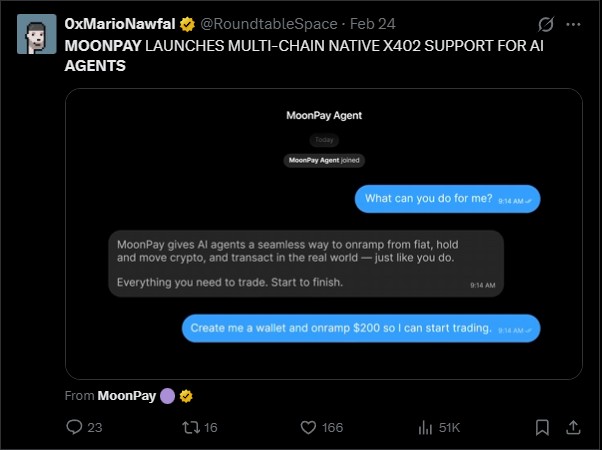
Source: @RoundtableSpace
Why MoonPay is Pushing This Now
MoonPay’s CEO Ivan Soto-Wright summed up AI agents in one line: “AI agents can reason, but they cannot act economically without capital infrastructure.” Soto-Wright predicts that software will continually grow as a market participant, getting involved in trading and other on-chain actions.
The company also has a large user base for extensive testing. After all, MoonPay powers nearly 500 companies and serves more than 30 million customers across 180 countries, which is part of its scale argument.
Crypto Automation Safety Tips: How to Use Agents Without Costly Mistakes
Automating your processes can save time, but it also opens up the potential for mistakes.
Some practical safety habits:
Start small. Use a test wallet or low balances first.
Keep your device secure, as it stores keys locally.
Treat agent permissions like your spending power, as that’s what they are.
Factor in fees, as swaps and bridges can add costs.
MoonPay’s docs stress the non-custodial model and local key storage, which helps, but it does not remove the need for you to be careful while setting it up.
MoonPay describes it as non-custodial. Its help center says keys are stored locally on your device and never leave your machine.
What does DCA mean here?
DCA means dollar-cost averaging. It is scheduled buying, like buying a fixed amount every week. MoonPay lists DCA as one of the supported trading actions.
Do you need identity verification to use AI agents?
MoonPay says some services require verification, such as virtual accounts and fiat onramps. After that, the agent can execute transactions on your behalf.
How do people use MoonPay Agents in practice?
MoonPay positions it for tasks like wallet management, trading automation, swaps and bridges, recurring buys, and moving between fiat and crypto through its rails.
Disclaimer:
The information provided in this article is for informational purposes only. It is not intended to be, nor should it be construed as, financial advice. We do not make any warranties regarding the completeness, reliability, or accuracy of this information. All investments involve risk, and past performance does not guarantee future results. We recommend consulting a financial advisor before making any investment decisions.
Max Moeller is a Chicago‑based writer and video editor passionate about games, tech, and crypto. Whether it’s crafting clear, insightful articles or piecing together engaging video retrospectives, he’s driven by curiosity and takes pride in keeping things human. Since 2017, Max has been published in a variety of notable crypto magazines.


 Easy
Easy