SwissBorg ofers a 3% deposit match and Bitcoin rewards as it targets users of non-MiCA exchanges ahead of the EU's July 1 licensing deadline. | Credit: CCN.com
Share
Key Takeaways
SwissBorg is targeting users of non-MiCA exchanges with a promotional campaign offering up to a 3% deposit match.
The campaign comes ahead of the EU’s July 1 MiCA deadline, when crypto platforms without full CASP authorization will no longer be allowed to legally serve EU clients.
Competition for European users is intensifying, with regulated exchanges using MiCA compliance as a key selling point.
SwissBorg has launched a new campaign aimed directly at European crypto users ahead of the European Union’s July 1 MiCA transition deadline, offering incentives of up to a 3% deposit match for customers transferring assets from exchanges that have yet to secure full regulatory approval.
The Swiss-based wealth management platform, which says it is fully compliant with the EU’s Markets in Crypto-Assets (MiCA) framework, is positioning itself as a safe alternative for users concerned about potential service disruptions as the new regulatory regime comes into full effect.
The move comes as regulators prepare to end the transition period for exchanges operating under legacy national registrations, forcing firms without full Crypto-Asset Service Provider (CASP) authorization to stop serving EU clients.
Try Our Recommended Crypto Exchanges
Sponsored
Disclosure
We sometimes use affiliate links in our content, when clicking on those we might receive a commission at no extra cost to you. By using this website you agree to our terms and conditions and privacy policy.
SwissBorg Launches Incentives for Users Switching Before MiCA Deadline
In a post on X, SwissBorg highlighted its MiCA compliance and urged users not to wait until they are forced to move funds from non-compliant platforms.
“Our team did the heavy lifting to ensure complete compliance with MiCA across Europe, while others have let you down,” the company said.
SwissBorg Is Fully MiCA Compliant: Join us for up to a 3% Deposit Match and Much More.
Our team did the heavy lifting to ensure complete compliance with MiCA across Europe, while others have let you down.
Using the promotional code “WELCOME,” new customers can receive an onboarding package that includes up to €100 worth of Bitcoin, a deposit match of up to 3%, and additional promotional rewards that SwissBorg says could total as much as €16,000.
The campaign specifically targets users who may be considering moving their portfolios before the July 1 regulatory deadline.
“Do not wait for a forced Euro-exit to control from your hands,” the company added, describing itself as “Engineered in Switzerland. Licensed in Europe.”
SwissBorg’s marketing reflects a broader industry trend as MiCA-compliant exchanges compete to attract customers from platforms that have not yet secured authorization under the EU’s new regulatory framework.
July 1 Marks a Major Turning Point for European Crypto Markets
The campaign arrives just days before one of the most significant regulatory milestones in Europe’s crypto industry.
Beginning July 1, exchanges that continue operating solely under legacy national Virtual Asset Service Provider (VASP) registrations will no longer be permitted to legally provide crypto services across the European Union unless they have obtained full CASP authorization under MiCA.
FT: Binance to Stop Serving EU Clients Next Week After Failing to Obtain MiCA Licence
According to FT, Binance has notified EU clients that it will stop providing services to them from next week after failing to obtain a MiCA licence. From July 1, crypto companies operating in… pic.twitter.com/ibdLC6czj4
Major exchanges including Coinbase and Kraken have all obtained licenses through individual EU member states, allowing them to passport their services across the entire European Economic Area. But Binance didn’t and will no longer serve its European clients.
CASP authorization goes well beyond the anti-money laundering registrations many firms previously held.
Licensed providers must satisfy requirements covering governance, capital adequacy, cybersecurity, custody standards and consumer protection before receiving approval from national regulators.
For users, the change also introduces stronger safeguards.
Licensed exchanges must segregate client assets from company funds, provide greater fee transparency and comply with stricter custody rules designed to reduce risks if a platform experiences financial difficulties.
Industry Warns Against Waiting Until the Last Minute
Industry participants have repeatedly warned users against delaying migration from exchanges that have not clearly confirmed their MiCA status.
According to recent industry analysis, more than 80% of firms that previously operated under national registrations have yet to transition to full CASP authorization.
While not all of those companies necessarily serve retail investors, the figures highlight the scale of the regulatory overhaul taking place across Europe.
Experts have drawn comparisons with previous crises involving exchanges such as Celsius, Voyager and Mt. Gox, where users who acted early generally faced fewer complications than those waiting for official announcements.
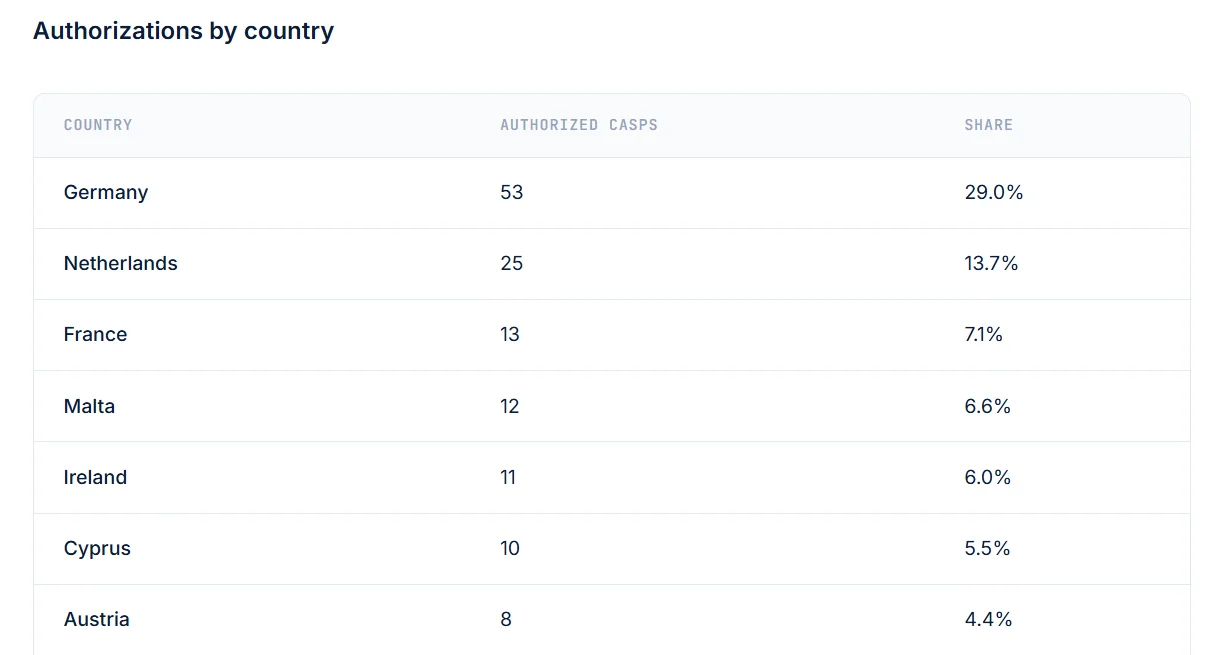
Germany dominates the register with 53 authorized entities. | Credit: chainscreen.io
Under MiCA, exchanges losing authorization may implement orderly wind-down procedures and notify customers before ending services.
However, users may still face temporary withdrawal delays, mandatory account migrations or new identity verification requirements if they wait until the final stages of the transition.
Regulatory enforcement could temporarily freeze operations at non-compliant platforms while authorities investigate, potentially restricting customer access to funds during the process.
Against that backdrop, SwissBorg is using regulatory certainty as a competitive advantage. Rather than competing solely on trading fees or token listings, the company is emphasizing compliance and uninterrupted access to crypto services as Europe enters a new regulatory era.
Disclaimer:
The information provided in this article is for informational purposes only. It is not intended to be, nor should it be construed as, financial advice. We do not make any warranties regarding the completeness, reliability, or accuracy of this information. All investments involve risk, and past performance does not guarantee future results. We recommend consulting a financial advisor before making any investment decisions.
Giuseppe Ciccomascolo began his career as an investigative journalist in Italy, where he contributed to both local and national newspapers, focusing on various financial sectors.
Upon relocating to London, he worked as an analyst for Fitch's CapitalStructure and later as a Senior Reporter for Alliance News. In 2017, Giuseppe transitioned to covering cryptocurrency-related news, producing documentaries and articles on Bitcoin and other emerging digital currencies. He also played a pivotal role in establishing the academy for a cryptocurrency exchange website. Crypto remained his primary area of interest throughout his tenure as a writer for ThirdFloor.