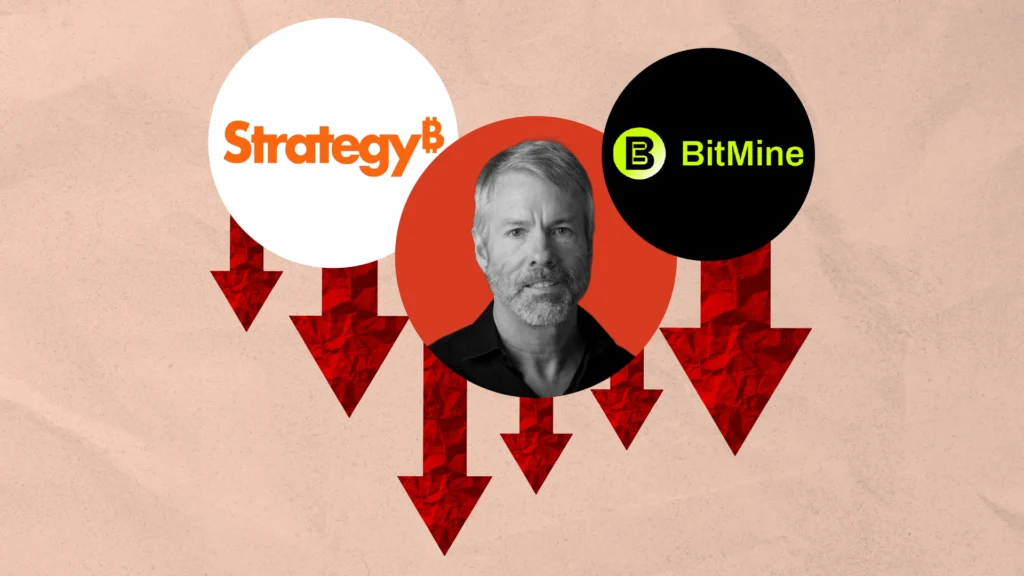
Strategy Stops Buying Bitcoin and Drops $139M on STRC Instead
Share
Key Takeaways
Strategy’s CEO Phong Le said the company’s belief in Bitcoin has helped it survive multiple “near-death experiences” throughout its history.
Le added that the crypto downturn built resilience within Strategy’s leadership and reinforced its long-term Bitcoin conviction.
Ripple CEO Brad Garlinghouse criticized Michael Saylor’s leveraged Bitcoin strategy while maintaining a bullish outlook on Bitcoin itself.
Strategy CEO Phong Le says the company’s unwavering conviction in Bitcoin has enabled it to weather repeated crises throughout its nearly four-decade history, arguing that periods of extreme stress, not bull markets, ultimately define great businesses.
Speaking in a June 19 interview, Le compared Strategy’s journey to companies such as Amazon and Tesla, both of which endured multiple “near-death experiences” before becoming some of the world’s most valuable corporations.
While acknowledging the psychological challenge of watching billions of dollars in unrealized losses accumulate during market downturns, Le said his confidence stems from a long-term belief in Bitcoin’s underlying fundamentals.
His comments come as Strategy faces growing scrutiny over its increasingly leveraged capital structure, with critics questioning whether the company’s financing model can remain sustainable despite its industry-leading Bitcoin holdings.
New Trending Crypto Wallet Offers
Sponsored
Disclosure
We sometimes use affiliate links in our content, when clicking on those we might receive a commission at no extra cost to you. By using this website you agree to our terms and conditions and privacy policy.
Phong Le Says Bear Markets Forged Strategy’s Resilience
Asked how he remains calm during periods of massive paper losses, Le pointed to Strategy’s long operating history since its founding in 1989 and said resilience is built during the toughest moments.
According to Le, the 2022 crypto bear market became a defining chapter for the company, strengthening both its leadership team and its conviction in Bitcoin as a treasury reserve asset.
Strategy CEO: Great Companies Have All Survived "Near-Death Experiences"
On June 19, 2026, during an interview with Coinage, when asked about his feelings on watching billions of dollars in paper losses stack up, Strategy CEO Phong Le @phongle reflected on the company's… pic.twitter.com/s0i5tmeirP
“Great companies have all survived near-death experiences,” Le said, arguing that surviving severe downturns ultimately separates enduring businesses from short-lived success stories.
He cited Amazon and Tesla as examples of companies that endured prolonged periods of investor skepticism before ultimately delivering significant shareholder value.
For Strategy, that resilience has translated into an aggressive Bitcoin accumulation strategy. The company now holds more than 843,000 BTC, representing roughly 76% of all Bitcoin owned by publicly traded companies, making it by far the largest corporate holder of the cryptocurrency.
Le suggested that maintaining a consistent long-term thesis has allowed the company to look beyond short-term market volatility and temporary balance-sheet fluctuations.
Garlinghouse Questions Strategy’s Leveraged Bitcoin Model
Not everyone shares that confidence.
Ripple CEO Brad Garlinghouse criticized Michael Saylor’s leveraged Bitcoin strategy, describing the company’s financial structure as “a damning indictment” after Strategy’s perpetual preferred shares (STRC) traded roughly 26% below their $100 par value.
While reaffirming his long-term bullish outlook on Bitcoin itself, Garlinghouse drew a distinction between believing in the asset and relying on increasingly complex financial engineering to acquire it.
He argued that long-term value in digital assets should ultimately be driven by utility rather than leverage.
“Financial engineering doesn’t create long-term value,” Garlinghouse said, contrasting Strategy’s debt-funded accumulation model with Ripple’s focus on expanding real-world payment infrastructure through XRP and its RLUSD stablecoin.
Ripple highlighted more than $70 million in charitable contributions during 2025, while also expanding lending initiatives using XRP Ledger technology. Through its partnership with Accion Opportunity Fund, the company said it helped provide more than $53 million in financing to underserved small-business owners.
Mounting Financial Pressures Fuel Debate Over Sustainability
Annualized dividend obligations tied to the company’s STRC preferred shares have climbed to roughly $1.2 billion, while analysts note that Strategy’s dividend coverage period has fallen from more than seven years to approximately 14 months.
The company also made headlines in late May after selling 32 Bitcoin to help fund preferred dividend payments—the first known instance of Strategy liquidating part of its Bitcoin treasury to meet financial obligations.
nobody is connecting STRC crashing to $74 with what saylor already did once before
– in 2000 MicroStrategy went from $333 to $4. SEC charged him with fraud. Fortune ranked him the biggest loser of the entire dotcom bubble – spent 20 years in the shadows. found bitcoin. built the… pic.twitter.com/2uPyGXiaE1
The sale prompted renewed debate over whether the company’s financing model can continue supporting its expanding Bitcoin position without placing additional pressure on shareholders.
Strategy is also navigating a securities investigation launched earlier this year, adding another layer of regulatory uncertainty to its financial outlook.
Despite those concerns, institutional Bitcoin treasury adoption continues to accelerate across corporate America. Dozens of publicly traded companies have adopted Bitcoin reserve strategies in 2026, although none approach Strategy’s scale or financial complexity.
For Le, however, short-term financial pressures do little to alter the company’s long-term thesis.
Giuseppe Ciccomascolo began his career as an investigative journalist in Italy, where he contributed to both local and national newspapers, focusing on various financial sectors.
Upon relocating to London, he worked as an analyst for Fitch's CapitalStructure and later as a Senior Reporter for Alliance News. In 2017, Giuseppe transitioned to covering cryptocurrency-related news, producing documentaries and articles on Bitcoin and other emerging digital currencies. He also played a pivotal role in establishing the academy for a cryptocurrency exchange website. Crypto remained his primary area of interest throughout his tenure as a writer for ThirdFloor.