The OCC found major banks restricted lawful businesses, including crypto firms, through subjective reputation policies, fueling calls for reform. | Credit: CCN.com
Share
Key Takeaways
The OCC found subjective reputation policies across nine major banks that disadvantaged lawful businesses and customers.
Digital assets were among the six industry categories facing banking restrictions.
The findings support complaints about crypto debanking but do not prove a coordinated government campaign.
Crypto’s complaints about exclusion from the banking system have gained federal backing. The Office of the Comptroller of the Currency released findings showing that major banks used subjective reputation policies that disadvantaged lawful businesses and customers.
The review covered the nine largest national banks under OCC supervision between 2020 and September 2025.
Investigators examined nearly 100,000 complaints, hundreds of individual decisions, and approximately 420,000 pages of bank documents.
Digital assets appeared among six industry categories facing restrictions. For an industry that describes politically driven banking exclusion as “Operation Choke Point 2.0,” the report provides official evidence of barriers but leaves questions about their causes and scale.
Try Our Recommended Crypto Exchanges
Sponsored
Disclosure
We sometimes use affiliate links in our content, when clicking on those we might receive a commission at no extra cost to you. By using this website you agree to our terms and conditions and privacy policy.
OCC Finds Reputation Policies Across Nine Major Banks
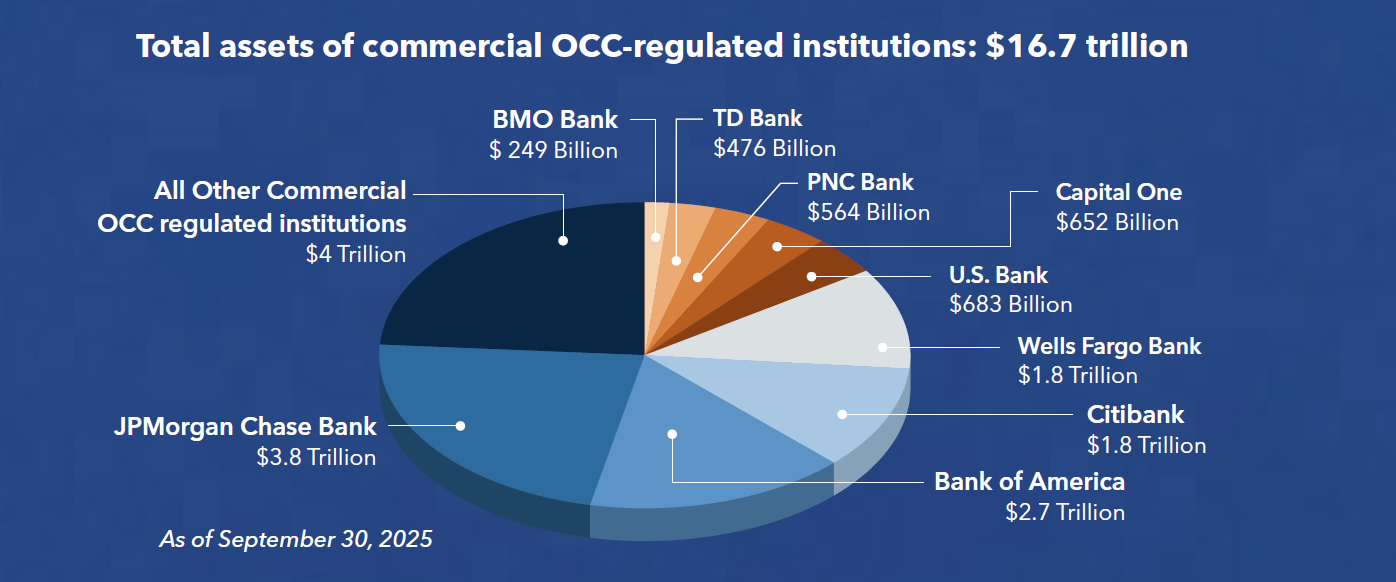
The institutions reviewed were JPMorgan Chase, Bank of America, Citibank, Wells Fargo, US Bank, Capital One, PNC, TD Bank, and BMO Bank.
The OCC said all nine maintained policies that could influence access to banking based on political or religious beliefs or lawful business activities. Its central criticism concerned reputation assessments lacking clear standards and objective measures of risk.
Comptroller Jonathan Gould said the policies allowed “political considerations, public opinion, and social pressures” to influence banking decisions.
Total assets of commercial OCC-regulated institutions. | Credit: OCC
The report described banks using negative news searches and advocacy organizations’ opinions when assessing customers.
Some ordinary customers lost their services due to unverified allegations, while certain wealthy clients with substantial negative publicity retained their banking relationships.
Examples crossed political lines. One bank-owned processor closed a merchant’s account selling Trump-branded merchandise. Another bank declined to provide services to an educational organization because its political arm endorsed only Democratic candidates.
The findings suggest a broader problem: access may depend on subjective judgments about controversy rather than on consistent assessments of financial exposure.
Digital Assets Named, but Findings Have Limits
The report identified restrictions affecting digital asset issuers, exchanges, and administrators, which banks often attribute to financial crime considerations.
Other categories included Arctic oil and gas activities, coal, firearms, detention facilities, and tobacco or e-cigarettes. Across these sectors, the OCC found that restrictions frequently extended beyond core financial risks into judgments about public perception and lawful business activities.
For crypto companies, that finding strengthens the argument that access to banking sometimes depended on sector-wide assumptions rather than individual circumstances.
bombshell report from the OCC out today confirming what we all suspected:
between 2020 and 2025, based on a review of 100,000 complaints, America’s largest banks systematically denied banking to lawful businesses based on political and reputational considerations rather than… pic.twitter.com/YN90ZmhJqv
Banking restrictions can disrupt payments, financing, and access to operating funds. The report noted that customers needing sophisticated services might struggle to replace a major bank or face higher costs assembling alternatives.
However, the findings do not establish that every crypto account closure was politically motivated or that there was a coordinated government campaign against digital assets.
The OCC also said documentation and tracking limitations prevented it from comprehensively quantifying debanking or its costs. Nearly 100,000 complaints reviewed do not, therefore, mean nearly 100,000 confirmed cases of improper exclusion.
That distinction matters: the report substantiates harmful practices while stopping short of validating every claim associated with Operation Choke Point 2.0.
Washington Turns Findings Into a Fair-Access Push
The next question is whether the findings produce lasting changes in banking decisions.
The OCC has eliminated reputation risk from its supervisory framework and is considering further rules addressing discrimination and subjective reputation assessments.
Its report also encourages Congress to protect access to banking through legislation and oversight.
No American should lose access to a bank account because of their politics or their industry, and that includes the digital asset businesses wrongfully targeted under Operation Chokepoint 2.0. Thank you @SecScottBessent and @USComptroller for working to ensure Americans have fair… https://t.co/9YAM4nyqyo
Banks reported revising policies, narrowing industry restrictions and requiring senior review of sensitive customer decisions. Yet the OCC questioned whether those changes would prevent the same practices from returning under different terminology.
Gould emphasized that the objective is individualized evaluation, saying banks should assess customers using objective, risk-based criteria.
For crypto, the practical test will be whether lawful companies can obtain banking services through that process.
Disclaimer:
The information provided in this article is for informational purposes only. It is not intended to be, nor should it be construed as, financial advice. We do not make any warranties regarding the completeness, reliability, or accuracy of this information. All investments involve risk, and past performance does not guarantee future results. We recommend consulting a financial advisor before making any investment decisions.
Giuseppe Ciccomascolo began his career as an investigative journalist in Italy, where he contributed to both local and national newspapers, focusing on various financial sectors.
Upon relocating to London, he worked as an analyst for Fitch's CapitalStructure and later as a Senior Reporter for Alliance News. In 2017, Giuseppe transitioned to covering cryptocurrency-related news, producing documentaries and articles on Bitcoin and other emerging digital currencies. He also played a pivotal role in establishing the academy for a cryptocurrency exchange website. Crypto remained his primary area of interest throughout his tenure as a writer for ThirdFloor.