Key Takeaways
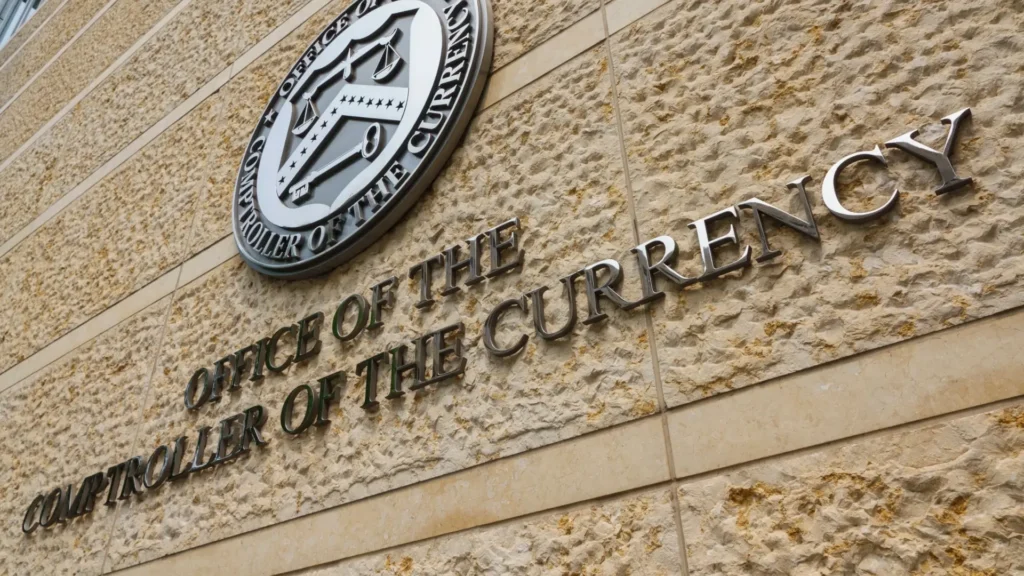
- The Office of the Comptroller of the Currency (OCC) has published new guidance letting banks act as crypto brokers.
- Under the new guidance, crypto exchanges face new competition from Wall Street.
- In Europe, banks have integrated crypto trading within retail banking apps.
American banks will be able to act as crypto brokers under fresh guidance from the Office of the Comptroller of the Currency (OCC).
The rule change sets the stage for banks to integrate crypto trading into their offerings, bringing increased competition to a market currently dominated by specialized platforms.
Banks Can Now Broker Crypto Under OCC Rule Change
On Tuesday, Dec. 9, the OCC published Interpretive Letter #1188, confirming that banks can legally act as intermediaries in crypto asset transactions.
The OCC’s guidance marks the latest U.S. policy shift under Trump, enabling deeper integration of crypto into the traditional financial sector.
The rule change follows the Securities and Exchange Commission’s (SEC) move to repeal Staff Accounting Bulletin 121 (SAB121) earlier this year.
Together, Interpretive Letter #1188 and the withdrawal of SAB 121 extend the scope of U.S. crypto banking to the full range of custody, investment, and brokerage services.
From being unable to touch the stuff just a year ago, banks can now purchase and hold crypto for clients, and facilitate transactions between buyers and sellers.
Exchanges Face New Competition
With banks able to facilitate digital asset trading, exchanges face the prospect of increased competition from Wall Street.
In Europe, a group of crypto-forward banks have emerged as rivals to the likes of Binance and Coinbase, either building their own exchange platforms, or integrating the feature into their existing banking apps.
For instance, Revolut has aggressively expanded its crypto offering in recent years, chasing super-app status as it integrates payments, savings, credit cards, loans, trading, and investments under a unified platform.
Revolut’s multi-service model embodies the threat banks pose to traditional crypto exchanges.
While professional traders are drawn to low fees, new features, and extensive listings, for the average retail investor, it’s hard to beat the convenience of using a single app for banking and crypto.
Although Revolut launched in the U.S. in 2020, it has struggled to make inroads in a market where traditional banks still dominate, and local neobanks like Chime are more established.
However, with the OCC setting the stage for U.S. banks to act as brokers, the European firm is well-positioned to move quickly to bring its established model stateside.
Top Trending Crypto Articles

James Morales is CCN’s blockchain and crypto policy reporter. He has been working in the news media since 2020, writing about topics such as payments, banking and financial technology. These days, he likes to explore the latest blockchain innovations and the evolving landscape of global crypto regulation.
With an educational background in social anthropology and media studies, James uses his platform as a journalist to explore how new technologies work, why they matter and how they might shape our future.