Ethereum Tops Bitcoin as $2.48B Flows Into Crypto ETFs — Weekly Winners & Losers Revealed.
Share
Key Takeaways
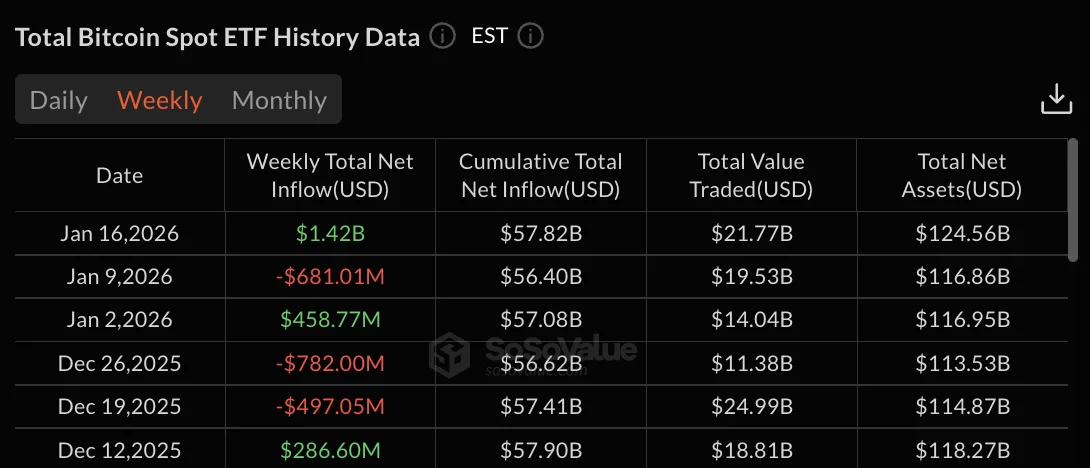
U.S. spot Bitcoin ETFs recorded $1.42 billion in net inflows during the week of January 12–16, 2026, reversing the prior week’s $681 million in outflows.
BlackRock’s IBIT dominated Bitcoin ETF demand, capturing $1.035 billion, or 73% of total weekly inflows.
Spot Ethereum ETFs added $479 million in net inflows, with ETHA accounting for nearly half of weekly allocations.
The strong weekly reversal suggests renewed institutional confidence in crypto ETFs despite recent price consolidation and macro uncertainty.
U.S. spot Bitcoin and Ethereum exchange-traded funds (ETFs) recorded a strong rebound in institutional demand during the trading week of January 12–16, 2026, reversing the outflows seen earlier in the month and reinforcing the role of ETFs as a key transmission channel for capital into crypto markets.
According to aggregated ETF flow data, spot Bitcoin ETFs attracted $1.42 billion in net inflows over the week, while spot Ethereum ETFs added $479 million, marking one of the strongest combined weekly performances of the year so far.
The shift follows a volatile start to January, with investors recalibrating exposure amid macro uncertainty, price consolidation in crypto markets, and renewed debate over risk appetite across global assets.
Bitcoin ETFs See Sharp Reversal After Prior Week Outflows
Bitcoin ETFs delivered a decisive turnaround in flows. The previous trading week, ending January 9, had recorded $681 million in net outflows, reflecting risk-off sentiment and profit-taking after earlier gains. The latest week’s $1.42 billion inflow therefore represents a swing of more than $2.1 billion in flow direction.
The recovery was driven largely by a handful of strong trading sessions. Tuesday, Jan. 14, stood out as the strongest day of the week, with $843.62 million in net inflows, followed closely by Monday, Jan. 13, which added $753.73 million. These two days alone accounted for the majority of weekly inflows.
Last week’s ETFs flows data. | Credit: SoSoValue
Flows moderated midweek. Wednesday, Jan. 15, brought a more modest $100.18 million in net inflows, while Thursday, Jan.16, marked the only day of net outflows, with $394.68 million leaving Bitcoin ETF products. Sunday, Jan. 12, contributed $116.67 million in inflows.
Despite the single day of outflows, the overall weekly picture remained firmly positive, underscoring how quickly institutional demand can reassert itself after short-term pullbacks.
BlackRock Dominates Bitcoin ETF Allocations
BlackRock’s iShares Bitcoin Trust (IBIT) continued to dominate the category, capturing $1.035 billion of the total $1.42 billion in weekly inflows. This means IBIT alone accounted for approximately 73% of all Bitcoin ETF inflows during the period.
The concentration of flows highlights BlackRock’s position as the primary institutional gateway to Bitcoin exposure, particularly for asset managers and allocators seeking liquidity, scale, and brand familiarity.
By the end of the week, total net assets across all U.S. spot Bitcoin ETFs reached $124.56 billion, while cumulative net inflows since launch climbed to $57.82 billion. Weekly trading volume across Bitcoin ETF products totaled $21.77 billion, reflecting sustained investor engagement even as price action remained relatively range-bound.
Ethereum ETFs also posted a strong performance, though with a different flow profile than Bitcoin. While Bitcoin flows were concentrated in a few large days, Ethereum ETFs saw more consistent daily inflows throughout the week.
Spot Ethereum ETFs recorded $479.04 million in net inflows between Jan. 12 and 16. The strongest day came on Tuesday, Jan. 14, when Ethereum products added $175 million. Wednesday, Jan. 15, followed closely with $164.37 million, while Monday, Jan. 13, saw $129.99 million in inflows.
Smaller but still positive flows were recorded on Thursday, Jan. 16 ($4.64 million) and Sunday, January 12 ($5.04 million), meaning Ethereum ETFs avoided any daily net outflows during the week.
This steadier pattern suggests Ethereum allocations may be coming from longer-term positioning rather than tactical trading alone.
ETHA Leads Ethereum ETF Market
As with Bitcoin, BlackRock played a central role in Ethereum ETF flows. The firm’s iShares Ethereum Trust (ETHA) attracted $219 million, accounting for roughly 46% of total Ethereum ETF inflows during the week.
By week’s end, total net assets across Ethereum ETF products reached $20.42 billion, while cumulative net inflows since launch stood at $12.91 billion. Weekly trading volume across Ethereum ETFs reached $7.74 billion, indicating rising participation as Ethereum’s institutional narrative continues to mature.
What Weekly Flows Reveal About Market Sentiment
The divergence between Bitcoin and Ethereum ETF flow dynamics offers insight into how institutions are currently positioning. Bitcoin flows remain more reactive and momentum-driven, with large daily swings tied to macro signals and price levels.
Ethereum flows, by contrast, appear more incremental and consistent, reflecting its growing role in tokenization, stablecoins, and on-chain financial infrastructure.
Together, the strong weekly inflows suggest that institutional investors continue to view both assets as core components of crypto exposure, even amid short-term volatility. The sharp reversal from the prior week also highlights how quickly sentiment can shift once selling pressure exhausts.
As ETFs increasingly shape crypto market structure, weekly flow data is becoming one of the most closely watched indicators of underlying demand. For now, the latest numbers point to renewed confidence, and a market that remains firmly on institutional radar.
Inflows mean new money entering a fund when investors buy ETF shares. Outflows mean money leaving a fund when shares are sold or redeemed. Big inflows usually show optimism, while big outflows often signal fear or profit-taking.
Which had larger inflows last week – Bitcoin or Ethereum ETFs?
Ethereum ETFs won the week, attracting about $1.4B, nearly double the $748M that flowed into Bitcoin funds. BTC still gained solid inflows, but ETH was the star.
Which regions led crypto ETF inflows?
The United States dominated with about $2.29B in inflows. Europe followed, led by Switzerland ($109M) and Germany ($70M). Canada added about $41M. Other regions were quiet.
What do weekly fund flows tell beginner investors?
They act like a sentiment barometer. Large inflows = bullish (money entering). Large outflows = bearish (money leaving). But flows don’t guarantee price moves, they’re best read as clues to big-money behavior, not predictions.
Disclaimer:
The information provided in this article is for informational purposes only. It is not intended to be, nor should it be construed as, financial advice. We do not make any warranties regarding the completeness, reliability, or accuracy of this information. All investments involve risk, and past performance does not guarantee future results. We recommend consulting a financial advisor before making any investment decisions.
Giuseppe Ciccomascolo began his career as an investigative journalist in Italy, where he contributed to both local and national newspapers, focusing on various financial sectors.
Upon relocating to London, he worked as an analyst for Fitch's CapitalStructure and later as a Senior Reporter for Alliance News. In 2017, Giuseppe transitioned to covering cryptocurrency-related news, producing documentaries and articles on Bitcoin and other emerging digital currencies. He also played a pivotal role in establishing the academy for a cryptocurrency exchange website. Crypto remained his primary area of interest throughout his tenure as a writer for ThirdFloor.


 Easy
Easy