IMF researchers found over half of trading in tokenized equity markets studied occurs after hours, though liquidity and legal hurdles remain. | Credit: CCN.com
Share
Key Takeaways
More than half of trading in the tokenized equity markets studied by IMF researchers occurs outside traditional market hours.
Around 80% of analyzed trades were smaller than one share, highlighting demand for fractional access.
Tokenized markets remain relatively illiquid, fragmented, and more volatile than traditional counterparts.
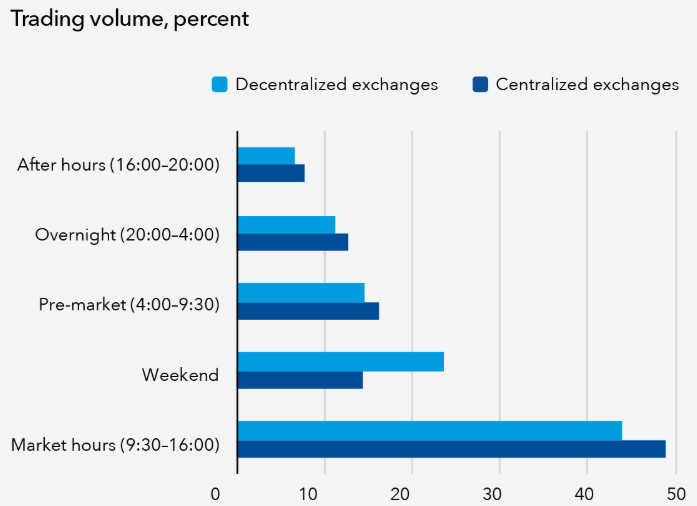
More than half of trading in the tokenized equity markets analyzed by International Monetary Fund researchers occurs outside traditional market hours, highlighting demand for stock exposure that extends beyond the opening and closing bells.
In their analysis, the researchers also found that around 80% of tokenized equity trades were for less than one share, suggesting investors are embracing fractional transactions alongside continuous access.
The findings point to changing trading habits in a small, emerging market.
However, the IMF warned that thin liquidity, fragmented infrastructure and unresolved legal questions still limit tokenization’s ability to reshape mainstream finance.
Try Our Recommended Crypto Exchanges
Sponsored
Disclosure
We sometimes use affiliate links in our content, when clicking on those we might receive a commission at no extra cost to you. By using this website you agree to our terms and conditions and privacy policy.
Investors Are Trading Beyond Traditional Market Hours
The IMF’s findings offer early evidence that investors value features associated with tokenized stocks: extended trading availability and the ability to transact in small amounts.
Tokenization represents financial assets on distributed programmable ledgers. Depending on their structure, these instruments can provide exposure to equities through platforms that operate beyond conventional exchange hours.
The finding that more than half of trading occurs outside traditional hours applies to the markets the researchers examined. It does not mean half of all stock trading has moved onto blockchains.
Nevertheless, the results suggest meaningful demand for access when conventional markets are closed.
More than half of trading in tokenized equities takes place outside regular market hours. The demand for 24/7 access is real. The challenge is building markets that are also deep, liquid, and resilient. Learn more in our GFSR chapter on tokenization: https://t.co/9cT70LCj40pic.twitter.com/7FY5JAfwws
The researchers also found that overnight tokenized-equity returns were reflected in traditional equity prices shortly after the market opened.
That suggests both markets respond to similar information, with overnight tokenized trading potentially providing signals relevant to the next conventional session.
Fractional transactions were another prominent feature. Around four in five of the analyzed trades were smaller than one share, enabling participation at lower entry costs.
Together, these findings show how tokenized markets can accommodate different schedules and investment amounts, even before they achieve substantial scale.
Round-the-Clock Access Comes With Thin Liquidity
Continuous availability does not automatically produce a deep or efficient market.
The IMF said tokenized markets remain relatively illiquid and exhibit higher volatility than their traditional counterparts. Trading is spread across platforms, networks, and settlement arrangements, weakening price formation and contributing to price deviations.
An investor may be able to trade overnight but still face limited counterparties or less favorable execution.
The broader tokenization market also remains small compared with conventional finance.
Half of tokenized trading happens outside regular trading hours. | Credit: IMF
Tokenized repurchase agreements account for the bulk of activity, averaging $300-$350 billion in daily transaction volume, according to the researchers.
Repos are short-term, collateral-backed loans in which counterparties agree to reverse the transaction at a later date. Their use illustrates tokenization’s appeal for collateral management.
The IMF placed daily US repo market volume at approximately $13 trillion, underscoring the gap between tokenized activity and established markets.
It also cited another $65 billion in trade in tokenized assets, including credit, money market funds, and equities.
These figures cover different financial activities and should not be interpreted as tokenized stock trading alone.
Legal Rights and Safe Settlement Will Determine Growth
The IMF identified four constraints holding back tokenization: legal certainty, regulatory clarity, interoperability, and suitable settlement assets.
Investors need confidence that tokens represent enforceable rights. Regulators must clarify how existing requirements apply, while platforms need connections that prevent liquidity from remaining trapped in isolated venues.
Settlement also requires safe, widely accepted money.
Addressing those obstacles could help tokenized markets build depth and connect issuance, trading, settlement, and servicing more efficiently.
However, greater scale could amplify financial risks. The researchers warned that interconnectedness and leverage could accelerate fire sales, liquidity runs, and contagion.
Traditional processes introduce delays and costs, but also provide time to manage liquidity and exposures. Compressing those processes can remove useful buffers during stress.
The IMF therefore called for consistent regulation across technologies and safeguards that evolve with market growth.
Investors are already using tokenization’s flexibility. Whether that demand develops into a durable alternative to conventional trading will depend on market depth, enforceable rights, and reliable settlement.
Disclaimer:
The information provided in this article is for informational purposes only. It is not intended to be, nor should it be construed as, financial advice. We do not make any warranties regarding the completeness, reliability, or accuracy of this information. All investments involve risk, and past performance does not guarantee future results. We recommend consulting a financial advisor before making any investment decisions.
Giuseppe Ciccomascolo began his career as an investigative journalist in Italy, where he contributed to both local and national newspapers, focusing on various financial sectors.
Upon relocating to London, he worked as an analyst for Fitch's CapitalStructure and later as a Senior Reporter for Alliance News. In 2017, Giuseppe transitioned to covering cryptocurrency-related news, producing documentaries and articles on Bitcoin and other emerging digital currencies. He also played a pivotal role in establishing the academy for a cryptocurrency exchange website. Crypto remained his primary area of interest throughout his tenure as a writer for ThirdFloor.