IMF researchers found over half of trading in tokenized equity markets studied occurs after hours, though liquidity and legal hurdles remain. | Credit: CCN.com
Share
Key Takeaways
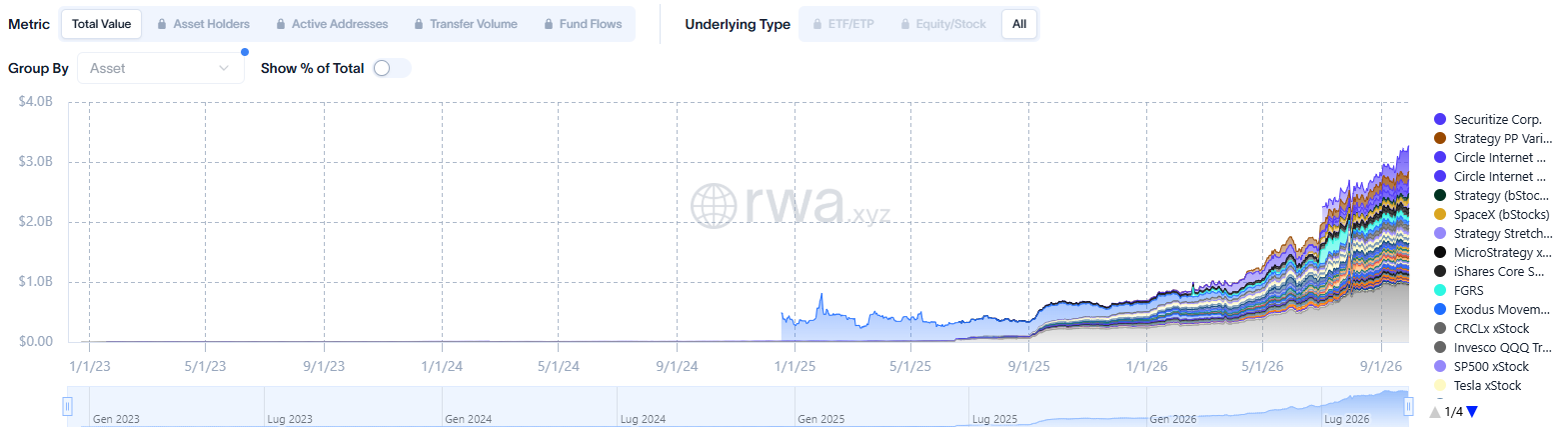
Tokenized stocks have reached a record $3.5 billion market cap, jumping 33% in a month and roughly 860% year-over-year.
The SEC’s five-year Innovation Exemption allows qualifying platforms to experiment with trading tokenized versions of real US-listed stocks.
Trading activity is accelerating, with Jupiter reportedly seeing tokenized equity volume surge 104% during the month.
Tokenized stocks are gaining momentum after the US Securities and Exchange Commission (SEC) opened a five-year regulatory window for certain US equities to trade directly on blockchain networks.
The market capitalization of onchain tokenized equities has climbed to roughly $3.5 billion, up 33% over the past month and about 860% year-over-year, according to data cited by The Kobeissi Letter. Trading activity is accelerating too, with Jupiter reportedly recording a 104% monthly increase in tokenized equity volume.
The growth follows the SEC’s Sept. 17 approval of its “Innovation Exemption,” temporary regulatory relief designed to let qualifying Tokenized Securities Venues, or TSVs, experiment with onchain trading of real US-listed stocks. The exemption lasts five years, giving regulators time to observe the market before deciding on a permanent framework.
The broader market is already expanding rapidly. Binance Research reported that tokenized stocks crossed $3 billion in September, describing equities as the fastest-growing real-world asset category of 2026.
Try Our Recommended Crypto Exchanges
Sponsored
Disclosure
We sometimes use affiliate links in our content, when clicking on those we might receive a commission at no extra cost to you. By using this website you agree to our terms and conditions and privacy policy.
The SEC’s Innovation Exemption removes one of the biggest regulatory barriers facing blockchain-based stock markets.
Under the framework, qualifying TSVs receive temporary, conditional relief from being treated as traditional securities exchanges under the Exchange Act. Certain liquidity providers participating in their automated market maker pools can also receive relief from dealer-registration requirements.
The exemption applies to permissioned environments and contains strict conditions covering access, transparency, recordkeeping and investor protection. Anti-fraud and anti-manipulation provisions continue to apply.
Importantly, eligible tokens must represent actual National Market System stocks and give investors the same rights and privileges as the underlying traditional shares, including dividend and voting rights where applicable.
That separates the framework from synthetic products that merely track the price of stocks such as Apple or Nvidia without conveying equivalent shareholder rights.
Issuers also have the ability to object to third parties tokenizing their securities.
Tokenized Stocks Are Already Breaking Records
The regulatory shift arrives as demand for onchain equities is accelerating.
The Kobeissi Letter said tokenized equity capitalization has reached a record $3.5 billion, representing a 33% monthly jump and an approximately 860% increase from a year earlier.
It also pointed to a 104% increase in tokenized equity trading volume on Jupiter during September.
Other data show how quickly the sector has expanded.
Binance Research said tokenized stocks surpassed $3 billion during the fourth week of September. Onchain transfers involving tokenized stocks exceeded $100 billion during Q3, compared with just $6 billion during the first quarter.
The appeal goes beyond simply putting familiar tickers on a blockchain.
Traditional US equity markets operate during defined trading hours and currently use a T+1 settlement cycle. Blockchain infrastructure can potentially support around-the-clock markets and much faster settlement while allowing assets to interact directly with stablecoins, lending protocols, and other tokenized financial products.
SEC Commissioner Mark Uyeda said tokenization could modernize functions such as trading, settlement, transfers, and ownership records, while potentially reducing costs and improving transparency.
The Five-Year Experiment Comes With Limits
The SEC’s decision is nevertheless better understood as a controlled experiment than a wholesale replacement for Wall Street’s existing infrastructure.
TSVs face limits on both the number of stocks they can make available and the amount of trading they can facilitate. They must also use auditable public smart contracts and publish information about their operations and trading activity.
Trading access itself remains permissioned rather than completely open.
If the primary exchange halts trading in an underlying stock, the corresponding tokenized stock must also stop trading. These requirements are intended to keep the experimental blockchain market connected to protections in the existing securities system.
🚨SEC CHAIR WANTS TOKENIZED STOCKS BUILT IN THE U.S.!
SEC Chair @SECPaulSAtkins told CNBC’s Squawk Box the last administration kept the door shut on these products. His SEC is doing the opposite.
He said the agency already defined tokenized securities with the CFTC, and the… pic.twitter.com/6TLNF0dtxD
The exemption is scheduled to expire five years after publication, while the SEC is requesting public feedback to help determine what longer-term rules should look like.
Commissioner Hester Peirce described the framework as an opportunity to observe how tokenized and traditional markets interact before regulators establish more durable rules.
For now, the numbers suggest investors and platforms aren’t waiting for that permanent framework.
With tokenized stocks growing at a triple-digit annual pace, onchain transfers exploding, and major financial institutions increasingly exploring tokenization, the SEC’s five-year sandbox could become one of the most consequential experiments yet in bringing traditional securities onto public blockchains.
Disclaimer:
The information provided in this article is for informational purposes only. It is not intended to be, nor should it be construed as, financial advice. We do not make any warranties regarding the completeness, reliability, or accuracy of this information. All investments involve risk, and past performance does not guarantee future results. We recommend consulting a financial advisor before making any investment decisions.
Giuseppe Ciccomascolo began his career as an investigative journalist in Italy, where he contributed to both local and national newspapers, focusing on various financial sectors.
Upon relocating to London, he worked as an analyst for Fitch's CapitalStructure and later as a Senior Reporter for Alliance News. In 2017, Giuseppe transitioned to covering cryptocurrency-related news, producing documentaries and articles on Bitcoin and other emerging digital currencies. He also played a pivotal role in establishing the academy for a cryptocurrency exchange website. Crypto remained his primary area of interest throughout his tenure as a writer for ThirdFloor.










 Cboe Locks In SPX Options Through 2051, and Tokenized Contracts May Be Next