Key Takeaways
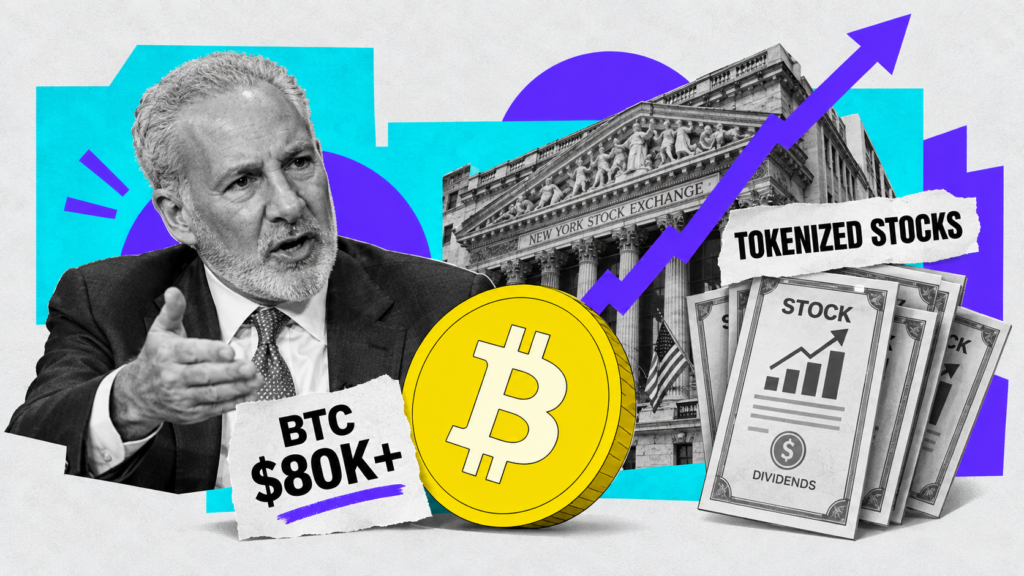
- Peter Schiff says Bitcoin’s rally above $80,000 following the SEC’s tokenized-stock decision “makes no sense,” arguing the development creates more competition for BTC.
- The SEC granted a five-year conditional exemption allowing qualifying venues to trade tokenized versions of US-listed stocks under specific investor-protection requirements.
- Schiff argues tokenized shares can offer blockchain-based ownership while retaining dividends and shareholder rights, although Bitcoin supporters view BTC as a fundamentally different asset.
Bitcoin’s surge above $80,000 following a major US regulatory breakthrough for tokenized stocks has drawn an unlikely interpretation from longtime crypto critic Peter Schiff: the market is celebrating news that could actually weaken Bitcoin’s investment case.
Bitcoin jumped more than 5% Friday, reaching around $80,587 after the Securities and Exchange Commission opened a regulatory route for tokenized US equities. BTC later traded around $81,290 on Saturday, up roughly 1.6% over 24 hours.
Schiff argues investors have the story backward.
“Yesterday’s big Bitcoin rally following the SEC’s tokenized stock announcement makes no sense,” Schiff wrote, calling the development bearish because Bitcoin must now compete with tokenized securities.
Why Schiff Thinks Tokenized Stocks Threaten Bitcoin
Schiff’s argument centers on what investors actually receive for owning each asset.
A Bitcoin represents a scarce digital asset, but it does not provide a claim on corporate earnings, cash flows or dividends.
Tokenized stocks can potentially combine some features associated with crypto markets, like blockchain settlement, fractional ownership and potentially longer trading hours, with economic ownership of an underlying business.
Under the SEC’s new framework, qualifying tokenized National Market System stocks must preserve shareholder rights associated with the equivalent traditional shares. Synthetic products that merely track a stock’s price without providing ownership rights are excluded.
For Schiff, that creates a direct competitor for capital seeking digitally native assets.
He argues that tokens representing profitable, dividend-paying companies offer a more reliable store of value than Bitcoin. He also contends that the expansion of tokenized assets gives investors more places to allocate liquidity that might otherwise enter BTC.
SEC Gives Tokenized Stocks a Five-Year Window
The debate follows a significant shift in US securities regulation.
The SEC granted qualifying platforms a five-year conditional “innovation exemption” allowing tokenized US stocks to trade using blockchain-based infrastructure.
Issuers must receive advance notice and may object to the tokenization of their shares. Investors must also retain standard rights, such as dividends and voting rights.
The market is still smaller than traditional equities. Tokenized stocks are currently valued at only about $3 billion, with less than $30 billion in monthly trading volume, according to Reuters Breakingviews.
Is Bitcoin Really Competing With Tokenized Stocks?
Schiff’s argument depends on investors treating Bitcoin and tokenized equities as substitutes, a premise that remains contested.
Bitcoin has a fixed maximum supply of 21 million coins and no corporate issuer. Its store-of-value thesis rests largely on scarcity, decentralization, and independence from company performance.
A tokenized stock remains an equity investment. Its value ultimately depends on the underlying company and is subject to issuer, market, and regulatory risks.
There is also another interpretation of Friday’s rally: rather than threatening Bitcoin, the SEC decision could validate blockchain infrastructure for mainstream financial markets. Bitcoin ETF inflows also returned Thursday, with roughly $160 million entering the products after two days of outflows.
Bitcoin also rallied despite two significant headwinds earlier in the week: the Senate’s failure to advance the CLARITY Act and the Federal Reserve’s first rate hike in three years.
For Schiff, however, tokenization changes the competition for digital investment capital. The question is whether investors see tokenized stocks as an alternative to Bitcoin — or simply another asset class moving onto the same blockchain-based financial infrastructure.
The information provided in this article is for informational purposes only. It is not intended to be, nor should it be construed as, financial advice. We do not make any warranties regarding the completeness, reliability, or accuracy of this information. All investments involve risk, and past performance does not guarantee future results. We recommend consulting a financial advisor before making any investment decisions.

Giuseppe Ciccomascolo began his career as an investigative journalist in Italy, where he contributed to both local and national newspapers, focusing on various financial sectors.
Upon relocating to London, he worked as an analyst for Fitch's CapitalStructure and later as a Senior Reporter for Alliance News. In 2017, Giuseppe transitioned to covering cryptocurrency-related news, producing documentaries and articles on Bitcoin and other emerging digital currencies. He also played a pivotal role in establishing the academy for a cryptocurrency exchange website. Crypto remained his primary area of interest throughout his tenure as a writer for ThirdFloor.