Key Takeaways
- AI is gaining potential to be a powerful player in crypto governance.
- Efficiency vs decentralization is the core tension.
- Bitcoin’s structure limits AI takeover scenarios.
Meta’s efforts to build an AI version of Chief Executive Mark Zuckerberg — designed to replicate his thinking and interact with employees — are pushing the boundaries of how machines can mirror human decision-making.
The experiment, still in early stages, highlights a broader shift towards how AI is increasingly being positioned not just as a replacement for human judgment.
That shift is raising new questions in the world of crypto, where governance has traditionally relied on distributed human participation.
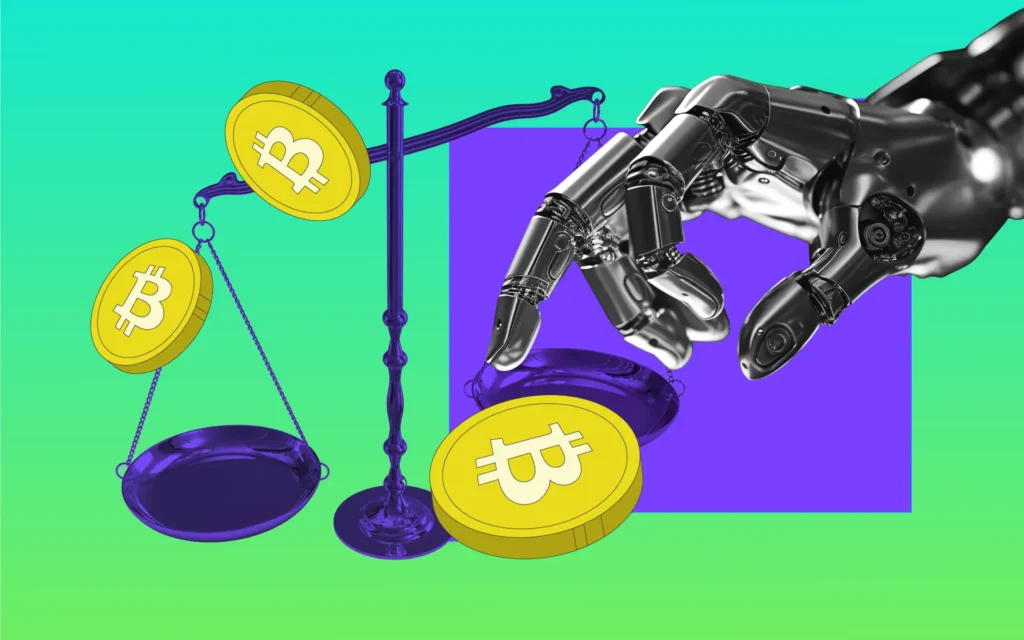
If AI systems can emulate leaders in corporations, some experts are asking whether autonomous agents could one day influence — or even help govern — networks such as Bitcoin.
AI and Crypto Converge
The debate comes as AI and blockchain technologies rapidly converge.
Public blockchains provide transparent, immutable infrastructure for transactions, while AI systems enable the interpretation of complex data, automated decision-making, and optimized outcomes.
Recent developments on Ethereum, including standards such as EIP-4337 and emerging protocols like x402, are enabling AI agents to hold digital assets and execute transactions.
These “agentic” systems can analyze market conditions, trigger payments and even generate profits within predefined parameters.
“The fusion is pushing us beyond simple digital transactions toward intelligent, autonomous financial systems,” blockchain analytics firm Chainalysis said in a recent report.
Professor Andrea Barbon of the University of St Gallen told CCN that these capabilities could extend into governance.
“If they accumulate capital and buy governance tokens of decentralized platforms, they would gradually increase their voting power,” he said.
Adding: “Even though AI may not fully replace human governance, it could definitely become a dominant participant.”
Governance: Human Problem or Machine Solution?
Proponents argue that AI agents could improve efficiency in systems often slowed by human coordination and disagreement.
But critics caution that governance in decentralized systems is not purely a technical challenge.
“The idea sounds seductive,” Paulo Cardoso do Amaral told CCN, a former NATO scientific advisor on cybersecurity.
“If decentralization is slowed by human disagreement, why not let AI agents manage the process more efficiently? But Bitcoin is not a corporation.”
He argued that Bitcoin’s design deliberately avoids discretionary decision-making at the protocol level, relying instead on mechanical consensus.
Others see AI playing a more limited role.
James Robinson, chief information security officer at Netskope, stated that AI agents analyze better than they exercise authority.
“AI agents are well suited to monitoring activity, detecting anomalies, analyzing trends and modeling potential outcomes,” he said.
Adding: “But governance, particularly in decentralized systems, still requires human oversight.”
Robinson warned that introducing AI-driven governance could increase risks, including manipulation, bias and reduced accountability.
“It also risks concentrating influence in the hands of those designing and controlling the technology, which runs counter to the core principles of decentralization,” he added.
Anthony DeMartino, chief executive of Sentora, echoed that view, stating that practical need should guide innovation rather than technical possibility.
“Where AI-based systems may add value is in execution, monitoring and risk analysis,” he said.
“The key challenge is ensuring new tools enhance resilience and efficiency without introducing unnecessary centralisation or complexity.”
Risks of Uniformity and Complexity
Even advocates acknowledge potential downsides.
Barbon warned that widespread use of AI agents in governance could lead to unintended uniformity.
“Decentralization does not necessarily imply pluralism,” he said. “Governance could become more uniform if AI agents rely on similar training data or incentives.”
There are also concerns about increasing financial complexity.
AI systems could create and deploy sophisticated instruments beyond human comprehension, raising the risk of systemic instability.
“If markets become so complex that humans can no longer understand them, it may be impossible to detect systemic risks in due time,” Barbon said.
Lessons From Big Tech?
Meta’s push to develop AI personas, including a digital version of Zuckerberg, illustrates how companies are experimenting with delegating aspects of leadership to machines.
While such tools may improve efficiency in centralized organizations, experts say the analogy does not easily translate to decentralized networks.
“What works as an efficiency tool in a hierarchy does not automatically belong in the governance of a public blockchain,” Cardoso do Amaral said.
He warned that relying on AI for governance could reintroduce a form of centralized control.
“The real risk is that AI governance would quietly reintroduce the trusted third party that Bitcoin was designed to remove,” he said.
What Does AI Mean For Satoshi’s Bitcoin Vision?
Whether AI-driven governance aligns with Bitcoin’s founding principles remains deeply contested among experts.
Bitcoin’s pseudonymous creator, Satoshi Nakamoto, described the network as “a purely peer-to-peer version of electronic cash” designed to function without trusted intermediaries.
For some, the rise of autonomous AI agents participating in governance could seem like an extension of decentralization.
If thousands of independent agents operate across networks, making decisions and holding assets without centralized control, it may reinforce the idea of a system not dominated by any single actor.
Barbon said such a development could be interpreted as consistent with that vision.
“As thousands of AI agents take seats in governance of a variety of platforms, there are good reasons to support that,” he said.
But others draw a sharper distinction between decentralization and automation.
Cardoso do Amaral argued that Bitcoin was explicitly designed to remove discretion, not replace human judgment with algorithmic proxies.
“Its core consensus mechanism is not about intelligence in the human sense. It is about verifying that the rules are followed,” he said.
He added that governance ultimately resides in the social layer with the community of developers, miners, node operators and users who decide whether to adopt changes.
“The real risk is that AI governance would quietly reintroduce the trusted third party that Bitcoin was designed to remove,” he said.
“Not a bank this time, but an algorithmic interpreter standing between the community and its own rules.”
There are also concerns that AI systems, rather than decentralizing power, could concentrate it in new ways.
Since agents are built, trained and optimized by humans or organizations, their behavior may reflect common incentives or shared datasets.
Robinson noted that this could run counter to the ethos of distributed control.
“While AI could improve efficiency, it also risks concentrating influence in the hands of those designing and controlling the technology,” he said.
AI Agents Already Playing Role in Bitcoin and Crypto
According to CCN’s Education team, unlike earlier generations of trading bots, which followed rigid instructions, newer AI-driven systems operate with greater autonomy.
They can observe market conditions, adjust strategies in real time and execute transactions without continuous human oversight.
These agents are increasingly able to move capital across platforms, interact with smart contracts and respond to both on-chain and off-chain signals as part of a continuous decision-making loop.
In practice, this means an AI system can monitor liquidity, rebalance positions and trigger trades across multiple venues with minimal intervention.
However, many risks remain.
MEXC CEO Chief Operating Officer Vugar Usi recently told CCN that AI systems can replicate errors at scale, especially in trading environments.
“It takes only one wrong decision… and there were hundreds of liquidations because just one bot made one mistake,” he said.
“When something goes wrong, that is where human interference comes into place,” he added.
While current use cases focus on efficiency and infrastructure, traders could, in theory, apply the same capabilities to more complex and coordinated trading strategies.
What AI Governance Means For Bitcoin
In practical terms, experts say AI is unlikely to “take over” Bitcoin’s governance in the foreseeable future, largely because of how the network is structured.
Ownership of Bitcoin does not automatically translate into control over the protocol.
Changes to the network require a broad consensus among participants, and users ultimately choose which version of the software to run.
Even “whales” cannot unilaterally impose changes.
That dynamic limits the ability of any single group, whether human or machine, to dominate decision-making.
Instead, AI’s role is more likely to emerge around the edges of governance: analyzing proposals, simulating outcomes, coordinating stakeholders and identifying risks.
These functions could make participation more efficient without replacing the underlying human consensus.
Still, the growing presence of AI in crypto could reshape how that influence is exercised, and it’s important to recognize that.

Kurt Robson is a London-based reporter at CCN, specialising in the fast-moving worlds of crypto and emerging technology. He began his career covering local news in Cornwall after graduating from Falmouth University with First Class Honours in Journalism. There, he cut his teeth on everything from council meetings to missing swans.
He quickly rose through the ranks to become a frontline journalist at several of the UK’s leading national newspapers. Over the years, he has interviewed musicians and celebrities, reported from courtrooms and crime scenes, and secured multiple front-page exclusives.
Following the upheaval of the COVID-19 pandemic, Kurt shifted his focus to technology journalism—just ahead of the AI boom. With a natural curiosity and a trained eye for emerging trends, he has found a new rhythm in reporting on innovation.
At CCN, Kurt's work focuses on the cutting edge of crypto, blockchain, AI, and the evolving digital world. Drawing on his background in people-first reporting and his deep interest in disruptive tech, Kurt delivers stories that are insightful, entertaining, and human-centric.