Bitcoin holds near $65,000 as MARA CEO Fred Thiel explains why miners are pivoting toward more predictable AI data-center revenue. | Credit: CCN.com
Share
Key Takeaways
Colombian President Gustavo Petro wants to turn parts of the Caribbean coast into a renewable-powered Bitcoin mining hub.
The economics currently look difficult, with Colombia’s electricity costs far above profitable mining thresholds.
Across Latin America, only countries securing sub-$0.05/kWh energy deals remain strongly profitable after Bitcoin’s 2024 halving.
Colombian President Gustavo Petro wants the country’s Caribbean coast to become part of the global Bitcoin mining economy.
His vision is ambitious: use renewable energy resources in cities such as Santa Marta, Riohacha, and Barranquilla to attract Bitcoin miners, investment, and spur new economic activity in northern Colombia.
But while the political narrative focuses on clean energy and regional development, the economics of Bitcoin mining in 2026 paint a much harsher story.
At current electricity prices and network conditions, industrial-scale Bitcoin mining in Colombia appears deeply unprofitable.
Try Our Recommended Crypto Exchanges
Sponsored
Disclosure
We sometimes use affiliate links in our content, when clicking on those we might receive a commission at no extra cost to you. By using this website you agree to our terms and conditions and privacy policy.
Petro Wants Renewable Energy To Power Bitcoin Mining
Petro raised the idea publicly while discussing renewable energy and economic development in Colombia’s Caribbean region.
He argued that countries with abundant clean energy resources, such as Venezuela and Paraguay, have already attracted Bitcoin mining investment, and suggested Colombia could follow a similar path.
“[Translated] If virtual currencies are based on fossil energy, global warming explodes, and climate collapse ensues,” Petro said.
Si las monedas virtuales se basan en energía fósil estalla el calentamiento mundial y el colapso climático
Hoy los países con abundantes energías limpias encerradas como Venezuela y Paraguay, logran atraer las inversiones en minería del bitcoin. La.minería del bitcoin es el… https://t.co/KroCrG9qkD
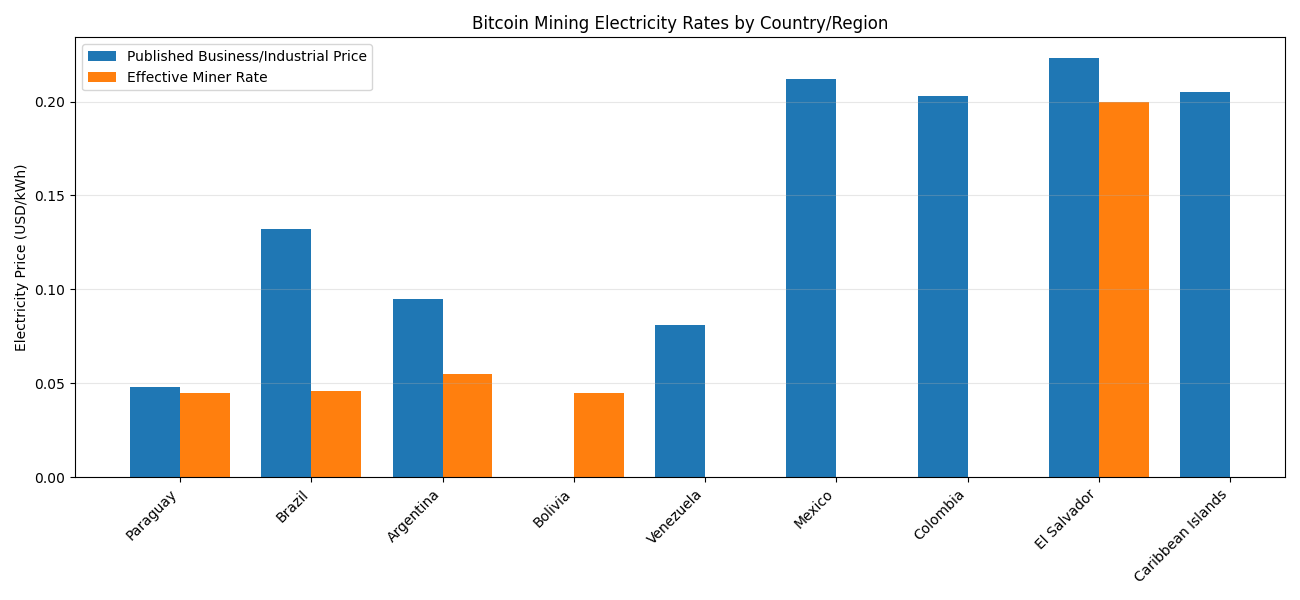
Even with negotiated discounts, effective large-scale mining rates remain far above what miners in Paraguay, Brazil, or Argentina can access.
Using current network conditions and standard industrial ASIC efficiency assumptions, electricity alone would cost an estimated $155,000 or more to mine a single Bitcoin in Colombia.
That figure exceeds Bitcoin’s current market price by a wide margin. And that only includes electricity.
LATAM Electricity rates. | Credit: CCN.
Cooling systems, maintenance, staffing, infrastructure, taxes, and equipment financing would push real operating costs even higher.
In practical terms, large-scale mining operations in Colombia would currently lose money before accounting for most operating expenses.
Latin America’s Mining Winners Are Those With Surplus Energy
Then comes the regional comparison, which makes Colombia’s challenge even clearer.
Countries that continue attracting industrial Bitcoin miners in 2026 all share one common trait.
They have access to stranded, surplus, or heavily discounted energy.
Paraguay remains one of the strongest examples globally thanks to hydroelectric surplus from the Itaipu Dam.
Effective mining power deals there still range between $0.04 and $0.05/kWh, allowing miners to maintain estimated electricity margins above 50% under current conditions.
Certain regions in Brazil also remain competitive, particularly where miners can tap into excess wind, hydro, or solar generation through curtailment agreements and free-market energy structures.
Argentina offers another path through flared natural gas projects in Vaca Muerta, though profitability varies significantly with gas pricing and political stability.
Elsewhere, conditions deteriorate rapidly.
Mexico’s industrial electricity rates remain too high for profitable mining without specialized energy agreements.
Many rely heavily on diesel and imported fuel for electricity generation, resulting in some of the highest electricity costs in the Americas.
Combined with high cooling demands from tropical climates, industrial Bitcoin mining becomes economically difficult to justify.
Renewable Energy Alone Does Not Guarantee Profitability
Petro’s argument reflects a common misconception in political discussions around Bitcoin mining.
Renewable energy availability alone does not automatically create a viable mining industry.
What matters is whether miners can access surplus electricity at extremely low, stable prices over long periods.
Paraguay succeeds because it produces more hydroelectric power than it consumes domestically.
Some Brazilian projects work because miners absorb excess renewable energy that would otherwise go to waste.
Colombia, by contrast, still faces relatively high grid costs, transmission constraints, and limited access to deeply discounted industrial energy agreements.
That does not mean Bitcoin mining projects are impossible in Colombia.
Small-scale or experimental operations tied directly to stranded renewable energy could emerge in specific regions.
But building a globally competitive “Bitcoin mining empire” under current economics would be extremely difficult.
The Industry Has Become Less Forgiving After the Halving
The economics of Bitcoin mining have changed dramatically over the past two years.
Even electricity costs around $0.06/kWh — once considered highly competitive — now produce much thinner margins than before.
That leaves very little room for countries with average or above-average energy prices.
There’s also the issue of miners leaving for AI infrastructure to improve profitability, but that’s a different story.
For Colombia, the current reality creates a difficult balancing act between political ambition and market economics.
Petro’s vision may align with broader goals around renewable development and regional investment.
But unless Colombia can secure dramatically lower electricity prices for miners, the country risks entering an industry where the numbers do not add up.
Insha Zia is the News Editor at CCN. Based in Dubai, United Arab Emirates, he ensures the CCN newsroom provides value to readers by educating, informing, and engaging them with accurate and timely coverage.
Before joining CCN, Insha was a Senior Journalist at DailyCoin, where his career in crypto journalism took off. At DailyCoin he garnered ample experience by covering some of the biggest news in the crypto industry, especially in the Cardano ecosystem, and maintain solid relations with KOLs in the industry.
Insha has worked as a ghostwriter and a developer for three years. He has co-authored numerous articles in reputable publications, including Hackernoon, Yahoo Finance, and Nasdaq. He also has experience as a Solidity Developer and a Data Analyst.
Insha’s developer and journalist backgrounds go hand in hand when educating readers on technically complex concepts within the crypto space. He values accuracy, transparency, and delivering valuable insights to his readers.
Insha firmly believes education can propel the mass adoption of the crypto space. He is committed to giving CCN readers a greater understanding of the technology using his technical background.
Insha earned a Bachelor of Science in Computer Systems Engineering at the University of Engineering and Technology, Peshawar, in 2022. His technical foundation includes expertise in quantitative and qualitative research, data analysis, programming languages, and cybersecurity.
His comprehensive skill set enables him to communicate complex concepts to crypto readers with authority and clarity, making his articles both informative and engaging for his audience.
Insha is determined to take CCN to the top of the industry. When he’s not working on his next article or editing, Insha enjoys playing video games, mainly in FPS and MMORPG genres. He also loves playing soccer and has supported Arsenal since he was six.