The Senate Banking Committee is scheduled to consider the CLARITY Act on May 14.
The bill would create a federal market-structure framework for digital assets.
A stablecoin-rewards compromise has eased one major dispute, though banks are still pressing for tighter language.
Democrats now hold the votes that could determine whether the bill becomes serious Senate business or stalls again.
The crypto industry’s biggest US policy fight is back on the Senate calendar.
On May 14, the Senate Banking Committee is scheduled to take up H.R. 3633, the Digital Asset Market Clarity Act of 2025, reviving a bill that has become the main vehicle for crypto market-structure reform in Washington.
The House passed the measure on July 17, 2025, by a vote of 294–134. The Senate is a harder arena.
The bill now has to survive a narrower political map, a banking-industry backlash and Democratic demands for stronger guardrails around stablecoins, market abuse and crypto-related conflicts of interest.
It is the first serious test of whether Congress can still turn crypto regulation into a bipartisan package before the legislative window narrows.
Try Our Recommended Crypto Exchanges
Sponsored
Disclosure
We sometimes use affiliate links in our content, when clicking on those we might receive a commission at no extra cost to you. By using this website you agree to our terms and conditions and privacy policy.
The CLARITY Act aims to answer a question Washington has avoided for years: which digital assets fall under securities rules, which under commodities rules and how crypto platforms should register when they list, trade or broker tokens.
For the crypto industry, the bill represents a path out of regulatory improvisation.
Exchanges, token issuers and DeFi-linked firms have spent years operating under agency guidance, court fights and enforcement actions. CLARITY would give them a statutory map.
Skeptics see a map with too many escape routes. Democrats want tougher AML, consumer-protection and conflict-of-interest language.
Banks are fighting a narrower battle: stopping stablecoin rewards from masquerading as deposit competition.
Those fights slowed the bill after it passed the House. This week, they return in compressed form.
Why Democrats Now Hold The Key
Republicans can put the bill on the agenda. They cannot deliver a durable Senate bill on their own.
The House vote gave CLARITY momentum, but Senate passage will require a wider coalition.
That places a small group of Democrats at the center of the negotiation.
Galaxy Research said a Democratic vote for the bill in markup would significantly increase the likelihood of eventual passage on the Senate floor.
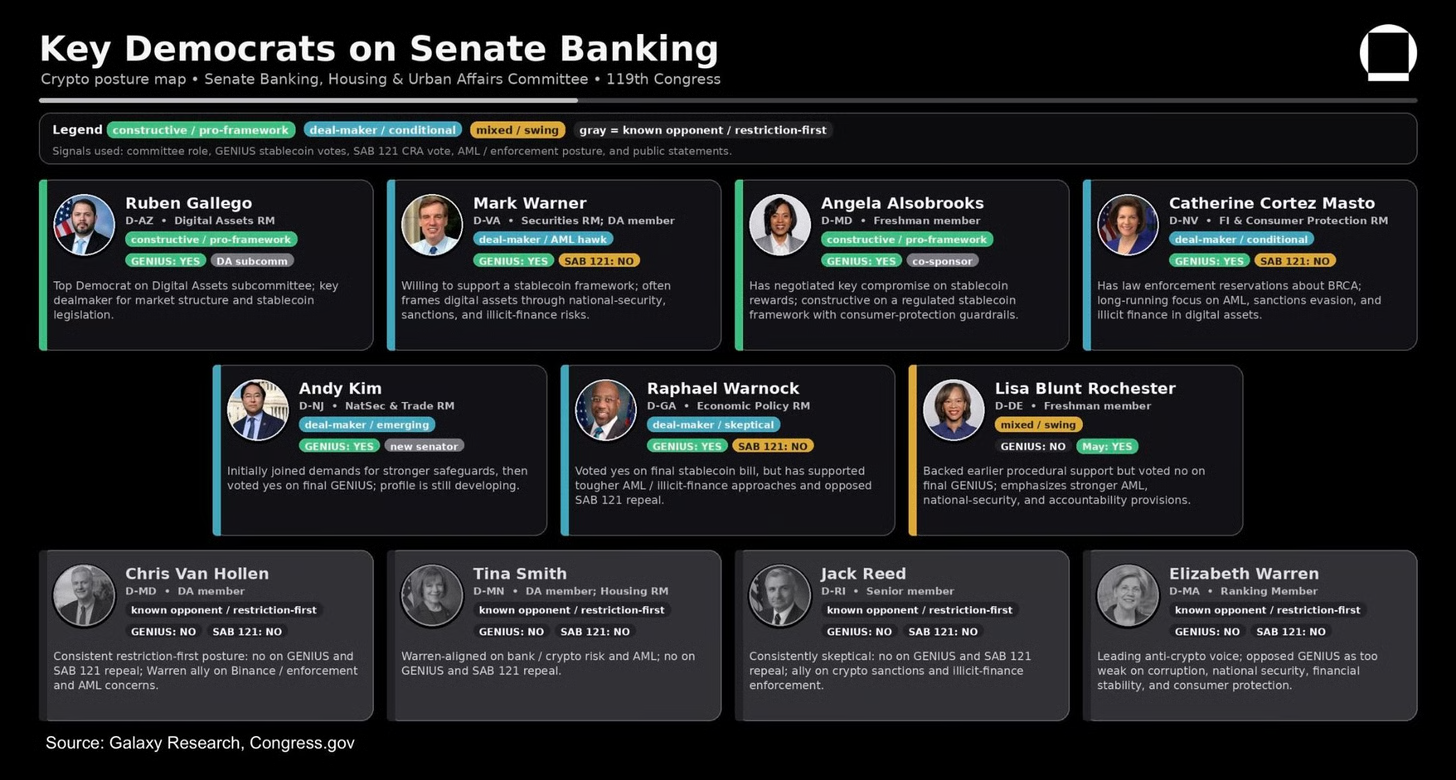
The firm also mapped Senate Banking Democrats into several camps, from constructive pro-framework votes such as Ruben Gallego and Angela Alsobrooks to restriction-first skeptics including Elizabeth Warren, Jack Reed and Chris Van Hollen.
Galaxy Research mapped Senate Banking Democrats by crypto posture ahead of this week’s CLARITY Act markup. Source: Galaxy Research
Passage may require support from at least seven Senate Democrats, while some Democrats remain concerned about anti-money laundering safeguards.
Their leverage is obvious. Support the bill, and the crypto industry gets its clearest route yet toward federal market-structure legislation.
Withhold support, and the bill risks another cycle of markup delays, amendments and public fights over whether Congress is giving crypto too much room to quickly.
Stablecoin Rewards Become The Pressure Point
The latest compromise centers on stablecoin rewards.
Sen. Thom Tillis and Sen. Angela Alsobrooks helped shape language that would restrict passive yield on idle stablecoin balances, easing concerns that crypto platforms could offer bank-like interest without bank-like obligations.
The compromise still appears to leave room for rewards tied to user activity, payments, transactions or platform engagement.
That distinction has become the bill’s most delicate piece of engineering.
Crypto firms can live with restrictions on passive yield if they retain some ability to reward users for activity.
Banks see a loophole. If rewards are attached to everyday stablecoin use, they argue, the effect could still resemble interest-bearing deposits by another name.
The result is a familiar Washington pattern: a few words in statutory language may decide whether the compromise survives.
Coinbase, Circle and other stablecoin-linked firms have a direct stake in the outcome.
So, do banks worry that payment stablecoins could move from a crypto-market tool into a mainstream cash-management product?
Banks Are Still Pressing
The banking lobby has not treated the compromise as settled.
Banking groups are still floating last-minute changes to the stablecoin-rewards language as the committee session approaches.
Their argument is simple: stablecoins already compete with parts of the payments system; reward programs could push them closer to deposit substitutes.
If Congress gives crypto platforms too much flexibility, banks warn, money could migrate out of regulated deposit accounts and into tokenized cash products with different oversight.
Crypto companies frame the issue differently. They argue that rewards tied to payments or activity are part of customer acquisition, loyalty and network growth.
A broad ban, in their view, would protect banks from competition while weakening US-regulated stablecoin firms against offshore alternatives.
The fight cuts across the larger politics of the bill. CLARITY may be written as market-structure reform, but the markup has become a contest over how much of the future financial stack banks are willing to share.
Ethics Language Could Still Blow Up The Deal
The other flashpoint is ethics.
Democrats have pushed for conflict-of-interest provisions covering digital asset activity by federal officials and politically connected figures.
The demand has grown as crypto firms spend heavily in Washington and digital assets become increasingly entangled with national politics.
Republicans may see the ethics push as a political trap; crypto lobbyists may see it as a delay machine.
Still, Democrats have little incentive to give the industry a clean win without extracting safeguards.
The bill’s fate may depend on whether ethics language becomes a negotiable add-on or a hard condition for support.
That makes the May 14 session unusually exposed.
A technical markup could quickly become a public fight over whether crypto legislation is being written for markets, banks, consumers or politically connected insiders.
A Market-Structure Bill With Bigger Stakes
The CLARITY Act began as an attempt to divide regulatory territory between the SEC and CFTC. It now carries a heavier political load.
The bill asks Congress to redraw crypto’s ground rules: who supervises exchanges, what issuers must reveal, where stablecoins meet banking, and how much trust a scandal-scarred industry has earned.
Narrower bills move faster. CLARITY tries to settle foundational questions.
Every unresolved piece invites another lobby, another amendment and another senator with a condition.
What To Watch This Week
The signal is simple: clean markup, or visible Democratic resistance.
A clean vote would give crypto its strongest US legislative opening of the year and show that the stablecoin-rewards deal can hold.
A messy session would expose the bill’s weak spots: bank amendments, ethics demands and Democratic doubts.
After months in limbo, CLARITY is moving again. This week will show whether it has a real Senate path — or whether it joins Washington’s long archive of crypto bills that almost arrived.